
TLDR
- Andrew Tyler, JPMorgan’s head of global market intelligence, adopted a “tactically bearish” stance on U.S. equities this Monday
- The S&P 500 would reach approximately 6,270 points following a 10% decline from its recent high
- Crude oil prices have surged beyond $100 per barrel amid escalating Iran conflict and attacks on energy facilities
- Morgan Stanley maintains optimism, indicating markets approach the conclusion of a “rolling correction” beginning in October
- The commodities division at JPMorgan indicated the current surge in oil product prices represents only the beginning
JPMorgan Chase has issued a forecast suggesting the S&P 500 may experience a 10% decline from recent highs as escalating Iran conflict drives crude oil prices beyond $100 per barrel.
US stock traders are unprepared for a correction in the S&P 500 that could see the gauge falling as much as 10% from its peak as a result of the war in Iran, according to JPMorgan Chase & Co.’s trading desk. https://t.co/g5OXEhIwQJ
— Bloomberg (@business) March 9, 2026
Andrew Tyler, who leads global market intelligence at JPMorgan, adopted a “tactically bearish” position on U.S. equities this Monday. The ongoing Middle East conflict serves as his primary concern.
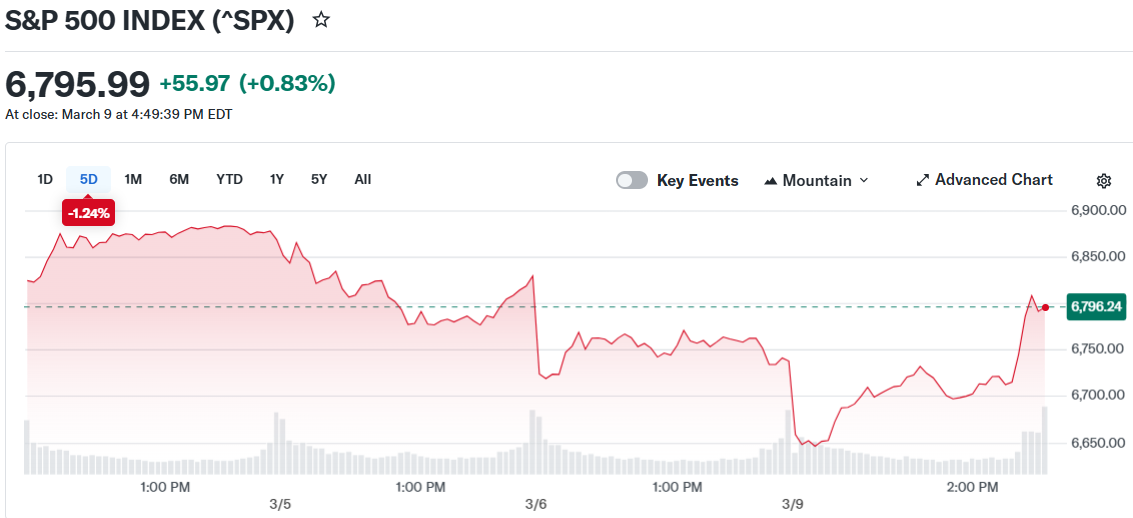
Such a correction would position the S&P 500 near 6,270 points. This represents roughly 7% beneath Friday’s closing level.
The commodities trading division at JPMorgan reported attacks on oil infrastructure affecting both parties in the conflict. According to the team, this development establishes a concerning precedent, with the current increase in oil product prices representing merely the initial phase.
“The precedent of oil infrastructure under attack has officially begun,” the desk wrote.
Crude oil exceeding $100 per barrel creates significant pressure throughout the economy. Elevated energy expenses increase costs across numerous industries, potentially reducing corporate profitability.
Where Morgan Stanley Stands
Wall Street analysts hold varying perspectives on JPMorgan’s assessment. Mike Wilson, Morgan Stanley’s chief investment officer, confirmed the firm maintains a bullish outlook on equities for the coming six to twelve months.
Wilson characterized recent market activity as a “rolling correction” dating back to October, featuring relatively stagnant returns despite robust earnings performance. According to his analysis, this corrective phase nears completion.
Both financial institutions interpret identical market data through different lenses. JPMorgan emphasizes immediate downside risks, whereas Morgan Stanley anticipates market stabilization.
What a 10% Drop Would Mean
Market analysts classify a 10% decline in the S&P 500 as a typical correction. Such events occur with regularity, appearing in 2018, 2020, and 2022, with subsequent recoveries following each instance.
Retirement portfolios and mutual funds tracking the index would experience short-term value reductions matching this magnitude. Financial advisors typically counsel investors to maintain their positions and resist emotional selling decisions.
The warning from JPMorgan connects directly to the Iran conflict escalation and related attacks on oil infrastructure. The institution has avoided citing any particular domestic economic catalyst.
Crude oil trading above $100 creates challenges for consumer expenditure and corporate operating expenses. Energy sector companies may see advantages from elevated pricing, while industries including aviation and manufacturing could encounter difficulties.
The S&P 500 encompasses 500 of America’s largest publicly traded corporations. This index ranks among the most extensively monitored benchmarks worldwide.
With $4.8 trillion in assets under management, JPMorgan stands as one of the world’s largest financial institutions. Investment professionals and individual investors pay close attention to its market assessments.
The bank’s stance on U.S. equities transitioned from neutral to tactically bearish as of Monday, reflecting the intensifying situation in the Middle East.



