
OpenAI, Anthropic and Google are racing to build the most capable AI model. Their latest releases are GPT-6, Claude 5.5 and Gemini 4. Each can write software, review documents and complete tasks with little help.
Independent tests show that each family leads in different areas. Google’s Gemini 4 Carbon has the highest overall score on the Artificial Analysis Intelligence Index. Claude Opus 5.5 and GPT-6 Astra sit just behind it.
Cost and speed also differ a great deal. A smaller model can cost far less than a flagship while scoring only a few points lower.
This article looks at the statistics behind each category. All figures come from the sources listed at the end.
Each section below covers one area: overall scores, coding, science, automation, knowledge work, accuracy, cost and speed. Every section includes a table and a chart. The final section pulls the results together into a simple verdict.
GPT-6 vs Claude vs Gemini: Intelligence Index Scores
The Artificial Analysis Intelligence Index v5 launched on 27 October 2026. It uses nine tests across four areas: general intelligence, coding, scientific reasoning and professional knowledge work.
AI Model | Developer | Index Score | Main Strength |
|---|---|---|---|
Gemini 4 Carbon | 59 | Highest overall benchmark score | |
Claude Opus 5.5 | Anthropic | 58 | Coding and complex knowledge work |
GPT-6 Astra | OpenAI | 57 | Scientific reasoning and technical analysis |
GPT-6.1 Sol | OpenAI | 55 | Strong performance at lower cost |
Claude Sonnet 5.5 | Anthropic | 54 | Everyday professional tasks |
Gemini 4 Argon | 50 | Autonomous workflows and tool use |
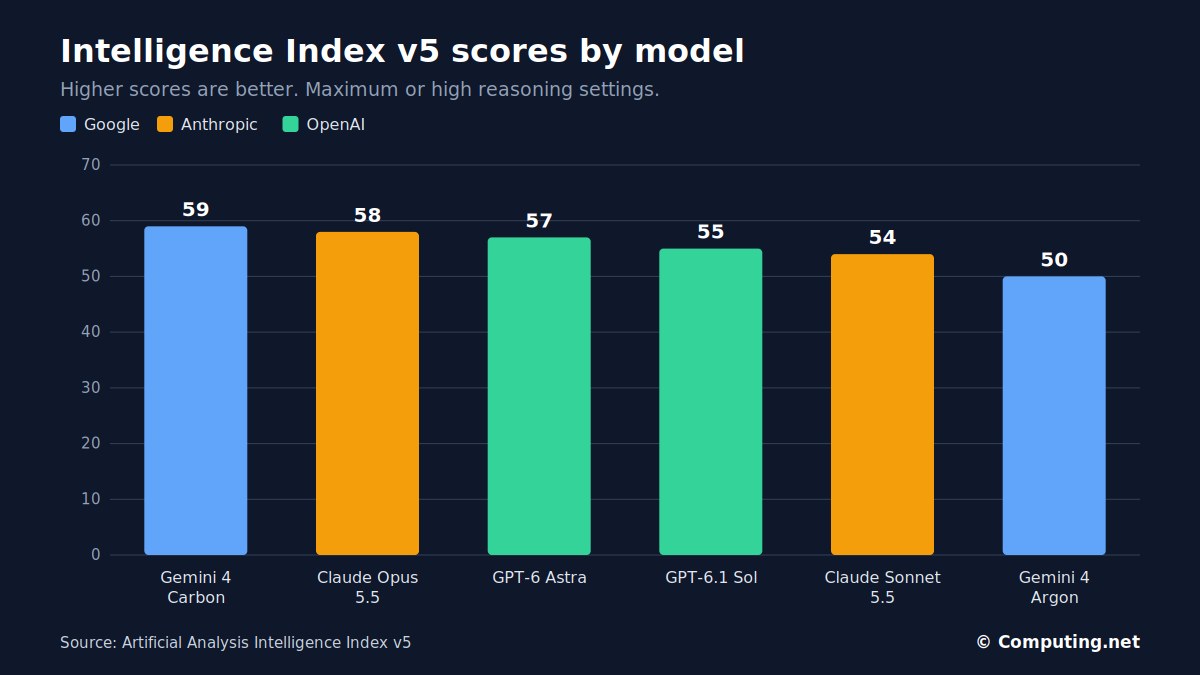
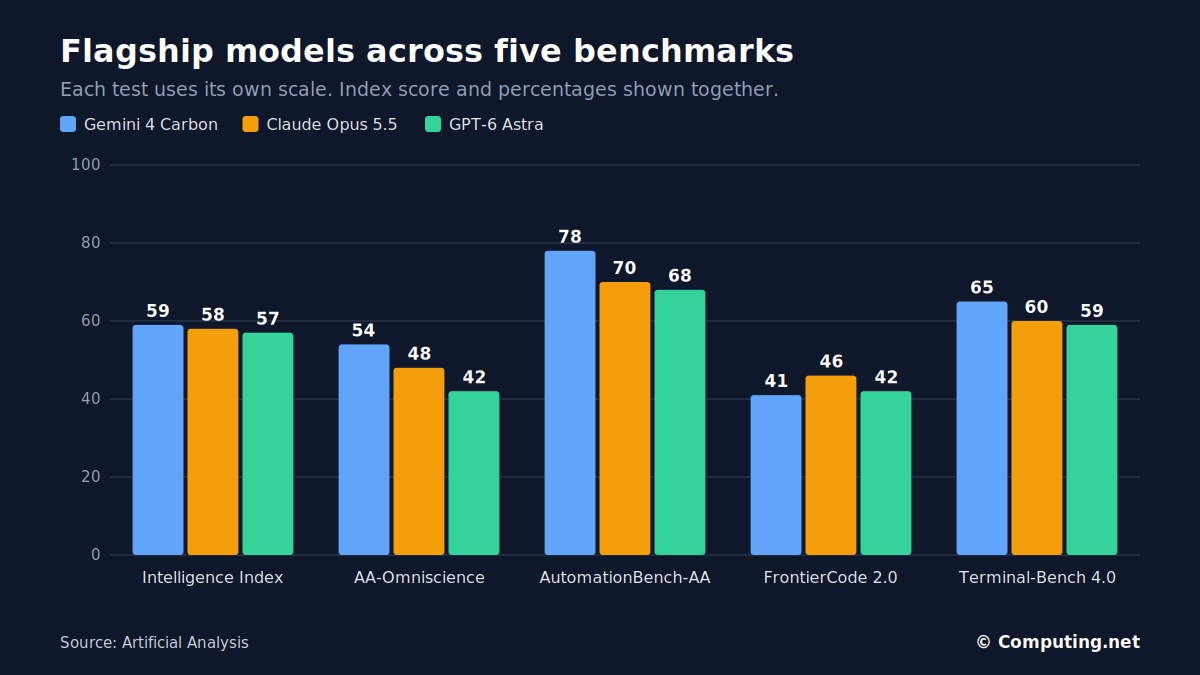
The gap between the top three is small. Gemini 4 Carbon scores 59, Claude Opus 5.5 scores 58 and GPT-6 Astra scores 57.
There is one catch. Google announced Gemini 4 Carbon on 28 October 2026 and limited access to selected cybersecurity professionals and trusted partners. Its score does not match what every Gemini subscriber can use today.
Smaller models also hold up well. GPT-6.1 Sol scores 55, only three points below Claude Opus 5.5. Claude Sonnet 5.5 scores 54, four points below its larger sibling.
Gemini 4 Argon sits lower at 50, but it does well on automation, as a later section shows. The index is a summary, and the individual tests tell a fuller story.
How the three model families differ
OpenAI released GPT-6 Astra in September 2026. It targets scientific problems, software development and computer use. OpenAI later added GPT-6.1 Sol, which balances capability and cost, and GPT-6.1 Terra, which focuses on visual reasoning.
Anthropic released Claude Opus 5.5 on 22 September 2026. It was built for long reasoning tasks and software engineering. Claude Sonnet 5.5 followed as a faster and cheaper option for everyday work.
Google introduced Gemini 4 Argon in September 2026 and Gemini 4 Carbon in October. Carbon is Google’s most advanced model and focuses on long-running tasks and cybersecurity. Gemini also connects to Google Workspace and developer tools.
Why Benchmark Scores Can Be Misleading
Artificial Analysis changed its index in October to rely more on private tests. About 60% of the updated index uses private datasets or withheld answers. Public test questions can end up in training data over time, which makes them less reliable.
The index gives equal weight to coding, science, knowledge work and general capabilities. No single model wins all nine tests. Claude Opus 5.5 leads several, GPT-6 Astra leads some science tests and Gemini 4 models lead selected automation tasks.
Reasoning effort changes the result
Settings matter as much as the model itself. Claude Opus 5.5 scored 35 at low reasoning effort and 58 at maximum effort. Cost per task rose from about $0.98 to $10.04.
Setting | Index Score | Cost per Task |
|---|---|---|
Low effort | 35 | $0.98 |
Maximum effort | 58 | $10.04 |
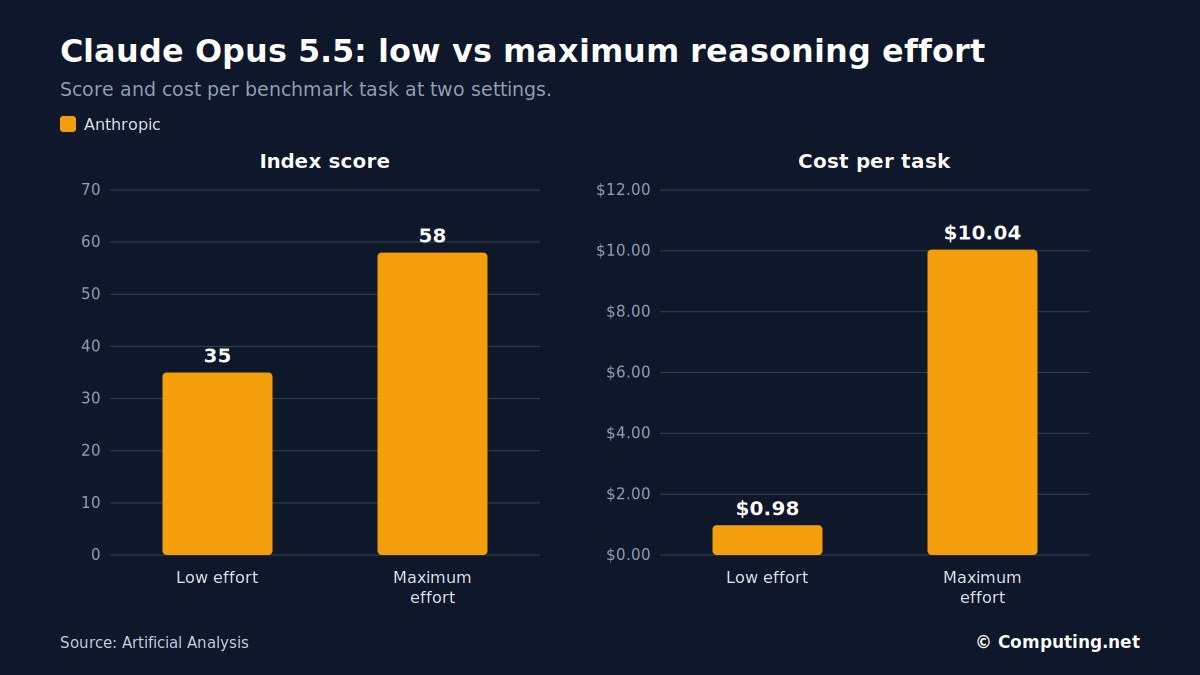
That is a cost increase of more than ten times for a gain of 23 points. For hard problems the extra spend may be worth it. For short emails or sorting customer questions, it may add little.
A score also does not show how useful a model is day to day. A model might do well at advanced math and still write a weak business report. Tool access, settings and test design all change the outcome.
Some tests let models use outside tools, while others measure answers without help. Comparing scores from different setups can lead to wrong conclusions. For that reason, this article names the test behind every figure.
Coding Statistics: Which AI Model Is Best for Software Development?
Coding is one of the most closely watched areas in AI. Modern coding agents can read a code base, edit several files, find bugs and run tests. The hard part is making changes that work inside an existing project.
FrontierCode 2.0 results
FrontierCode 2.0 uses real open-source projects. Results are judged by whether maintainers would accept the code changes. Claude Opus 5.5 leads with 46%.
AI Model | FrontierCode 2.0 |
|---|---|
Claude Opus 5.5 | 46% |
GPT-6 Astra | 42% |
GPT-6.1 Sol | 41% |
Gemini 4 Carbon | 41% |
Gemini 4 Argon | 26% |
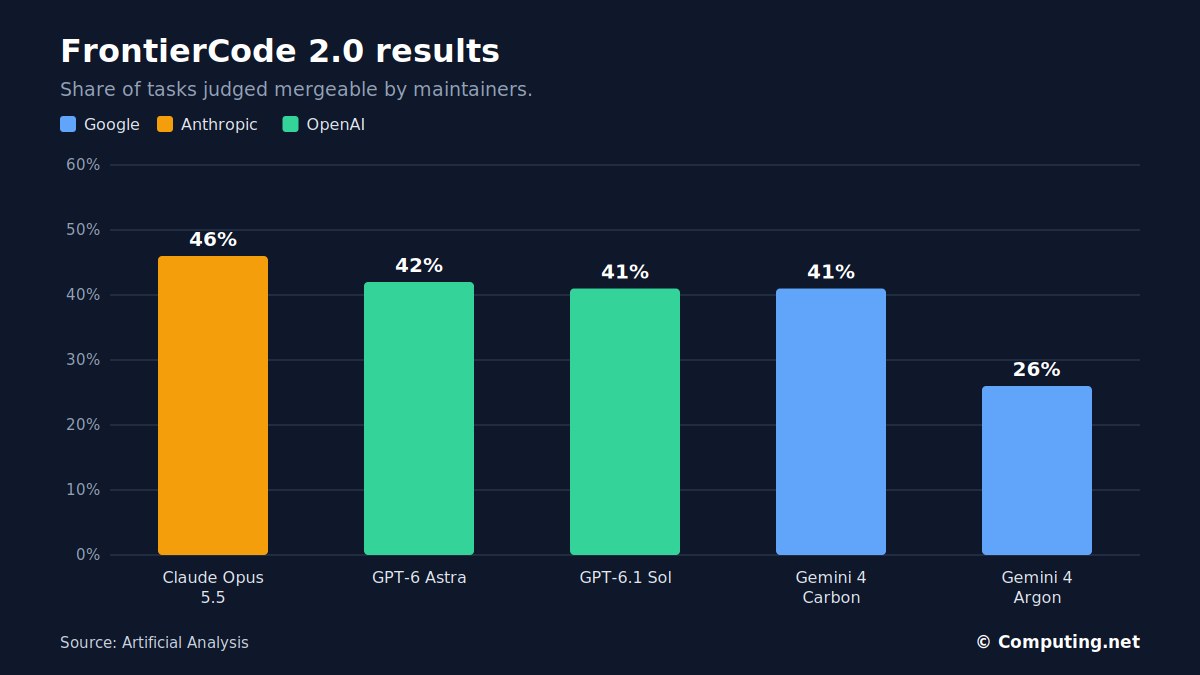
The top score also shows how hard the task is. More than half of the tasks did not meet the success standard. Even the best coding agents cannot yet replace developers on every complex project.
Terminal-Bench 4.0 results
Terminal-Bench measures whether AI agents can finish complex tasks in command-line settings. Here the order changes. Gemini 4 Carbon scores 65%, Claude Opus 5.5 scores 60% and GPT-6 Astra scores 59%.
Anthropic’s own tests report strong results for Claude Sonnet 5.5 on practical coding work. Company results may use different setups from independent tests. They should not be mixed without checking the method.
Developers should test models on their own projects. Useful measures include code quality, passing tests, unneeded changes and total cost.
The two tests measure different skills. FrontierCode rewards changes that a maintainer would merge, while Terminal-Bench rewards finishing tasks in a command-line setting. A model can lead one and trail the other.
Claude is a strong pick for demanding software work, especially with Claude Code. GPT-6 stays competitive through OpenAI’s coding tools. Gemini suits developers who work inside Google’s ecosystem.
Scientific Reasoning Statistics: Where GPT-6 Astra Leads
Scientific reasoning is where OpenAI’s flagship performs best. The index includes Terminal-Bench-Science, which checks whether models can finish research workflows using command-line tools. GPT-6 Astra scores about 63%.
Claude Opus 5.5 follows at 59% and Gemini 4 Argon scores 53%. GPT-6 Astra also leads the hard CritPt v2 physics subset with about 72%, against 61% for Claude Opus 5.5.
AI Model | Terminal-Bench-Science | CritPt v2 (hard subset) |
|---|---|---|
GPT-6 Astra | 63% | 72% |
Claude Opus 5.5 | 59% | 61% |
Gemini 4 Argon | 53% | 53% |
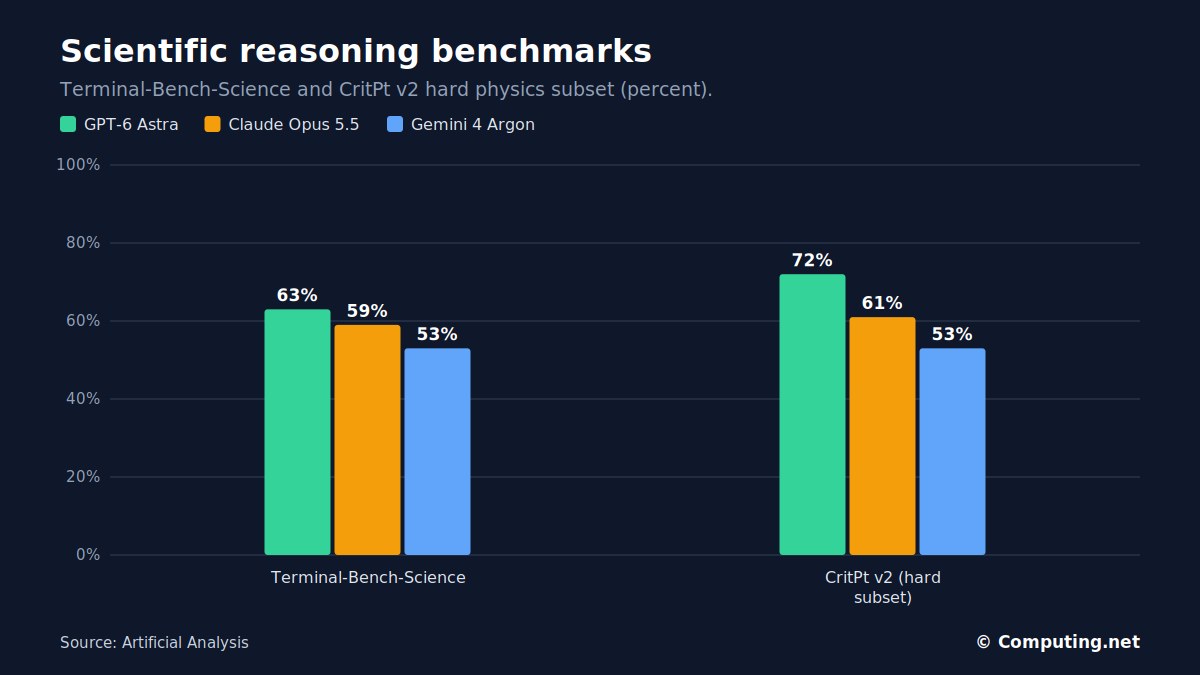
These results suggest an edge on hard problems that need long reasoning and computing tools. However, scientific reasoning and general research are different skills.
Gemini 4 Argon scores 53% on both science tests. That trails GPT-6 Astra by 10 points on Terminal-Bench-Science and 19 points on CritPt v2.
Research also depends on finding reliable sources and reading evidence correctly. For scientific work, users should still check assumptions, formulas and numbers.
Business Automation Statistics: Gemini Leads AutomationBench-AA
AI agents are now used for multi-step business tasks. These include analyzing information, using software and coordinating actions across apps. AutomationBench-AA tests this kind of work.
AI Model | AutomationBench-AA |
|---|---|
Gemini 4 Carbon | 78% |
Gemini 4 Argon | 78% |
Claude Opus 5.5 | 70% |
GPT-6 Astra | 68% |
GPT-6.1 Sol | 65% |
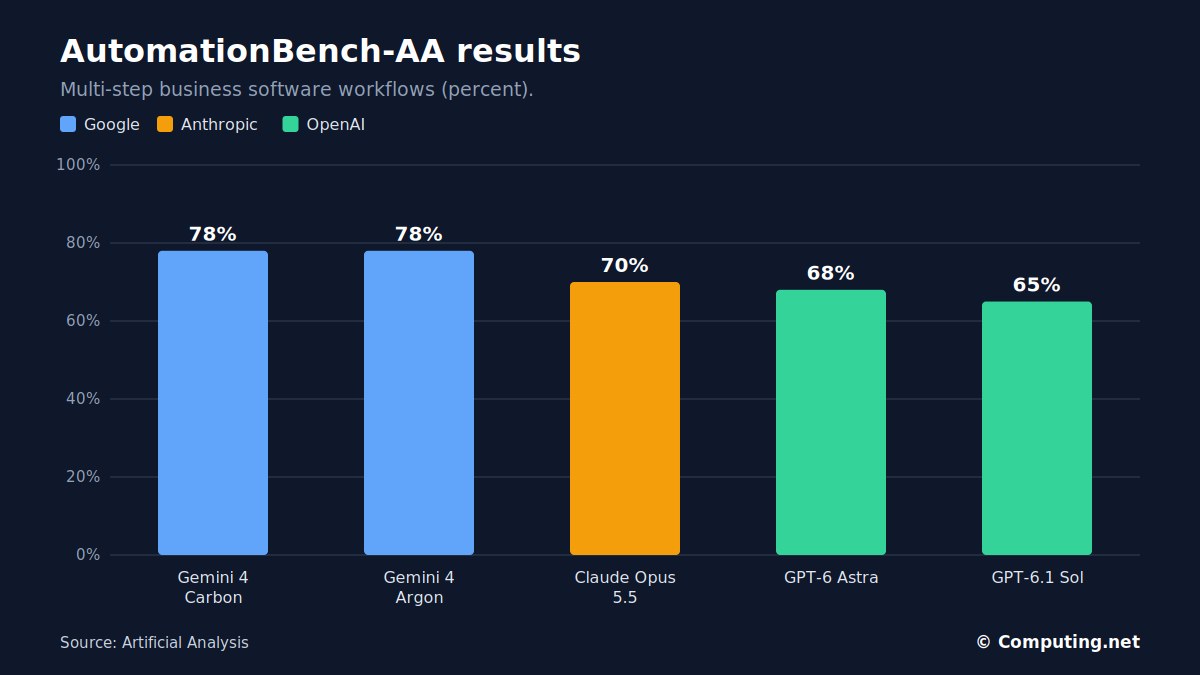
Google’s models lead by eight points over Claude Opus 5.5. This points to strong skills in navigating workflows and using outside tools.
Gemini 4 Carbon and Gemini 4 Argon tie at 78%. GPT-6.1 Sol, at 65%, is 13 points behind them.
The test cannot show that Gemini is best for every project. Integrations, permissions and the software a company already uses all matter. A business built around Microsoft tools may get better results from another model.
What this means for businesses
A model might pull up customer data correctly and then update the wrong record. Another might finish a report but make errors in the math. Automation needs independent checks.
Companies should track completion rates, time saved, error rates and the amount of human help needed. A score of 78% does not mean a model is 78% reliable across all work.
Knowledge Work Statistics: AA-Briefcase and GDP.pdf
Professional knowledge work covers reports, document analysis and business information. Models must keep context, organize facts and produce clear results. Artificial Analysis uses AA-Briefcase and GDP.pdf to measure these skills.
Claude Opus 5.5 has an AA-Briefcase Elo rating of about 1,801. Gemini 4 Carbon reaches 1,610 and GPT-6 Astra records 1,569.
That puts Claude 191 Elo points ahead of Gemini 4 Carbon and 232 points ahead of GPT-6 Astra. It is the widest lead any model holds in this article.
AI Model | AA-Briefcase (Elo) | GDP.pdf (all-pass) |
|---|---|---|
Claude Opus 5.5 | 1,801 | 26% |
Gemini 4 Carbon | 1,610 | 28% |
GPT-6 Astra | 1,569 | 31% |
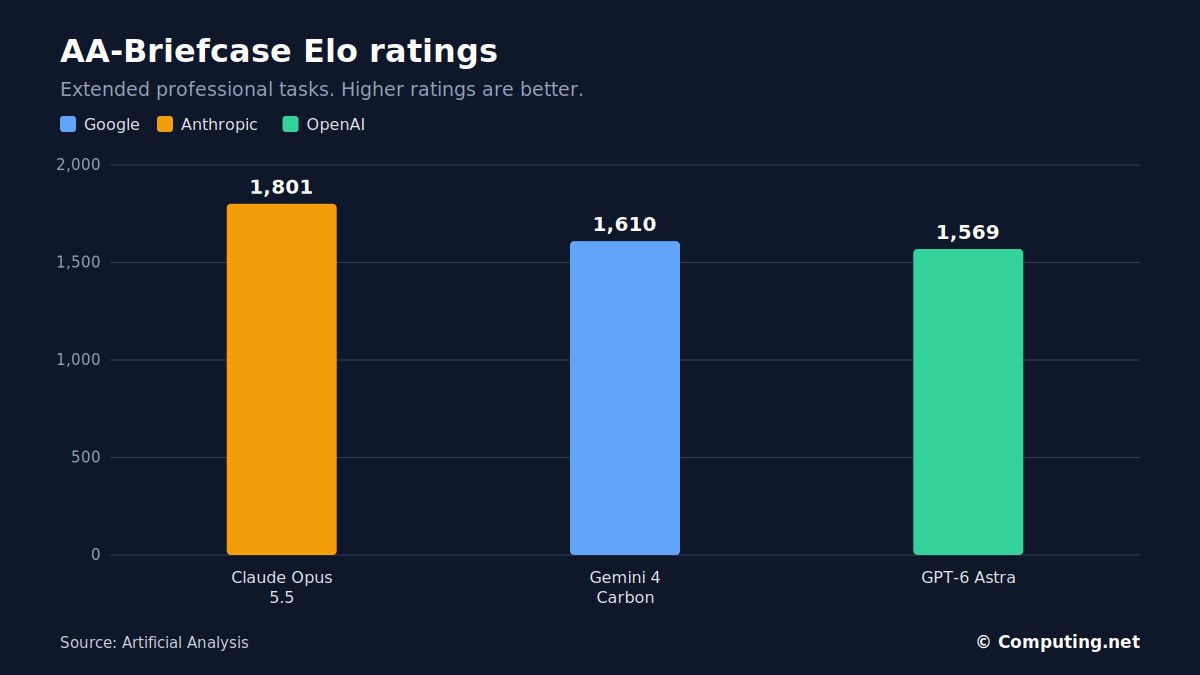
The picture reverses on GDP.pdf, which tests reasoning over complex documents. GPT-6 Astra has an all-pass score of 31%, compared with 28% for Gemini 4 Carbon and 26% for Claude Opus 5.5.
Claude looks strongest on extended knowledge tasks. GPT-6 does better on certain document reasoning challenges. Professional work is too broad for one universal winner.
Many office tasks mix both skills. A report may need long-range planning and also careful reading of a dense source file. Teams should test both before they pick a model for document-heavy work.
AI Accuracy Statistics: Which Model Hallucinates Least?
All leading models can hallucinate, which means they state wrong information in a confident way. This is a serious concern in journalism, finance and healthcare. Artificial Analysis measures it with AA-Omniscience.
Gemini 4 Carbon scores 54 overall. Claude Opus 5.5 scores 48, Gemini 4 Argon scores 46 and GPT-6 Astra scores 42.
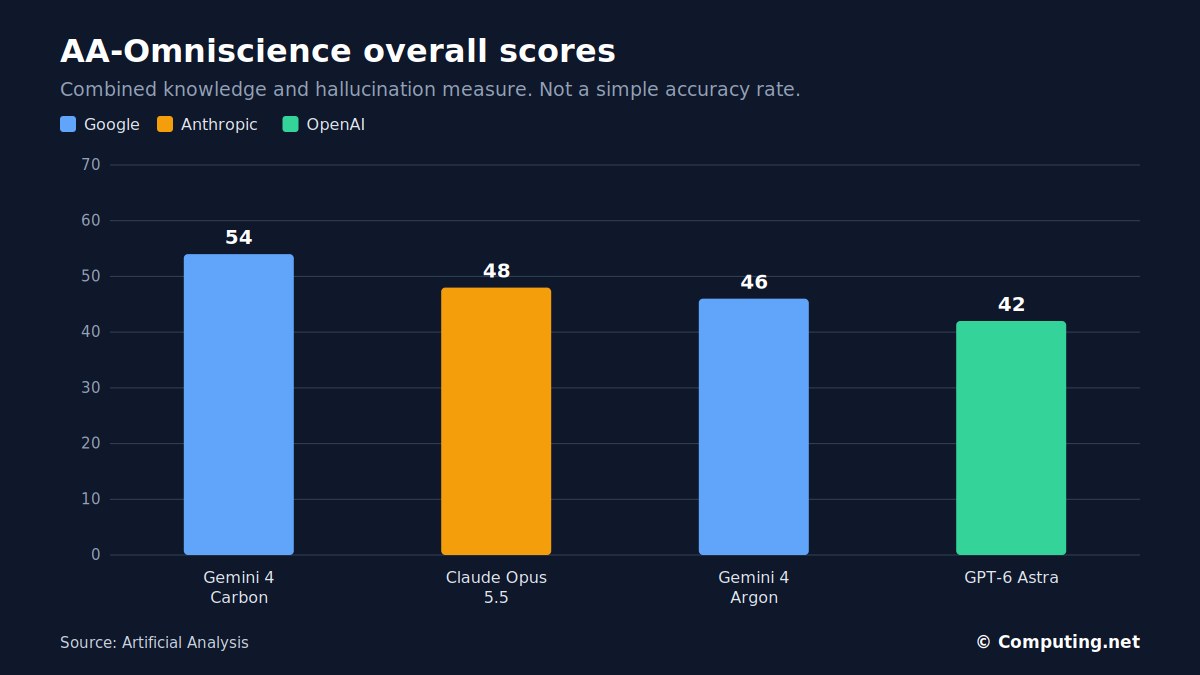
The score combines several factors, so it is not a simple accuracy rate. A model scoring 54 is not correct in 54% of conversations. The figures only reflect one specific test.
Gemini 4 Carbon leads GPT-6 Astra by 12 points on this measure. Claude Opus 5.5 sits in the middle, six points behind Carbon. Gemini 4 Argon, which ranks lower overall, scores 46 and beats GPT-6 Astra. Accuracy and overall intelligence do not always move together.
Can any AI model be trusted completely?
No. Even strong models can misread questions, miss information or reach unsupported conclusions. Tool use can improve reliability, but it also creates new chances for mistakes.
For important decisions, users should check facts against primary sources and verify calculations. In professional use, a model that admits uncertainty may be more useful than one that is confidently wrong.
AI Model Cost Statistics: Which Is Cheapest?
Price matters most when a business runs AI at scale. Developers usually pay by API usage, and the number of tokens needed for a task can vary widely. Artificial Analysis therefore measures the cost of finishing its benchmark tasks.
AI Model | Average Cost per Intelligence Index Task |
|---|---|
GPT-6.1 Sol | $1.27 |
GPT-6 Astra | $6.24 |
Gemini 4 Argon | $7.68 |
Claude Opus 5.5 | $10.04 |
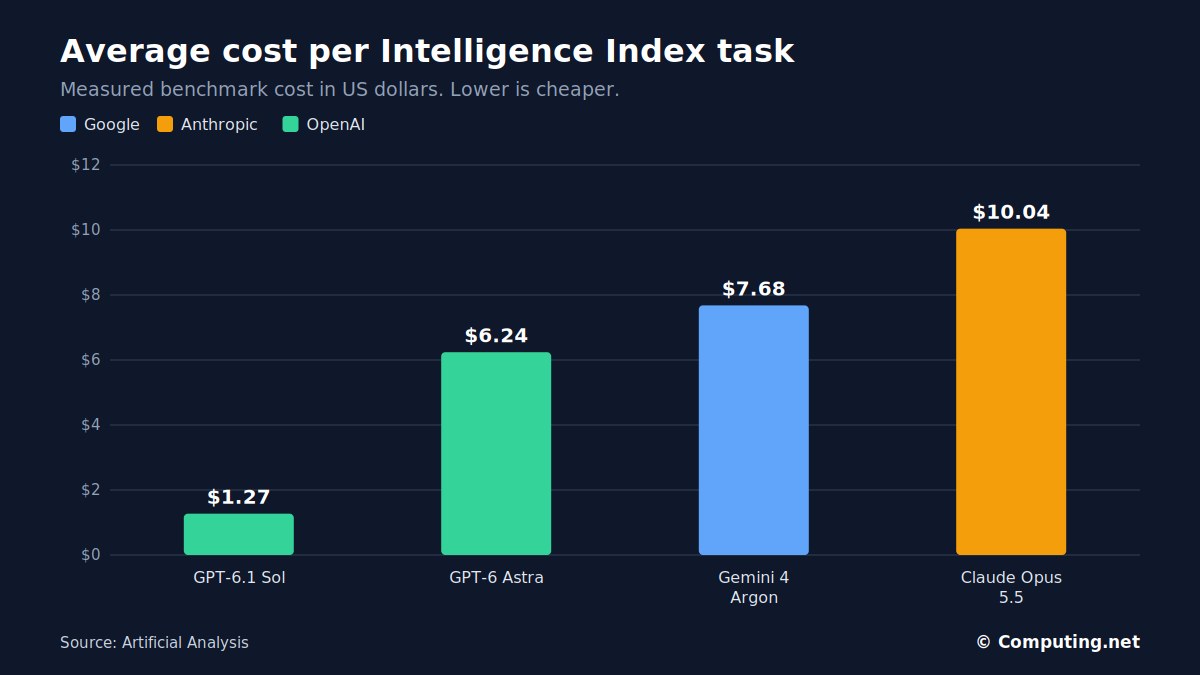
These are benchmark costs, not prices for single user requests. GPT-6.1 Sol scores only three points below Claude Opus 5.5 on the index. Its measured cost per task is about one eighth as high.
A cheaper model is not always cheaper in practice. If a costlier model finishes hard tasks in fewer attempts, the total bill could be lower. The better measure is cost per successfully completed task.
Gemini 4 Argon costs $7.68 per task, which is $2.36 less than Claude Opus 5.5. GPT-6 Astra costs $6.24, so it is cheaper than both while scoring 57 on the index. Prices and settings can change, so teams should recheck before they commit.
AI Speed Statistics: Tokens per Second and Task Time
Speed matters most for apps that need quick replies. However, output speed is only part of the story. A model may write fast but spend a long time reasoning before it starts.
Gemini 4 Argon generates about 83 output tokens per second. GPT-6 Astra generates roughly 71 at maximum reasoning effort.
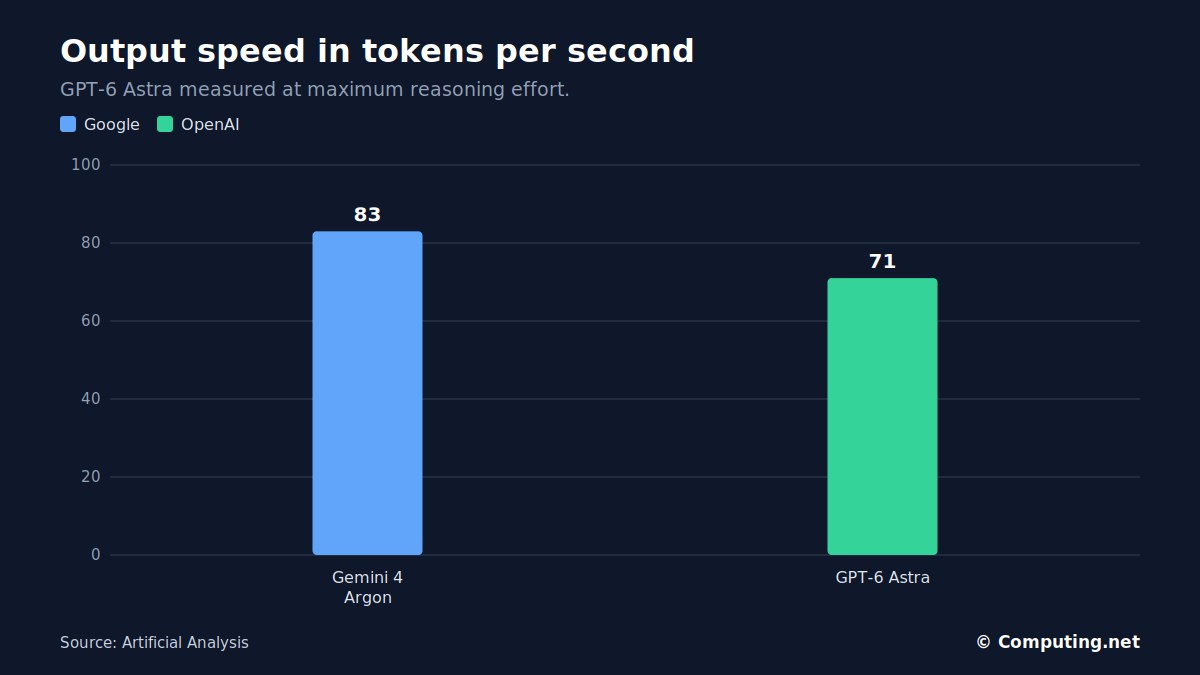
Total task time also depends on how much a model reasons. In the same evaluation, Gemini 4 Argon produced considerably more tokens per task than GPT-6 Astra. Its faster generation did not always mean faster completion.
Speed also changes with the reasoning setting. Lower settings usually give faster answers but can lower scores, as the reasoning effort section showed.
For businesses, the best measure is total time to a satisfactory result. A model that finishes a task correctly in five minutes may beat one that answers at once but needs many fixes.
Teams building live products should test response time under real load. Lab figures show a trend, but network delays, queue times and prompt length all change what users experience.
Final Verdict: Which AI Model Wins in 2026?
The race between GPT-6, Claude and Gemini is close. Gemini 4 Carbon holds the top Intelligence Index score at 59, but access is limited. Claude Opus 5.5 is one point behind and GPT-6 Astra is two points behind.
No model leads every category. Claude Opus 5.5 leads coding and extended knowledge work. GPT-6 Astra leads scientific reasoning, and Gemini leads automation and the accuracy measure.
Category | Leading AI Model |
|---|---|
Highest overall benchmark score | Gemini 4 Carbon |
Complex software development | Claude Opus 5.5 |
Scientific reasoning | GPT-6 Astra |
Autonomous business workflows | Gemini 4 Argon |
Professional knowledge work | Claude Opus 5.5 |
Cost-efficient advanced reasoning | GPT-6.1 Sol |
For businesses, the best approach is to test two or three models on real tasks. Track completion rates, operating costs and the amount of human help required. Also consider data protection, reliability and how well a model connects to existing systems.
Individual users should also weigh subscription features, tools and personal workflow. Developers and businesses care most about whether a model finishes a task reliably at a price they can afford.
The wider lesson is that different models now excel at different tasks. The highest scoring system is not always the most productive one. As models improve, the right choice will depend more on the work than on a single leaderboard.
This article uses published independent benchmarks and official information. No original side-by-side testing was carried out. Scores depend on model versions, reasoning settings and test methods.
Frequently asked questions
Is GPT-6 better than Claude? GPT-6 Astra leads on scientific and document reasoning tests. Claude Opus 5.5 leads several coding and knowledge work tests. Neither wins everywhere.
Is Gemini 4 more powerful than GPT-6? Gemini 4 Carbon scores 59 on the Intelligence Index, against 57 for GPT-6 Astra. Carbon has limited access, and its lead does not cover every task.
Which AI model is cheapest? Among the models compared, GPT-6.1 Sol has the lowest measured cost at $1.27 per task. Total cost depends on token use, reasoning settings and task difficulty.
Can benchmarks predict real-world performance? They offer useful evidence but cannot cover every task. Testing on your own work is still essential.
Sources
The article draws on independent evaluations and official announcements published in September and October 2026.
Artificial Analysis: Intelligence Index v5 (27 October 2026)
Explains the updated methodology, private datasets, leading models and measured costs.Artificial Analysis: Direct Model Comparison
Independent coding, automation, reasoning, knowledge work and cost results for Gemini, Claude and GPT-6 models.Google DeepMind: Introducing Gemini 4 Carbon (28 October 2026)
Details Google’s latest flagship model, its benchmark performance and cybersecurity capabilities.Anthropic: Introducing Claude Opus 5.5 (22 September 2026)
Explains Claude’s coding, professional reasoning and agentic capabilities.OpenAI: GPT-6 Astra
Technical details and published evaluations for software engineering, scientific reasoning and computer use.