

AI website builders let you describe a site in plain words and get a finished draft back. You do not need to write code. This article looks at the numbers behind ten popular tools, drawing on four recent reviews.
The figures cover price, speed, free plans and the real cost of running a site. Most of the data comes from tests run by the companies that wrote the reviews. Treat each number as a guide, not a promise.
Prices are in US dollars unless a pound sign is shown. Plans change often, so check each provider before you buy.
Each review built real sites to test its list. CatDoes gave all ten tools the same brief, a one-page site for a small local business. It scored them on output quality, speed, price and whether you can use your own domain.
ChilledSites built three business sites on each of eight tools, and Titan built stores, portfolios and landing pages. Base44 built landing pages, service sites and portfolios. These tests are small, so they show patterns and not firm rules.
More Small Businesses Now Have a Website
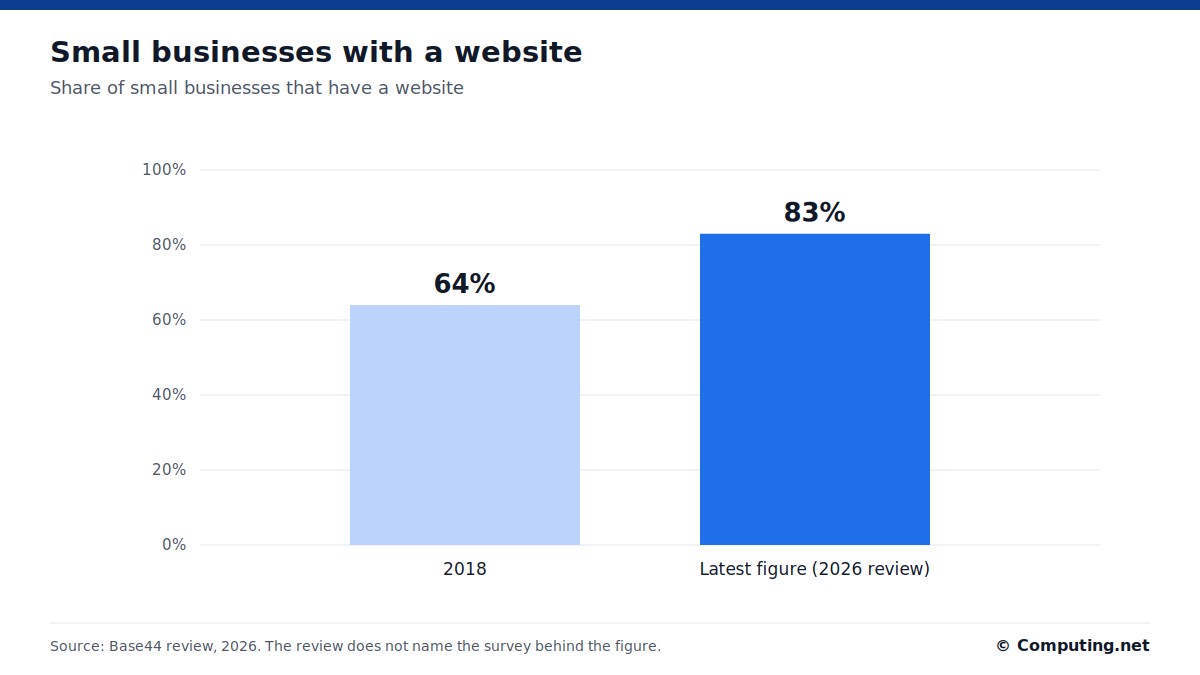
One review says 83% of small businesses now have a website. That is up from 64% in 2018. The gain is 19 percentage points, or about 30% more businesses.
The same review links the growth to no-code tools and AI site builders. It does not name the survey behind the figure, so the number is best read as a rough guide.
Cost is one likely reason. Titan’s guide says hiring a developer can run from $5,000 to $50,000. ChilledSites puts a basic five-page site from a web agency at £2,000 to £5,000.
Drag-and-drop builders came first as a cheaper route. AI builders go a step further by writing the layout, text and images from a short prompt. Titan says a job that once took weeks or months can now be done in one sitting.
Measure | Figure | Source |
|---|---|---|
Small businesses with a website, 2018 | 64% | Base44 |
Small businesses with a website, latest | 83% | Base44 |
Developer-built site | $5,000 to $50,000 | Titan |
Agency-built five-page site | £2,000 to £5,000 | ChilledSites |
The rest of this guide looks at what the AI route costs and how it performs.
Starting Prices for the Top 10 Builders
The ten tools in the CatDoes test start at very different prices. Hostinger is the lowest at about $2.99 a month. Lovable and Bolt are the highest at $25.
The average starting price across the ten is about $15.80. The middle value is $16.50. Three tools sit at $10: Framer, GoDaddy Airo and 10Web.
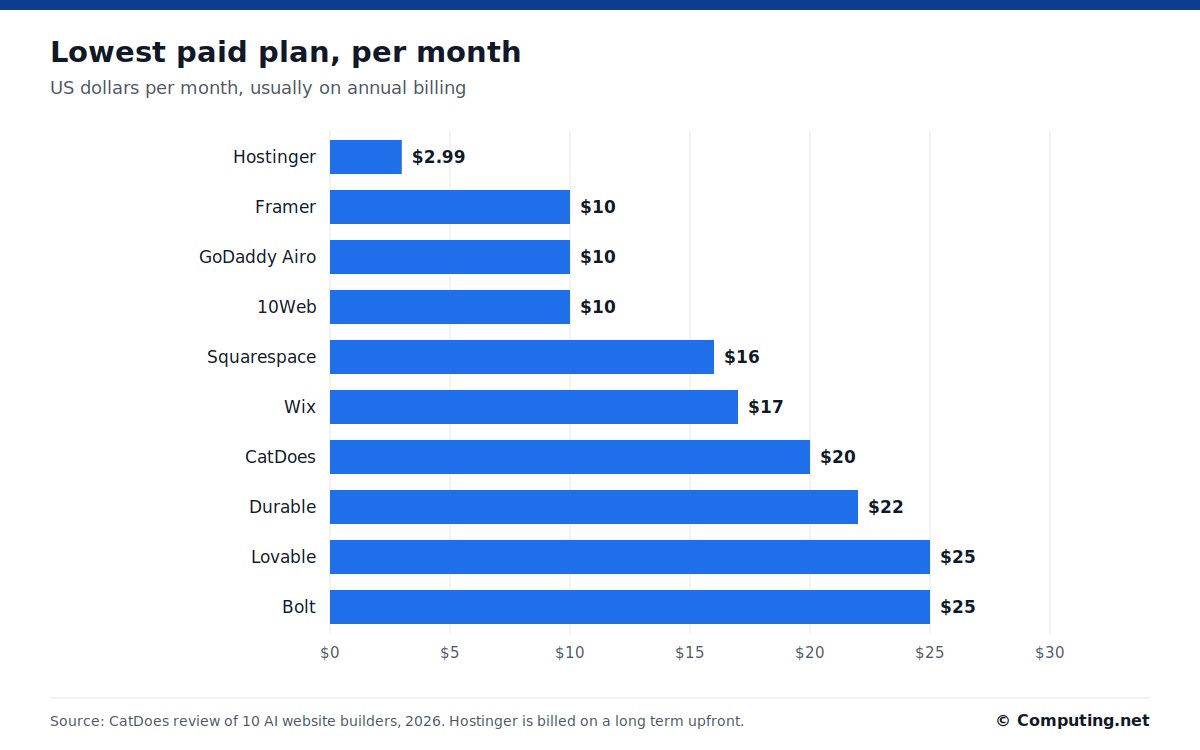
Most prices assume annual billing. Hostinger bills a long term upfront, so its low rate applies to the first cycle only. Check the billing term before you compare two tools.
Tool | Best for | Starts at | Custom domain |
|---|---|---|---|
CatDoes | A real site you own, plus a mobile app | $20/mo | Yes |
Wix | All-in-one use by non-technical people | $17/mo | Yes (paid) |
Framer | Design-led marketing sites | $10/mo | Yes |
Hostinger | The tightest budgets | About $3/mo | Yes (first year free) |
Durable | The fastest launch | About $22/mo | Yes (paid) |
Squarespace | Templates and polish | $16/mo | Yes (first year free) |
Lovable | Turning a site into a web app | $25/mo | Yes (paid) |
Bolt | Developers who want the code | $25/mo | Yes (paid) |
GoDaddy Airo | Domain, email and site in one bundle | About $10/mo | Yes |
10Web | WordPress under the hood | About $10/mo | Yes |
Price is not the only difference. Lovable and Bolt aim at people who want web apps or access to code. Squarespace and Framer lean toward design, while Wix covers stores, bookings and email in one place.
The CatDoes review also notes what each plan adds. CatDoes includes a backend on every plan, and its paid plans scale with credits and projects. Wix’s $29 Core plan unlocks ecommerce and analytics, and the review calls it the value pick for Wix.
Hostinger’s Business plan at $3.99 a month adds a lightweight store. Squarespace and Hostinger include a free custom domain for the first year. Framer includes one on annual plans.
Free Plans and Free Trials
Seven of the ten builders offer a free plan. Three offer a trial only: Hostinger, Squarespace and 10Web. Squarespace gives a 14-day trial.
Sources do not always agree. The CatDoes review says 10Web has no permanent free plan, while the Base44 review lists one. Check the current terms on the provider’s site.
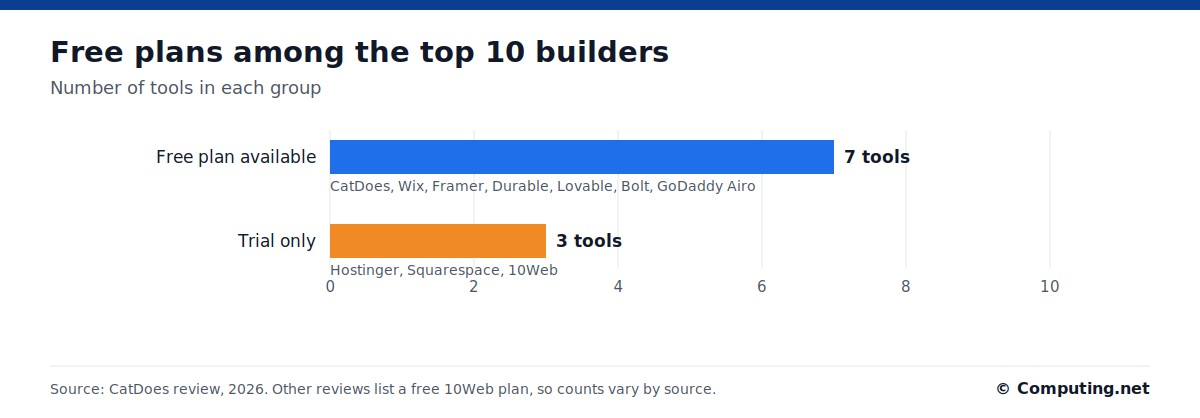
Free plans come with limits. Most publish to a branded subdomain, and many add the tool’s badge or ads. A custom domain usually needs a paid plan.
Tool | Free option | Stated limit |
|---|---|---|
CatDoes | Free plan | One-time credits |
Wix | Free plan | Ads and a Wix subdomain |
Framer | Free plan | Publishes to a framer.website subdomain |
Durable | Free plan | Subdomain and limited pages |
Lovable | Free plan | About 30 credits a month |
Bolt | Free plan | 1 million tokens a month, Bolt branding, no custom domain |
GoDaddy Airo | Free plan | 50 AI credits a month |
Hostinger | Trial only | No free plan |
Squarespace | 14-day trial | No free plan |
10Web | Trial only | No permanent free plan (CatDoes) |
GoDaddy’s 50 monthly credits can run out fast on a single project. GoDaddy Airo is also limited to the US and Canada in 2026, according to CatDoes.
Free plans are useful for testing. Bolt’s free tier gives 1 million tokens a month, and Lovable’s gives about 30 credits. Lovable’s Pro plan at $25 a month adds custom domains and private projects.
Durable’s free plan limits the number of pages. Wix’s custom domain is free for the first year on a paid plan. A free plan is a way to test a tool, but a finished site on your own domain usually needs a paid plan.
How Long It Takes to Get a Site Live
Speed is a main selling point. Durable says it builds a site in about 30 seconds. Titan timed it at 47 seconds from the click on start to a working business site.
ChilledSites reports about 60 seconds for its own tool. Wix and Hostinger take 5 to 10 minutes in its table, and Squarespace and 10Web take 10 to 15 minutes. Webflow takes 30 minutes or more.
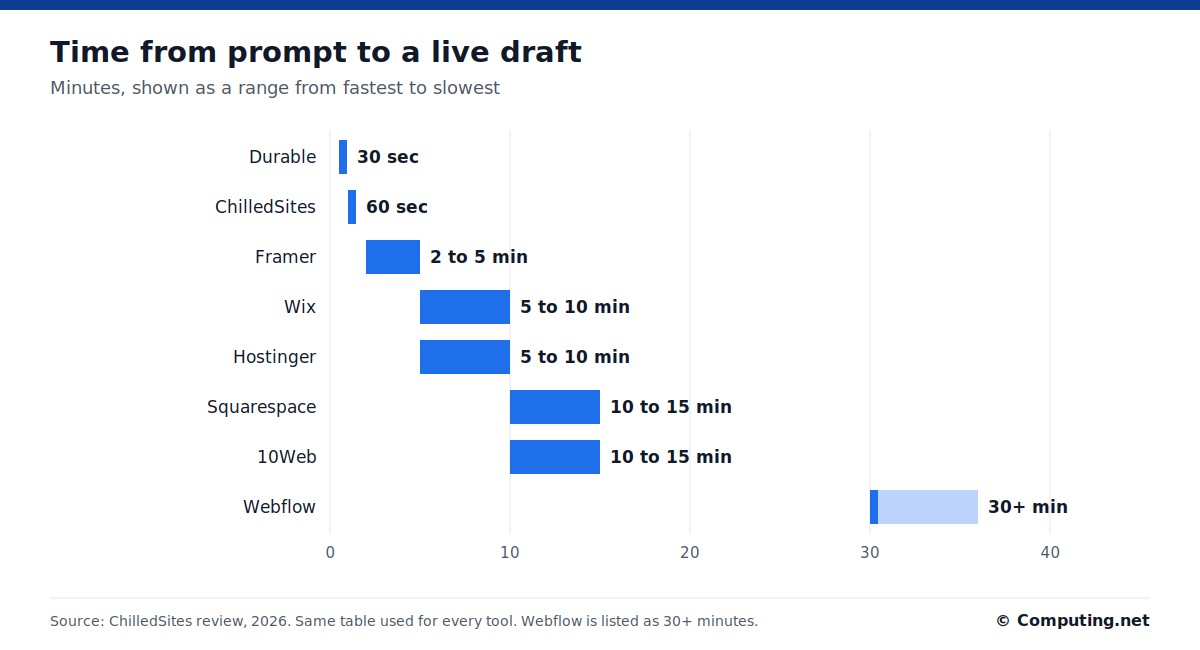
The ranges differ from review to review. Titan lists Hostinger at 1 to 3 minutes, while ChilledSites lists 5 to 10. Titan lists Framer at 15 to 30 minutes, while ChilledSites lists 2 to 5.
The chart uses one table, from ChilledSites, so every tool is measured the same way. That review comes from the maker of one of the tools, so the times are best treated as estimates.
Tool (Titan list) | Setup time |
|---|---|
Hostinger AI Builder | 1 to 3 minutes |
Durable | Under 1 minute |
Neo Sites | 3 to 5 minutes |
Olitt | 3 to 5 minutes |
Design.com | 3 to 10 minutes |
Jimdo Dolphin | 5 to 10 minutes |
GoDaddy Airo | 5 to 15 minutes |
10Web | 10 to 20 minutes |
Framer AI | 15 to 30 minutes |
Tithely Sites | 10 to 20 minutes |
Faster does not always mean better. Titan says Durable’s speed comes with less polish, and ChilledSites says its results look generic.
A fast first draft is not the same as a finished site. Titan notes that Durable makes assumptions based on business category. Sometimes they are right, and sometimes you need to fix them.
Framer takes longer because it gives more control. CatDoes says it has a steeper learning curve than a guided builder such as Wix. ChilledSites says a test user with no design background gave up editing a Framer site after 20 minutes.
What a Working Business Site Costs Each Month
A low headline price rarely covers everything. ChilledSites counted hosting, one domain, forms and basic analytics for each tool. It says a typical AI builder then costs £13 to £25 a month.
On that basis the tools in its test range from £3 to £14 a month. ChilledSites lists itself at £9, which is £108 a year. It wrote the review and ranks its own product first, so read the comparison with that in mind.
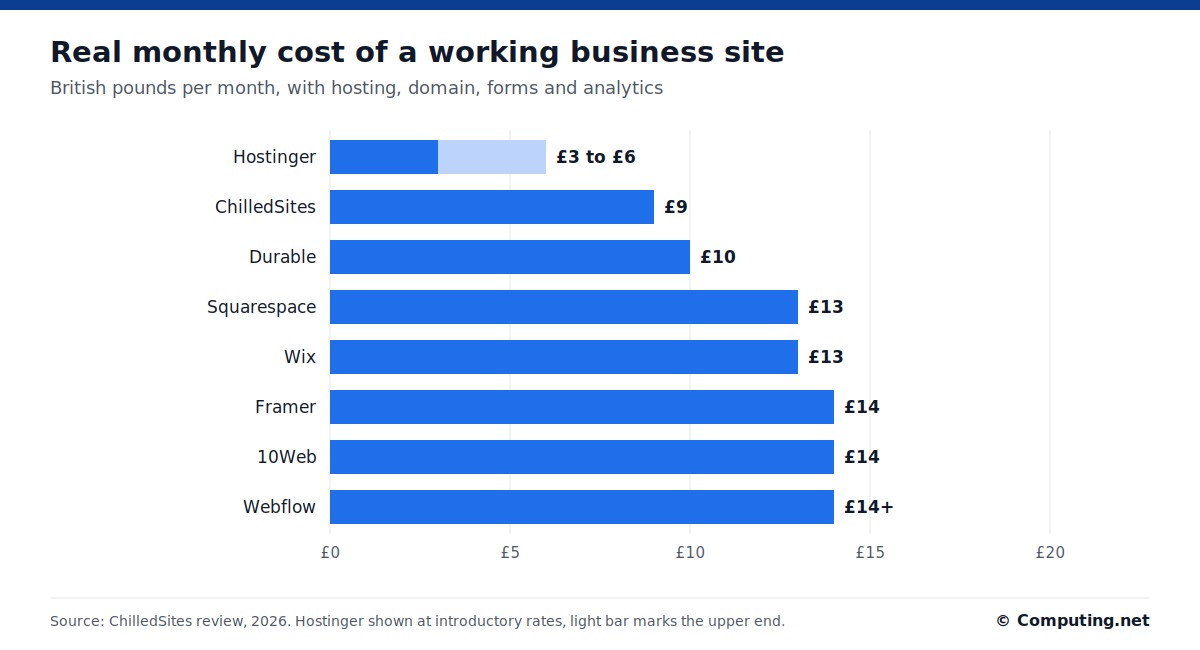
Renewal rates matter too. CatDoes says Hostinger’s price rises to about $10.99 a month at renewal. That is roughly 3.7 times the $2.99 starting rate.
Tool | Real monthly cost | Per year |
|---|---|---|
Hostinger (introductory) | £3 to £6 | £36 to £72 |
ChilledSites | £9 | £108 |
Durable | £10 | £120 |
Squarespace | £13 | £156 |
Wix | £13 | £156 |
Framer | £14 | £168 |
10Web | £14 | £168 |
Webflow | £14+ | £168+ |
The yearly column is a simple multiplication of the monthly figure. It does not include any one-off fees.
Add-ons are where the gap opens up. ChilledSites says hosting, a domain, analytics and form handling bought separately can total £150 to £300 a year. It says that can leave a plan costing three to five times its headline price.
Squarespace shows how a yearly minimum adds up. ChilledSites says its £156 a year is hard to justify for a typical small business. Squarespace and Wix include a domain for the first year only.
Why Prices Differ Between Reviews
The same tool can carry two prices in two reviews. Durable is $22 a month in the CatDoes table and $12 in Titan’s guide. Framer is $10 in one and $5 in the other.
Smaller gaps appear too. Jimdo is $11 in the Base44 review and $9 in Titan’s. Hostinger is $2.99 in Titan’s guide and $2.69 in Base44’s. Wix is $17 in both.
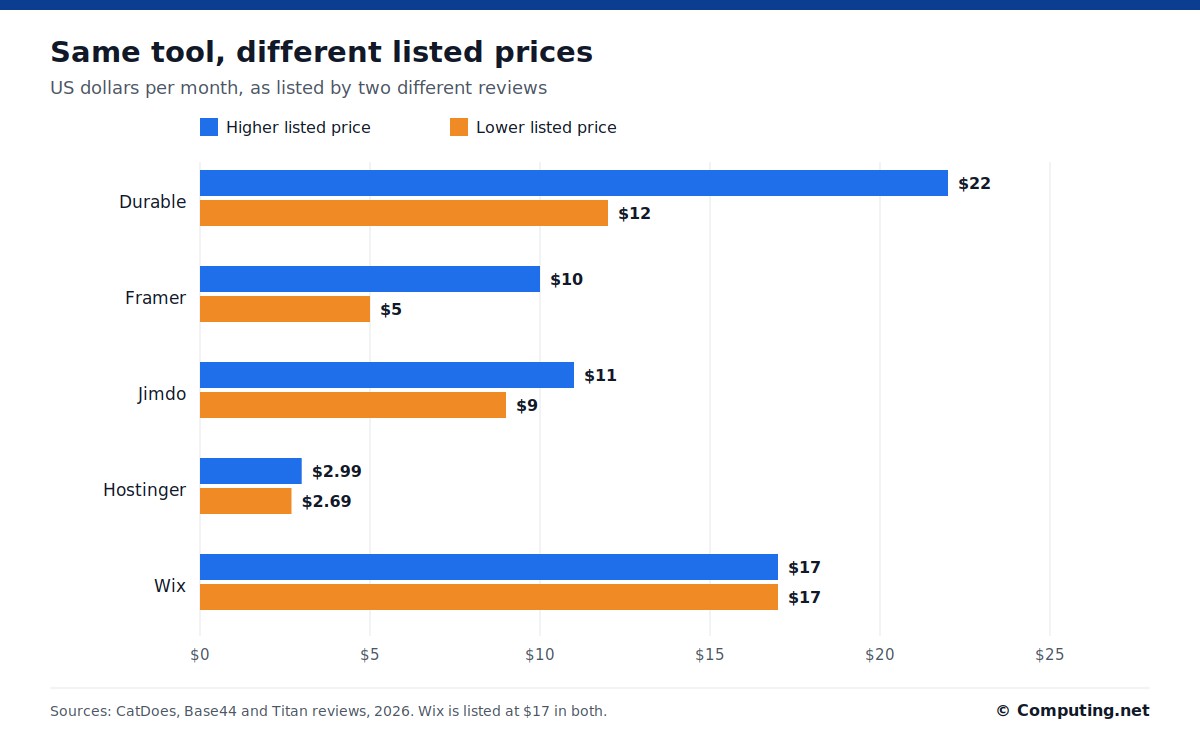
Several things can explain the gaps. Reviews may use annual or monthly billing, different plan tiers, or different regions. They may also have been written at different times.
The CatDoes review uses plans listed in 2026. Base44 uses rates as of August 10, 2026, and ChilledSites uses rates as of May 2026. Titan does not give a date.
Tool | Higher listed price | Lower listed price | Gap |
|---|---|---|---|
Durable | $22 (CatDoes) | $12 (Titan) | $10 |
Framer | $10 (CatDoes) | $5 (Titan) | $5 |
Jimdo | $11 (Base44) | $9 (Titan) | $2 |
Hostinger | $2.99 (Titan) | $2.69 (Base44) | $0.30 |
Wix | $17 (CatDoes, Base44) | $17 | None |
The lesson is simple. Use review prices to compare tools, then confirm the exact price on the provider’s own page.
Currency adds another layer. ChilledSites quotes prices in pounds, while the other three guides use dollars. This guide keeps the two apart and does not convert between them.
Some prices also change after the first term. CatDoes says both Hostinger and GoDaddy Airo advertise first-year rates that renew higher. A low first-year price tells you little about the second year.
The Cheapest Plans Across the Wider Field
The Titan and Base44 guides cover tools outside the top ten. Several of them cost less than $10 a month. Olitt is the lowest at $19 a year, which works out to about $1.58 a month.
Hostinger follows at $2.99 and Kleap at $3. Neo Sites starts at $3.59 a month on annual billing, and that price includes hosting and domain support.
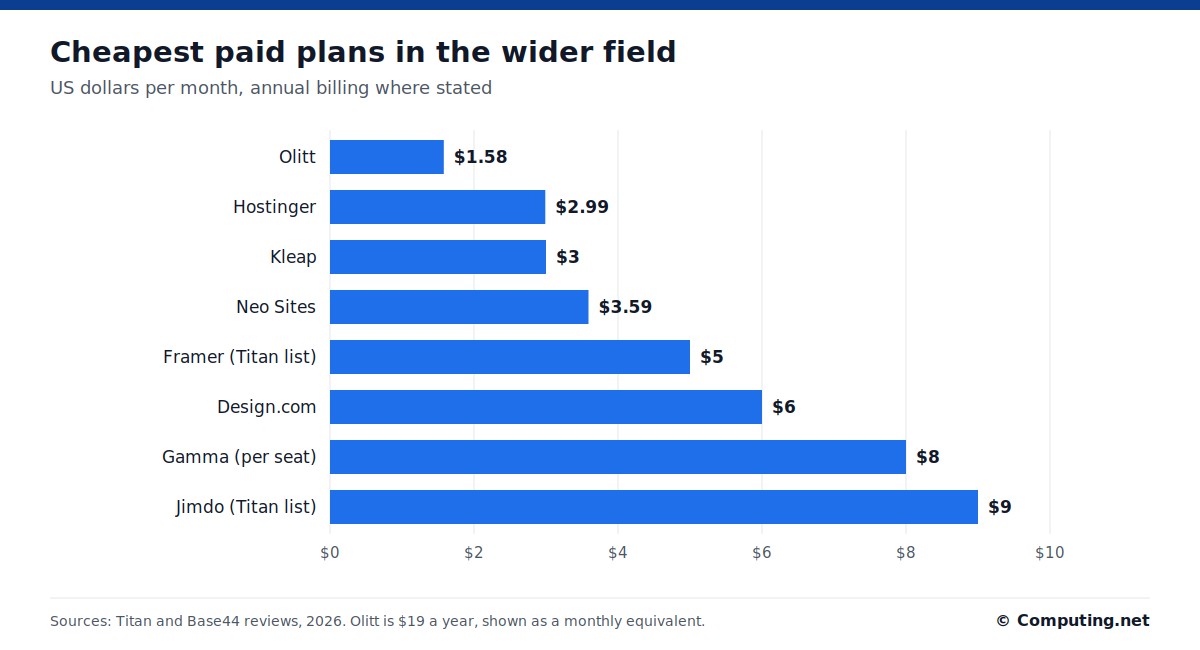
These tools suit different jobs. Kleap is built for mobile-first personal sites. Gamma is a presentation tool that can also make simple pages, and it charges per seat.
Titan says Olitt is newer than some rivals, so its template library is still growing. It also says Neo Sites offers less design control than developer-focused builders. Tithely Sites is built for churches and starts at $19 a month.
Tool | Monthly price | Billing note |
|---|---|---|
Olitt | About $1.58 | $19 a year |
Hostinger | $2.99 | Long term billed upfront |
Kleap | $3 | Free trial |
Neo Sites | $3.59 | Billed annually |
Framer (Titan) | $5 | Per site |
Design.com | $6 | Annual; $9 monthly |
Gamma | $8 | Per seat, annual |
Jimdo (Titan) | $9 | Business plans |
Titan lists Design.com at $6 a month on annual billing and $9 on monthly billing. The monthly option costs 50% more. Design.com also has a free plan with up to 3 pages and a watermark.
Appy Pie starts at $16 a month, and Jimdo starts at $11 in the Base44 list. Per-seat and per-site pricing, such as Gamma and Framer, can raise the total. Check how many seats or sites you need before you pick a plan.
AI Builders Compared With Hiring a Developer
Based on the listed starting prices, one year on a paid plan costs between about $36 and $300. The low figure is Hostinger at $2.99 a month. The high figure is Lovable or Bolt at $25.
Titan puts a developer-built site at $5,000 to $50,000. Even the lowest developer figure is about 17 times the priciest year of builder fees. Over five years at $25 a month, a builder costs $1,500, which is still below $5,000.
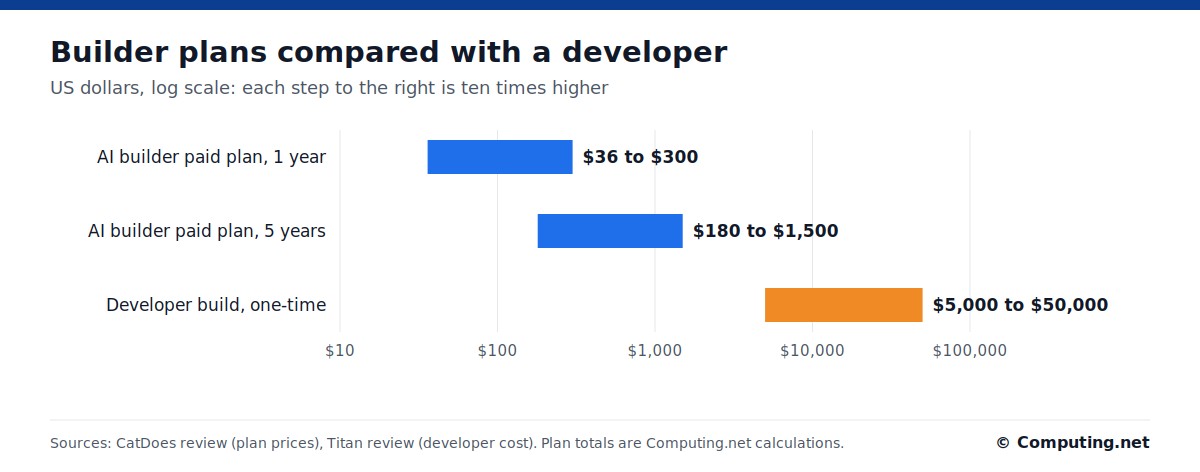
The comparison is rough. A developer builds a custom site once, while a builder charges every year. Plans also exclude extras such as a premium domain or add-on tools.
Option | Cost | Type |
|---|---|---|
AI builder paid plan | $36 to $300 a year | Recurring |
AI builder, real cost (ChilledSites) | £156 to £300 a year | Recurring |
Agency five-page site | £2,000 to £5,000 | One-time |
Developer-built site | $5,000 to $50,000 | One-time |
For a simple brochure site, the builder route costs far less. For a site with special needs, a custom build may still make sense.
Hosted builders also take on work a developer would charge for. Hosting, security and a domain connection often come bundled, as with GoDaddy Airo and Hostinger. A custom site would need those set up and paid for separately.
How to Choose a Builder
Start with what you want to build. For a simple local site, Wix, Hostinger and Durable are the quickest and cheapest in these reviews. For a design-led site, Framer and Squarespace are rated highest for looks.
Next, think about ownership. CatDoes offers code export on higher tiers, Bolt gives direct access to code, and 10Web builds on WordPress, which you can move. Wix, Squarespace and Durable keep your site on their own platforms.
Finally, check the full cost. Look at renewal rates, domain fees and add-ons, not just the first price. Try a free plan or trial before you commit.
The numbers show a wide spread, from under $3 to $25 a month. They also show that reviews disagree on many details. Testing two or three tools yourself is the surest way to find the right fit.
Keep in mind that all four reviews come from companies that sell or promote a website tool. Three of them rank their own product first. Reading more than one review, as this guide does, helps balance that.