
TLDR
- European natural gas markets declined 9.5% on Wednesday following Iran’s indication of willingness to pursue diplomatic talks with the United States.
- Earlier in the week, prices had climbed 54% following military actions by the U.S. and Israel against Iran that impacted the Strait of Hormuz corridor.
- Iranian drone strikes on Qatar led to the suspension of LNG operations at two Ras Laffan facilities, creating supply constraints worldwide.
- Shares of major U.S. LNG exporters Cheniere Energy and Venture Global declined during premarket hours following the price retreat.
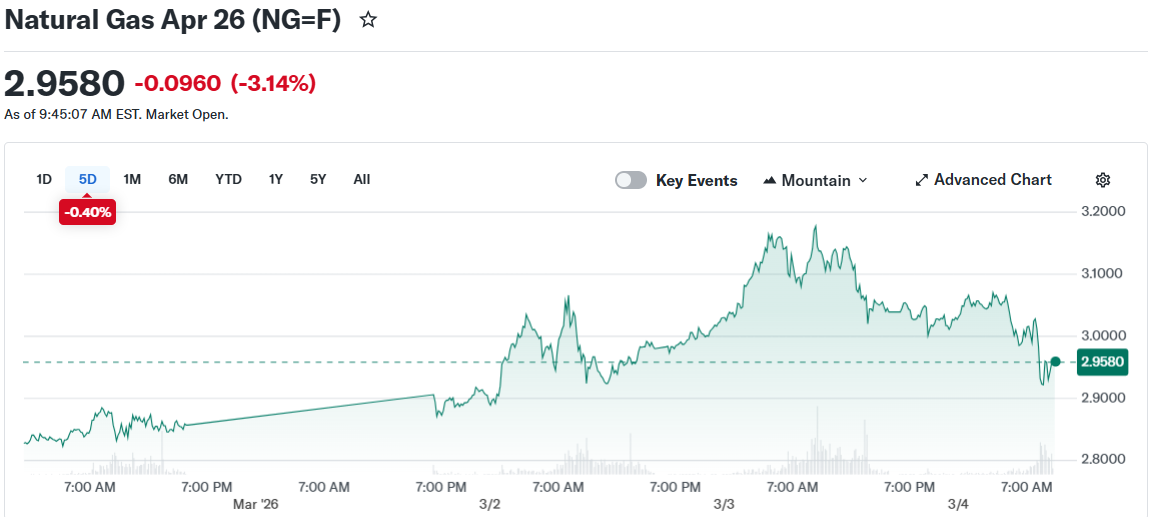
- Domestic U.S. natural gas futures dropped below $3, with market observers noting the American market remains buffered from international supply disruptions.
Military operations targeting Iran earlier this week sent European natural gas markets soaring as one of the planet’s most vital energy transit routes faced disruption. By midweek, diplomatic signals shifted market sentiment dramatically.
The Dutch TTF Gas benchmark contract, Europe’s reference price, fell 9.5% to 49 euros ($57) per megawatt hour on Wednesday. Despite the decline, the contract maintained a 54% gain for the week.
Military strikes by U.S. and Israeli forces on Iran triggered escalating regional tensions that threatened shipping operations through the Strait of Hormuz. This strategic waterway serves as a critical conduit for worldwide energy transport.
BREAKING: US stock market futures surge as the New York Times reports that Iran made a "secret" offer to the US to negotiate a deal to end the war.
Potential terms include:
1. Iran to abandon or drastically curtail its ballistic missile and nuclear programs
2. Iran to abandon… https://t.co/IsF3saWl1A
— The Kobeissi Letter (@KobeissiLetter) March 4, 2026
Qatar, holding the position as the world’s third largest exporter of liquefied natural gas, suspended operations at its Ras Laffan production complex following Iranian drone strikes on two facilities. The closures intensified concerns about global supply availability.
Asian LNG markets demonstrated pronounced volatility. The JKM-TTF spread, measuring the differential between Asian and European gas valuations, expanded beyond $6 per million British thermal units.
More than 80% of LNG exports from the Persian Gulf region flow to Asian destinations. Close to 90% of all liquefied natural gas transiting the Strait of Hormuz supplies Asian markets.
European markets lack direct dependence on Persian Gulf LNG shipments, yet remain vulnerable to worldwide spot market dynamics. Supply constraints in any major market exert upward pressure on international benchmark prices.
Market sentiment reversed course following a New York Times report revealing that Iran had initiated contact with Washington through confidential diplomatic channels. Tehran communicated readiness to engage in negotiations aimed at ending hostilities.
U.S. Defense Secretary Pete Hegseth and Chairman of the Joint Chiefs Gen. Dan Caine had a Pentagon briefing scheduled for Wednesday morning, the Wall Street Journal reported.
LNG Stocks Fall on Price Drop
The decline in natural gas valuations created pressure on American LNG production companies. Cheniere Energy shares retreated 0.4% while Venture Global dropped 3.1% in premarket trading Wednesday.
Both corporations represent major players in exporting American liquefied natural gas to international buyers. Elevated global prices typically strengthen their revenue projections.
U.S. Market Largely Shielded
Domestic U.S. natural gas futures retreated below $3, declining 4.1% to $2.929 per million British thermal units for April contracts. Market analysts emphasize the American market maintains substantial protection from global disruptions.
“Nymex natural gas — fundamentally insulated near-term from global supply outages with LNG exports already at maximum capacity — may be on the verge of decoupling lower from oil,” said Eli Rubin of EBW Analytics.
Meteorological forecasts call for above-average temperatures through the coming week, diminishing heating consumption. A return to colder conditions is anticipated in mid-March, potentially providing support for prices.
For perspective, European gas valuations surged 293% between February and August 2022 following Russia’s military invasion of Ukraine. Wednesday’s retreat to 49 euros per megawatt hour follows TTF reaching a three-year peak in the prior trading session.
Dutch TTF traded down 13% by mid-morning Wednesday, while U.S. Nymex gas futures showed a 4.1% decline.



