
TLDR
- Crude oil prices jumped above $119 per barrel on Sunday, stabilizing between $103–$107 Monday morning
- Dow futures plunged more than 1,000 points during overnight trading; S&P 500 and Nasdaq futures declined approximately 1%
- The Strait of Hormuz remains effectively blocked due to Iran conflict, disrupting a critical global oil shipping route
- Iraqi oil production has declined roughly 70%; Kuwait confirmed output reductions without specific numbers
- G7 finance ministers convene Monday to consider releasing up to 400 million barrels from strategic reserves
US equity futures experienced significant declines Monday morning following a dramatic surge in crude oil prices above $100 per barrel—the first time since 2022—as escalating tensions in Iran created major disruptions across Middle Eastern energy infrastructure.
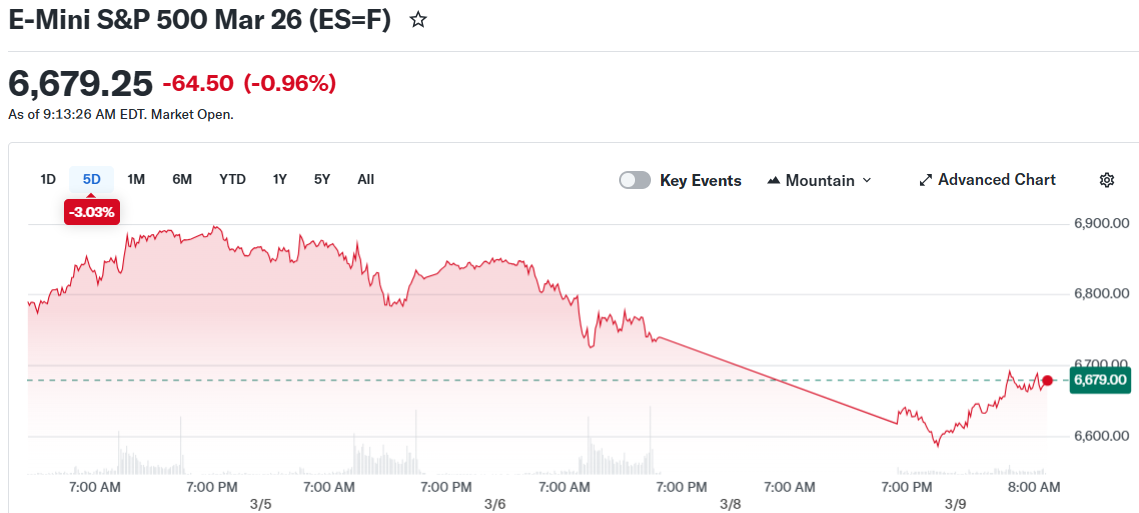
Dow Jones Industrial Average futures plummeted over 1,000 points during overnight sessions, though losses moderated somewhat by morning. S&P 500 and Nasdaq 100 contracts each declined roughly 1%.
West Texas Intermediate crude touched $119.48 per barrel Sunday before retreating. Monday morning saw prices hovering around $103. Brent crude, the international benchmark, traded above $107, representing approximately 15% gains for the day.
The dramatic increase in oil prices stems from attacks targeting oil infrastructure in Tehran. Mojtaba Khamenei, the son of former Ayatollah Ali Khamenei, has assumed the position of Iran’s supreme leader. Expectations point to continued conflict under his leadership, given his historical alignment with hardline elements.
The Strait of Hormuz, which serves as a vital conduit for global oil shipments, continues to be effectively shut down. Energy Secretary Chris Wright stated Sunday that the most optimistic timeline for resuming tanker operations spans several weeks.
Iraqi oil production has experienced approximately 70% decline according to reports. Kuwait confirmed production reductions while withholding specific volumes. Multiple Persian Gulf producers have curtailed or suspended refining activities, with Saxo Bank analysts highlighting diesel and jet fuel as the most urgent supply concerns among refined products.
G7 Responds to Energy Crisis
G7 finance ministers are convening Monday to evaluate a coordinated petroleum reserve release through the International Energy Agency. Current discussions center on releasing up to 400 million barrels. Three countries, including the United States, reportedly favor this approach.
This development provided some relief to oil prices and equity futures, which had suffered deeper losses during earlier overnight trading.
President Trump remarked via social media that temporary oil price increases represented a “very small price to pay” for neutralizing Iran’s nuclear capabilities. His statement initially unsettled markets Sunday before news of potential G7 reserve releases helped stabilize investor sentiment.
Bitcoin Briefly Drops Below $65,000
Bitcoin dipped beneath $65,000 during early Monday trading before bouncing back to approximately $68,000. Gold and silver futures each registered declines under 1%.
The US Dollar Index advanced 0.3%. The 10-year Treasury note yield climbed slightly to 4.175%.
Equity markets already endured a challenging week. The Dow recorded roughly 3% losses, marking its worst weekly performance since tariff-related market concerns emerged in April 2025. The S&P 500 declined around 2% while the Nasdaq finished with losses exceeding 1%.
Market participants are focusing attention on Wednesday’s Consumer Price Index release and Friday’s Personal Consumption Expenditures data, though these reports will likely capture minimal effects from the recent oil price surge.
Oracle and Adobe represent the primary earnings announcements scheduled for this week.
Remember: Preserve all tokens like [[EMBED_0]], [[IMG_0]], [[LINK_START_0]], [[LINK_END_0]], [[SCRIPT_0]], [[FIGURE_0]] etc. exactly as they appear. These are placeholders for embeds, images, and links that must not be changed.



