
TLDR
- Shares of DHL declined 3% following a conservative 2026 profit forecast that trailed analyst projections
- Management projects EBIT will surpass €6.2 billion in 2026, compared to €6.1 billion recorded in 2025
- Fourth-quarter operating profit slipped 1.3% to €1.83 billion, while freight forwarding division earnings plunged 36%
- Chief Executive Tobias Meyer stated the projection factors in a stagnant global economic landscape
- Weakening freight rates across air and ocean sectors, combined with sluggish European road freight demand, continue to impact performance
Shares of DHL tumbled 3% on Thursday following the German logistics company’s conservative 2026 profit projection that fell short of market expectations.
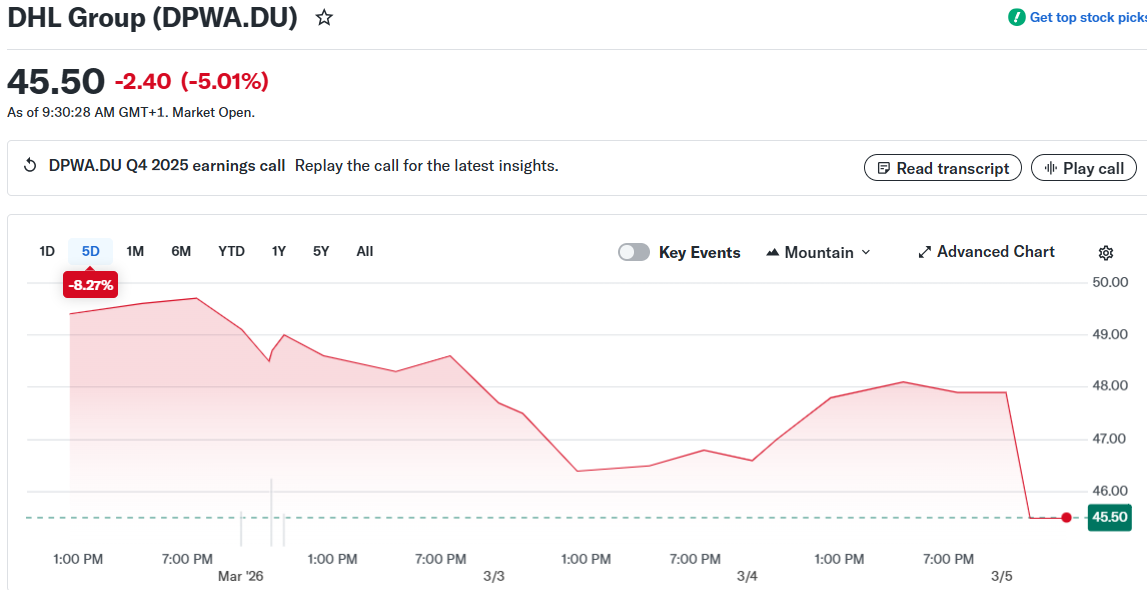
The stock landed at the bottom of Germany’s DAX blue-chip index by 0919 GMT.
Management indicated that earnings before interest and taxes will surpass €6.2 billion ($7.2 billion) this year. The projection follows the company’s operating profit of €6.1 billion for the complete 2025 fiscal year.
The forecast fell modestly below the average analyst projection based on the company’s consensus data.
Chief Executive Tobias Meyer addressed investors directly. “Our forecast does not assume any improvement in the global economic environment,” he stated in a company release.
Meyer pointed to geopolitical instability and uncertainty already evident during the opening two months of the year as primary factors influencing the conservative outlook.
Freight Forwarding Drags on Q4
The company’s fourth-quarter operating profit decreased 1.3% to €1.83 billion. The figure aligned closely with analyst expectations.
The freight forwarding division represented the primary source of weakness, with earnings collapsing 36% during the quarter.
Freight forwarding represents a vital component of DHL’s worldwide operations, managing the transportation of goods through air, ocean, and road channels.
“In air and ocean freight, we see declining freight rates,” Meyer explained to investors during Thursday’s conference call.
Road freight conditions mirror similar challenges. “In road freight, we feel the weak economic situation in Europe, and especially in Germany,” he continued.
Logistics operators across Europe have encountered challenging conditions — diminished demand and trade interruptions connected to tariffs from U.S. President Donald Trump have intensified pressure throughout the industry.
Middle East: A Different Story
DHL has found some advantages despite broader challenges. Meyer emphasized that the company historically performs better during Middle East disruptions compared to competitors.
“We have a very well established road network in the Middle East which enables us to bring cargo to those airports that are open,” he explained.
This infrastructure provides a strategic advantage as air and sea route disruptions stemming from the ongoing Middle East conflict continue to impact global shipping operations.
The overall business climate remains challenging. Shipping and logistics companies face increasing disruptions across air and sea routes worldwide.
The 36% decline in DHL’s Q4 freight forwarding earnings stands out as the most significant figure from the company’s recent quarterly report.
Management’s EBIT guidance of “exceeding €6.2 billion” for 2026 reflects minimal expansion compared to the €6.1 billion achieved in 2025.



