
Key Points
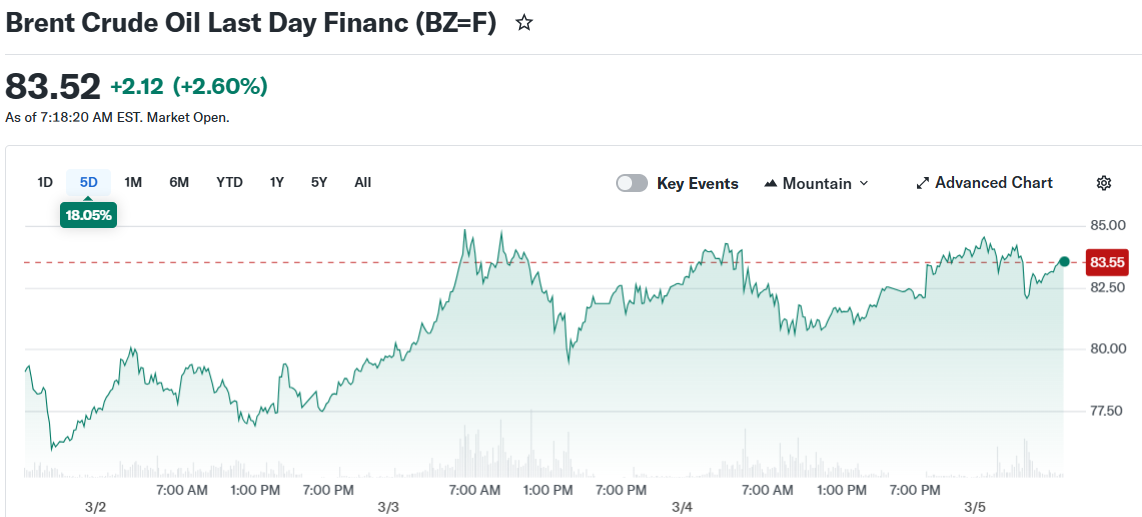
- Brent crude advanced 2.6% to reach $83.54 per barrel; WTI gained 3.1% to settle at $76.96 on Thursday
- Strait of Hormuz shipping traffic plummeted more than 95% following Iranian actions
- Iraq announced force majeure while reducing production by approximately 1.5 million barrels daily
- Market analysts project Brent could reach $140/barrel under full blockade scenarios; $100 under partial disruption
- China instructed refiners to stop fuel exports; Japan considered tapping emergency reserves
Middle East hostilities stretched into their sixth consecutive day Thursday, driving crude oil prices to levels unseen since July 2024.
Brent crude futures advanced 2.6% to settle at $83.54 per barrel. West Texas Intermediate gained 3.1% to close at $76.96. The benchmarks have posted gains across five consecutive trading sessions.
Hostilities escalated over the weekend following coordinated U.S. and Israeli military operations targeting Iranian sites. The U.S. military subsequently destroyed an Iranian warship operating near Sri Lanka in international waters.
The U.S. Senate rejected Wednesday a measure that would have mandated Congressional authorization for ongoing air operations. The vote followed partisan divisions.
BREAKING: Brent oil prices surge above $82.50/barrel with gas prices now up nearly +20% since January.
Keep watching oil prices as a leading indicator for a potential "deal" or market intervention.
The world simply cannot afford oil prices rising toward $100/barrel. pic.twitter.com/MEOXt0z4Iu
— The Kobeissi Letter (@KobeissiLetter) March 5, 2026
Tehran dismissed claims that Iran’s Ministry of Intelligence had initiated diplomatic outreach to Washington. Iranian officials characterized such reports as “pure falsehood.”
Shipping Crisis in Critical Waterway
The Strait of Hormuz remains the epicenter of supply concerns. Approximately 20 million barrels of oil and petroleum products transited the waterway daily during 2025, based on International Energy Agency figures.
Bloomberg vessel tracking data reveals shipping activity through the strait has collapsed by more than 95%. The majority of vessels are rerouting to avoid the area completely.
Iraq invoked force majeure on certain crude shipments due to transit constraints. The nation reduced production by approximately 1.5 million barrels per day, according to statements provided to Reuters.
As OPEC’s second-largest producer, Iraq’s output reduction stands as a primary factor driving the current price rally.
An Iranian military commander stated on government television that Iran does “not believe in closing” the strategic waterway. Regardless, vessel operators remain unwilling to risk passage through the strait.
Washington has floated proposals to provide insurance coverage guarantees and potential naval protection for commercial shipping. Marsh, the world’s largest insurance brokerage, indicated such arrangements would require several weeks to implement.
The Sonangol Namibe tanker sustained damage in the northern Persian Gulf. The vessel reported water leaking from a ballast tank while confirming no oil spillage occurred.
Asian Markets React to Supply Constraints
China directed major state-owned refineries to cease diesel and gasoline exports. The directive reflects Beijing’s focus on securing domestic fuel supplies during the disruption.
Japan requested government action to release petroleum from strategic stockpiles. A prominent Indian refining company similarly notified customers of suspended product exports.
ING analysts forecast that complete closure of the strait could propel Brent to $140 per barrel. Under scenarios involving partial disruption and tanker incidents, prices could spike toward $100 before stabilizing in an $80–$90 range.
U.S. crude inventories expanded by 5.6 million barrels during the week ending February 28, the American Petroleum Institute reported. The increase exceeded market forecasts of a 2.2 million barrel addition.
The U.S. Energy Information Administration was scheduled to release official inventory figures later Thursday.



