

Key Highlights
- Brent crude climbed more than 4% to reach $88.85 per barrel on Friday; WTI advanced 5.3% to $85.31 per barrel
- WTI recorded its strongest single-session performance since May 2020, surging 8.5% on Thursday
- Qatar’s Energy Minister issued warnings that Gulf nations might suspend production in a matter of days
- UBS analysts project oil prices could surpass $90 per barrel if Strait of Hormuz disruptions persist
- The energy price rally is driving bond yields upward while applying pressure to equity markets
Energy markets experienced another day of significant gains on Friday, extending Thursday’s sharp rally as concerns about Middle East supply disruptions intensified among traders.
Brent crude futures advanced approximately 4% to reach $88.85 per barrel. West Texas Intermediate increased 5.3% to settle at $85.31 per barrel. The two major benchmarks have now posted gains across five consecutive trading sessions. Brent has climbed 19% during this period, while WTI has surged 25%.
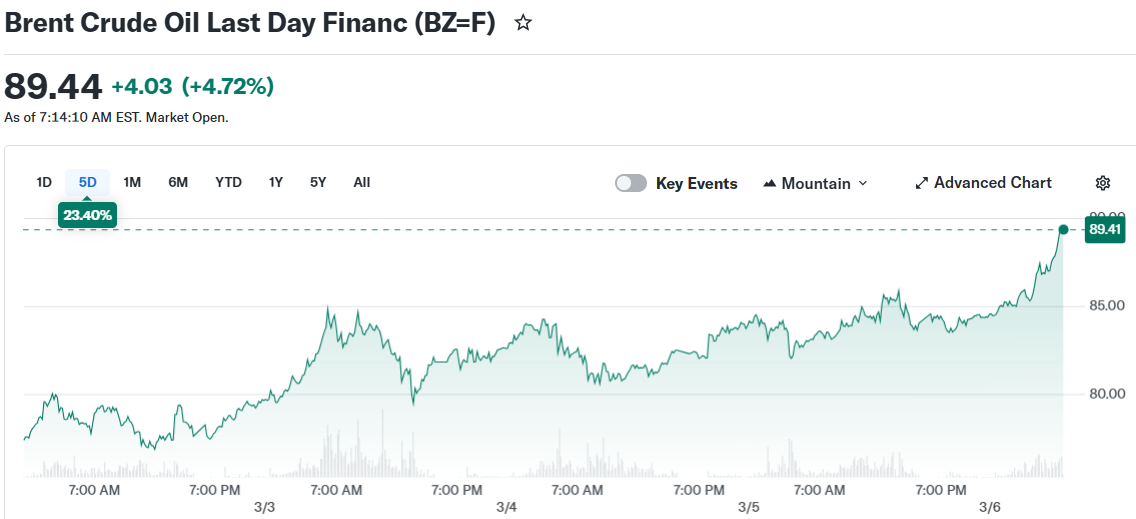
Thursday saw WTI deliver its most impressive single-session performance since May 2020, jumping approximately 8.5%. The dramatic movement sent ripples through wider financial markets.
BREAKING: US oil prices surge above $84/barrel for the first time since July 2025.
Oil prices are now up +55% since December with Brent nearing $90. https://t.co/0ELtpVOm74 pic.twitter.com/bAI8ugaz7T
— The Kobeissi Letter (@KobeissiLetter) March 6, 2026
Deutsche Bank strategist Jim Reid noted the oil market rally has prompted investors to scale back their projections for future interest rate reductions. This shift has driven bond yields higher across the Atlantic, while equities and fixed income securities both declined.
Supply Disruption Concerns Drive Market Anxiety
The primary worry focuses on the Strait of Hormuz, a critical narrow passage that carries approximately 20% of global oil supply. Intensifying conflict between Iran and combined U.S.-Israeli forces has elevated fears the waterway could face closure.
Qatar’s Energy Minister Saad al-Kaabi shared with the Financial Times on Friday that Middle East conflict could compel Persian Gulf nations to suspend energy production within a matter of days. He projected oil could surge to $150 per barrel under such circumstances.
UBS analysts stated in their research note that current oil prices do not represent a “stable equilibrium.” Should shipping interruptions continue or energy facilities sustain additional damage, prices could climb beyond $90 per barrel, according to their assessment.
UBS analysts Mark Haefele and Giovanni Staunovo noted that a cessation of hostilities would likely trigger a price decline, with Brent potentially retreating to the $60 to $70 per barrel range.
The U.S. government took action to relieve some market pressure by authorizing Russian oil sales to India for a 30-day period. The U.S. Treasury Department is also preparing to unveil measures designed to manage energy prices through financial market mechanisms, Reuters reported.
Implications for Inflation and Monetary Policy
Several investors have begun expressing concern that elevated oil prices might drive U.S. inflation higher, potentially causing the Federal Reserve to postpone interest rate reductions. U.S. bond yields have already risen in reaction, creating headwinds for equity markets.
UBS analysts indicated oil prices would need to remain elevated for multiple months before they would “materially affect growth or inflation.”
Energy Secretary Chris Wright indicated on Thursday that the Iran conflict might conclude within weeks. “We don’t know the exact length, but pretty temporary,” he stated to ABC News.
The fighting shows few indications of deceleration. Israel conducted strikes against Hezbollah positions in Lebanon and targeted Tehran on Friday, while Iran’s Revolutionary Guards launched drones and missiles toward Tel Aviv.



