

AI agents are software tools that complete tasks instead of only answering questions. They can research a topic, read documents, sort email, build simple websites and update business records with limited human input.
The big technology firms are all selling them. OpenAI, Anthropic, Google and Microsoft each offer agent products, while Zapier, n8n, Manus and Lindy serve smaller teams.
Not every product with the agent label works on its own. Some are workflow builders, and others are chatbots with a few added connections.
This article compares 12 agents by price, free access, use case and risk. It uses published starting rates as of November 2026, and those rates can change. Check each vendor before you buy.
Definitions matter here. A chatbot answers a prompt, while an agent plans steps, uses tools and returns a finished result. The line between the two is not always clear, so buyers should test a tool before paying.
Key figure | What the data shows |
|---|---|
12 | Agents compared, grouped into five job types |
6 | Agents with a starting price of about $20 a month (n8n is €20) |
3 | Agents with a free plan or free self-hosted option |
$0.99 | Starting price per outcome for Fin, the lowest unit price on the list |
~$200 | Common prepaid monthly option for Microsoft Copilot Studio, the highest on the list |
The 12 Agents Split Into Five Job Types
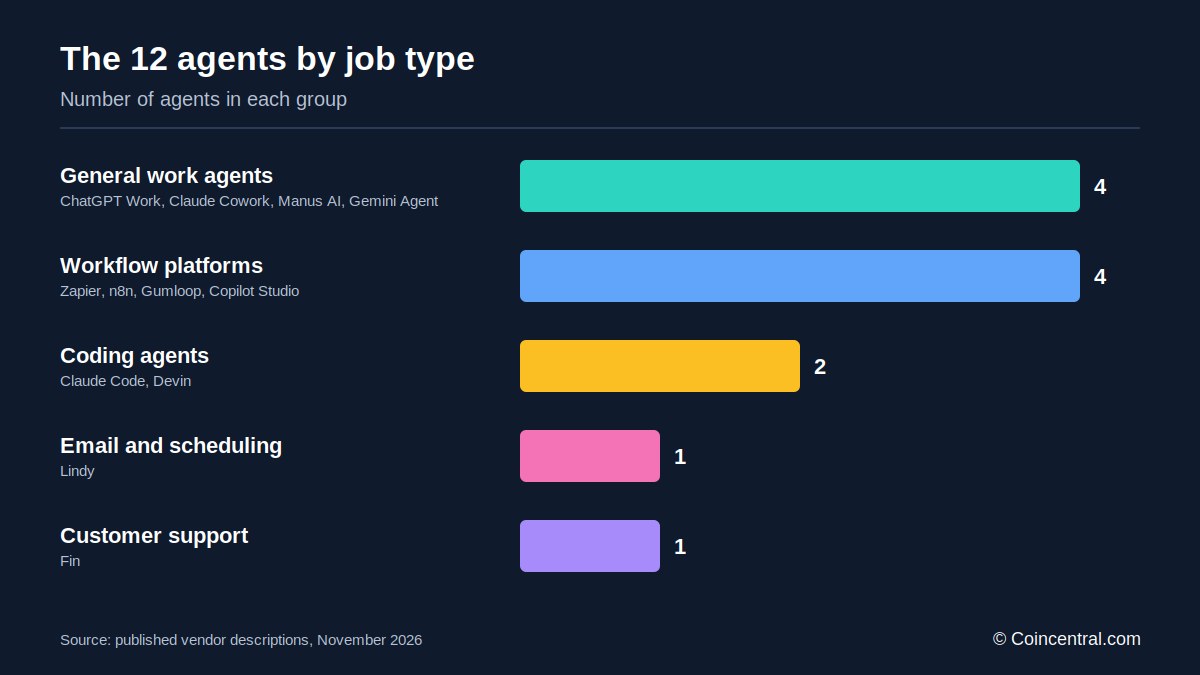
The 12 agents fall into five groups. Four are general work agents: ChatGPT Work, Claude Cowork, Manus AI and Google Gemini Agent.
Four more are workflow platforms: Zapier Agents, n8n, Gumloop and Microsoft Copilot Studio. Two are built for coding, and they are Claude Code and Devin.
Lindy covers email and scheduling. Fin focuses on customer support.
Eight of the 12 agents, or two thirds, are general work or workflow tools. Coding, email and support tools make up the other four.
This mix shows where the market is busiest. Most vendors want to handle broad office work, while a smaller group sells narrow tools for one job.
Starting Prices Compared
Price is often the first thing buyers check. The table below lists all 12 agents in ranking order, with the best use, free option and starting price.
Rank | AI Agent | Best For | Free Option | Starting Price |
|---|---|---|---|---|
1 | ChatGPT Work | General work automation | Limited access | Plus: $20/month |
2 | Claude Cowork | Documents and desktop tasks | Limited Claude access | Pro: $20/month |
3 | Zapier Agents | Business automation | Yes | Agents Pro: $33.33/month annually |
4 | Manus AI | Research and complex projects | Yes | From around $20/month |
5 | n8n | Custom AI workflows | Free self-hosted | Cloud: €20/month annually |
6 | Microsoft Copilot Studio | Enterprise automation | Trial | Usage-based pricing |
7 | Google Gemini Agent | Google Workspace | Limited access | Plans vary |
8 | Lindy | Email and scheduling | Trial or starter credits | From around $30/month |
9 | Claude Code | Software development | Limited access | Pro: $20/month |
10 | Devin | Autonomous coding | Limited access | From around $20/month |
11 | Gumloop | No-code AI automation | Free trial | From about $37/month |
12 | Fin AI Agent | Customer support | Trial | From $0.99 per outcome |
Prices are approximate published starting rates as of November 2026. Some are annual-billing equivalents. Subscription fees, AI usage credits and outside API charges may be separate.
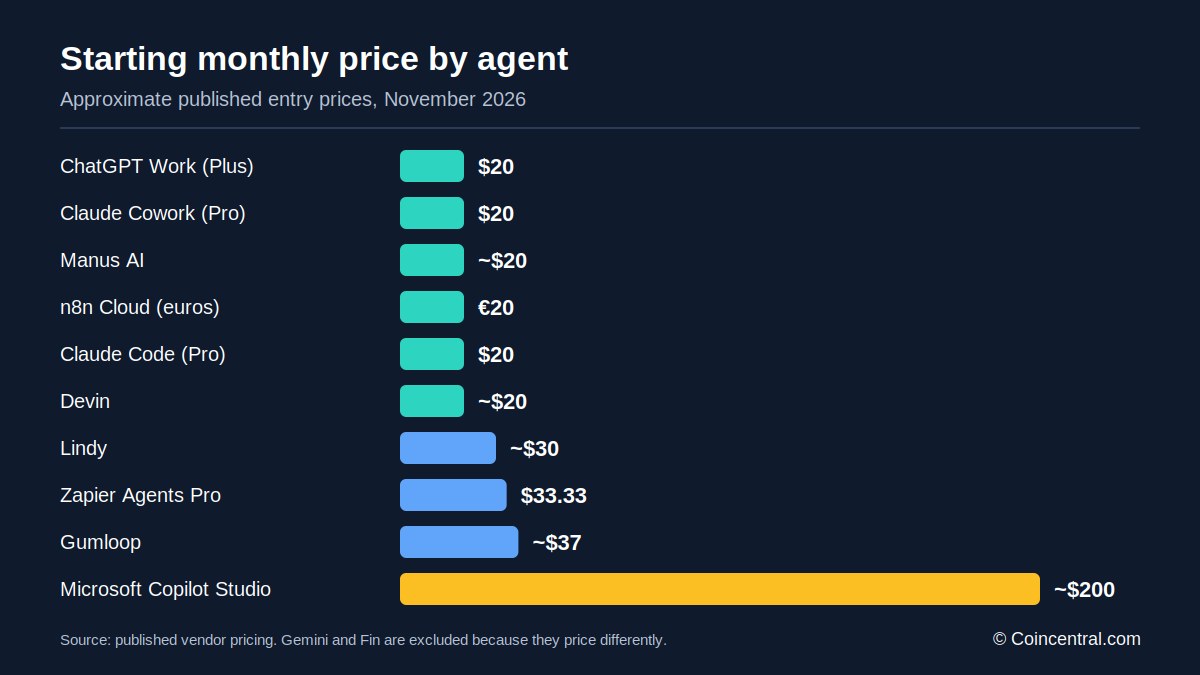
Six of the 12 agents start at about $20 a month. They are ChatGPT Work, Claude Cowork, Manus AI, n8n, Claude Code and Devin.
Lindy starts near $30, Zapier Agents Pro is $33.33 a month on annual billing, and Gumloop is near $37. Microsoft Copilot Studio sits at the top. A common prepaid option is about $200 a month for 25,000 Copilot Credits.
Two agents do not fit a simple monthly price. Google Gemini Agent pricing depends on the Workspace plan, and Fin charges per outcome.
The chart below shows the ten agents with a monthly figure. Copilot Studio costs about ten times as much as the $20 plans. It is built for enterprise use, and the final bill depends on actual usage.
How Many Agents Offer Free Access?
Most agents let buyers try them without paying. The type of access differs a lot, though.
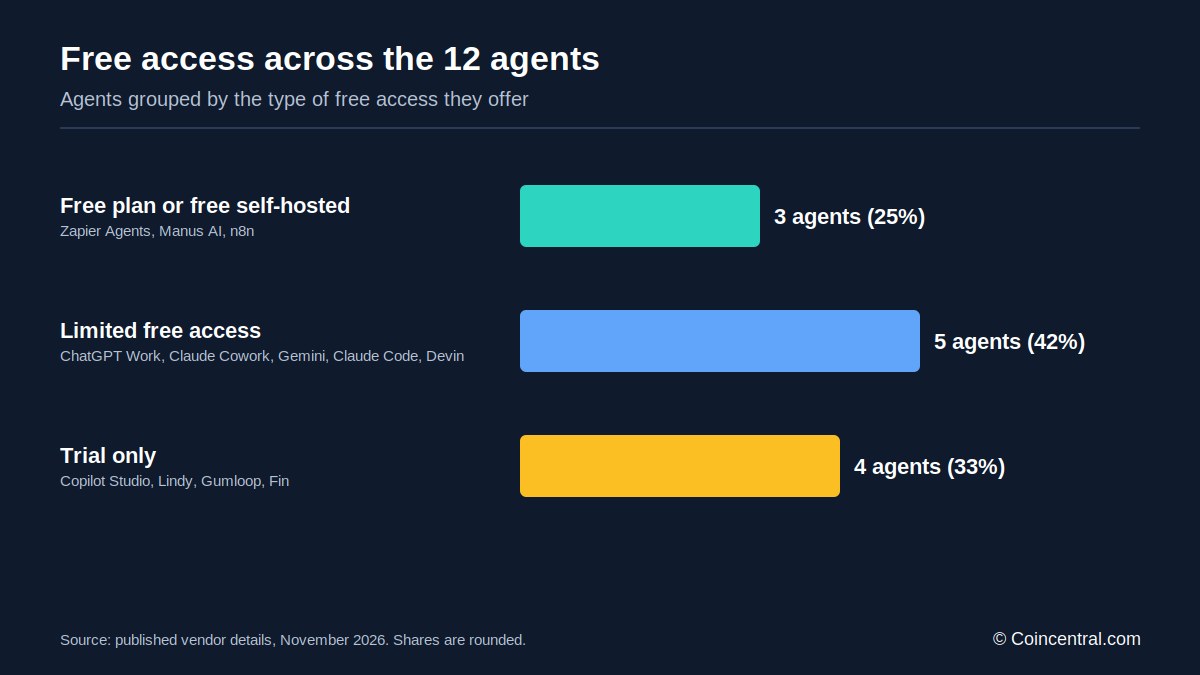
Three agents have a true free option. Zapier Agents has a free plan with limited monthly activity, Manus AI offers restricted free credits, and n8n has a self-hosted Community edition with no software fee.
Five agents offer limited access: ChatGPT Work, Claude Cowork, Google Gemini Agent, Claude Code and Devin. Four are trial only: Microsoft Copilot Studio, Lindy, Gumloop and Fin.
Access type | Agents | Share of 12 |
|---|---|---|
Free plan or free self-hosted | 3 | 25% |
Limited free access | 5 | 42% |
Trial only | 4 | 33% |
Free does not always mean no cost. Self-hosting n8n means paying for servers, backups and security work. Free tiers may also need paid AI model usage or outside services.
Google’s case needs care. Some consumer Gemini features are free, but enterprise agent features should not be assumed to come with a free Google account.
Buyers who only want to test an idea can start with the free options. Those who need steady daily use will likely move to a paid plan once the free allowance runs out.
General Work Agents: ChatGPT Work, Claude Cowork, Manus and Gemini
General work agents aim to handle research, writing and file tasks from start to finish. They suit people who want to hand over a whole project, such as a monthly report.
ChatGPT Work
ChatGPT Work, from OpenAI, was introduced in July 2026. It can plan multi-step tasks, search online, use connected apps and work with uploaded files.
It can produce documents, spreadsheets, reports, presentations and websites. It comes with eligible ChatGPT plans, including Plus at $20 a month. Its main limit is reliability, so users should check figures and claims.
Scheduled tasks let some supported workflows run at set times or react to events. Outside apps still need the right integrations and permissions, so the agent cannot reach every service a user relies on.
Claude Cowork
Claude Cowork, from Anthropic, focuses on documents, files and supported apps. A user could ask it to organise a set of files, find key facts and write a summary. Pro costs $20 a month, and allowances depend on the plan.
Anthropic has built its models for long documents and complex reasoning. That makes Cowork a fit for consultants, analysts and researchers. Autonomous document work still needs review, since the system may misread an instruction or change something the user did not intend.
Giving an agent access to local files raises security questions. Users should review permissions and avoid opening sensitive folders.
Manus AI
Manus AI runs projects in cloud-based environments. It can research a topic, build presentations, work with spreadsheets and create basic websites. It has a free option with restricted credits, and paid plans start near $20 a month.
The main concern is credit use. Complex tasks can use many more credits than simple ones.
Google Gemini Agent
Google announced its universal Gemini agent for work in October 2026. It is designed to work across Gmail, Docs and Drive. Google also offers Workspace Studio, which lets users build custom agents without code.
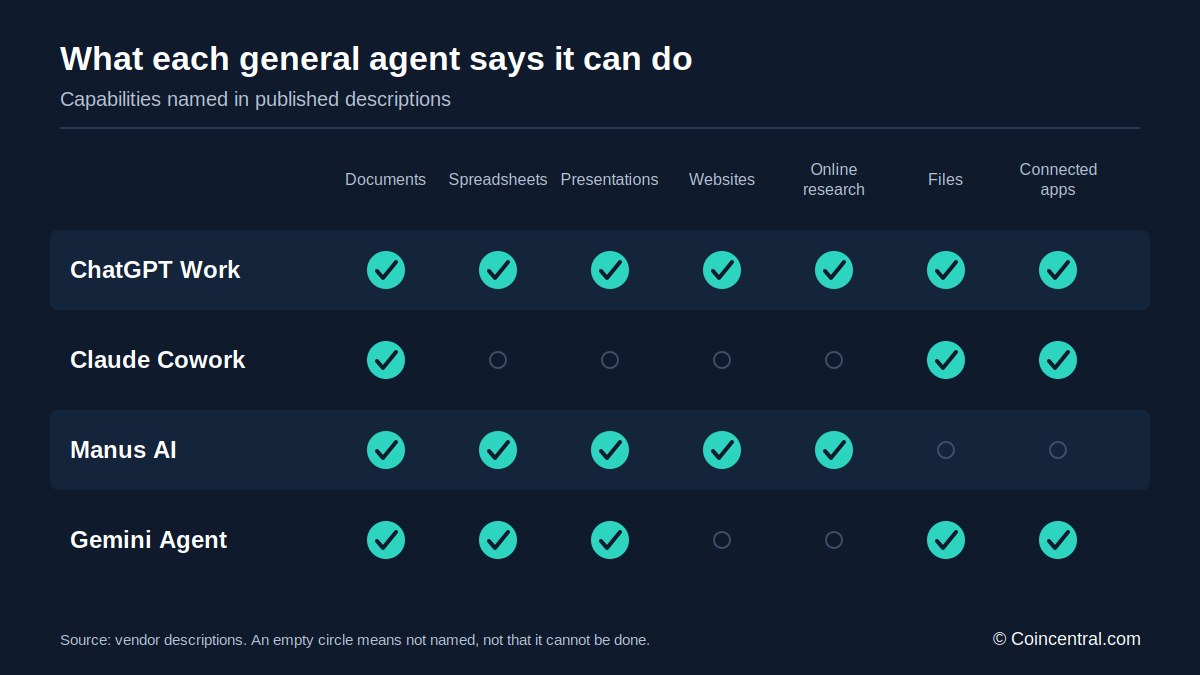
Access depends on the Workspace plan and account type. The chart below maps the capabilities each tool’s published description names.
Workflow Platforms: Zapier, n8n, Gumloop and Copilot Studio
Workflow platforms connect apps and let AI decide what to do at set steps. They suit recurring work, such as sorting customer enquiries or updating records.
Zapier Agents connects thousands of apps, including email, CRM and project tools. It offers visual and plain-language tools, so coding skills are not required. Costs can rise as activity grows.
For example, an agent could read a web form enquiry, sort it by type and update the right customer record.
n8n gives technical users more control. It mixes visual design with code and APIs, and it can be self-hosted. Cloud Starter costs €20 a month on annual billing and includes 2,500 workflow executions.
n8n also offers approval steps before selected tool actions. That helps when an automation could change business data.
Gumloop is a no-code builder that combines AI models with workflows. One example is collecting data from websites and sorting the results into a spreadsheet. Plans start near $37 a month, and credit-based pricing means costs can grow with workflow size.
Microsoft Copilot Studio targets large organisations. It works with Microsoft 365 and Power Platform, and it includes tools for permissions, deployment and monitoring. A common prepaid option is about $200 a month for 25,000 credits, but final cost depends on the actions taken.
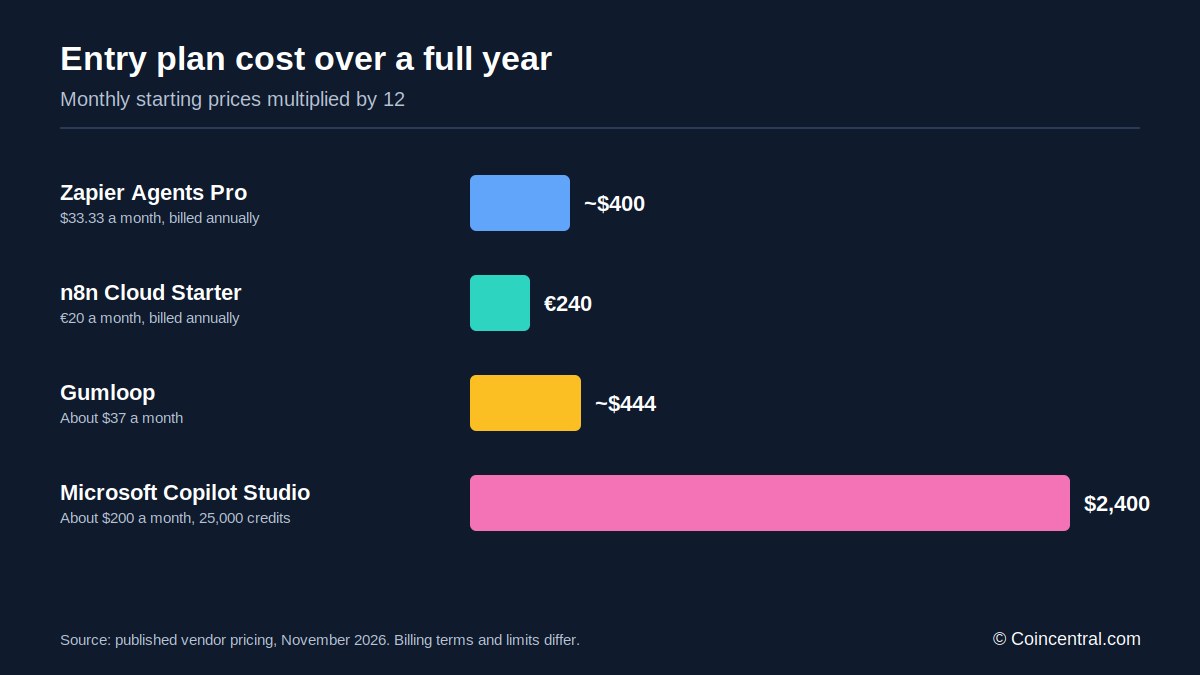
The chart turns those monthly prices into yearly figures. Zapier comes to about $400, n8n to €240, Gumloop to about $444 and Copilot Studio to $2,400.
Billing terms and usage limits differ, so the totals are not like for like.
Specialist Agents: Coding, Email and Customer Support
Specialist agents do one job. Four agents on the list fit this group.
Claude Code and Devin target software work. Claude Code can inspect a project, change files, investigate errors and run tests. It is included with eligible paid Claude plans, starting at $20 a month.
Devin focuses on delegated engineering tasks, such as bug fixes and new features, in a cloud environment. Paid plans start near $20 a month. For both tools, developers should use version control and review changes before release.
Claude Code allowances depend on the plan and the model chosen. Devin costs rise with heavier use and team features.
Lindy aims to act as a personal assistant for email, meeting preparation and scheduling. Paid plans start near $30 a month. Users should limit its authority to contact people outside the company, since a misread email could create an unwanted commitment.
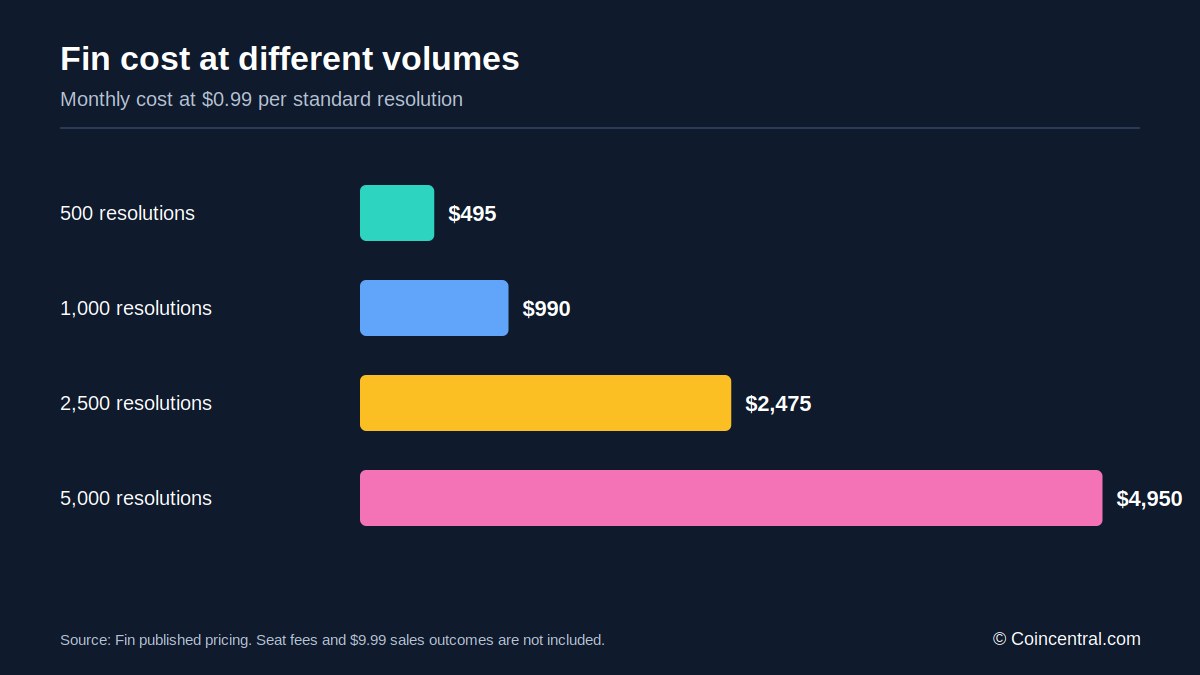
Fin handles customer support and uses outcome pricing. A standard resolution costs $0.99, and certain qualified sales outcomes cost $9.99. Companies using the full Intercom Helpdesk may also pay seat fees.
Outcome pricing grows with volume. If every outcome were a standard resolution, 1,000 resolutions would cost $990 a month.
Buyers should check how outcomes are classified. Not every charge means a fully solved customer problem.
Are AI Agents Worth the Cost?
The value of an agent depends on whether its work is correct. Time saved only counts if the output does not need heavy repair.
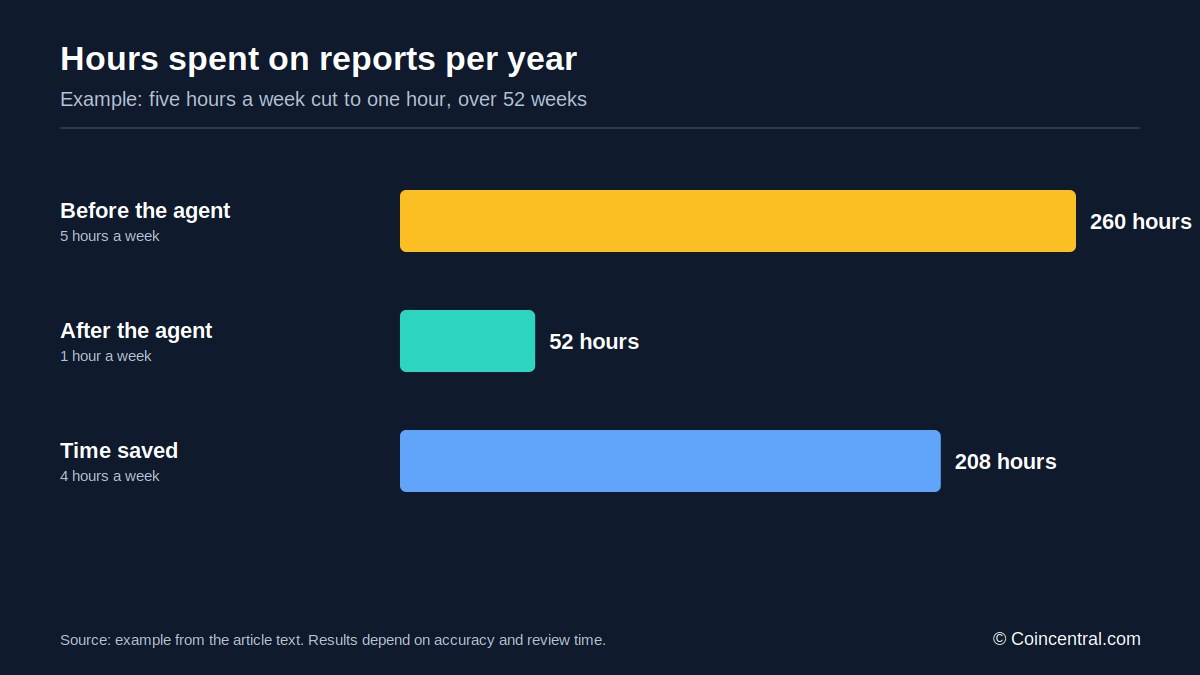
Take a business that spends five hours a week on reports. If an agent cuts that to one hour, the business saves four hours a week. Over a 52-week year, that is 208 hours.
If the reports contain many errors, that gain shrinks. Review time is a real cost.
Total cost includes more than the subscription. It also covers API charges, integration costs, staff training and the time spent supervising the system.
A $20 plan can look cheap and still cost more once extra services and upkeep are added. Traditional automation may be cheaper when a task follows predictable rules.
A useful measure is cost per successfully completed task. It divides total spending by the number of tasks that were correct and usable.
Consider a $20 plan that completes 20 tasks a month correctly. That is $1 per task. If only 10 of those tasks are usable, the cost is $2 per task. The numbers are an example, but they show why accuracy matters as much as price.
The Main Risks of AI Agents
Agents carry risks that chatbots do not. If a chatbot gives a wrong answer, the user can ignore it. If an agent sends an email or changes a record, the mistake may already be done.
Prompt injection is a key concern. Hidden instructions in a website, email or document may try to steer an agent into unauthorised actions.
Privacy matters too. Agents may handle confidential files, customer data and internal messages, so firms should review data policies and check that integrations meet the rules that apply to them.
Risk | What can happen | Common safeguard |
|---|---|---|
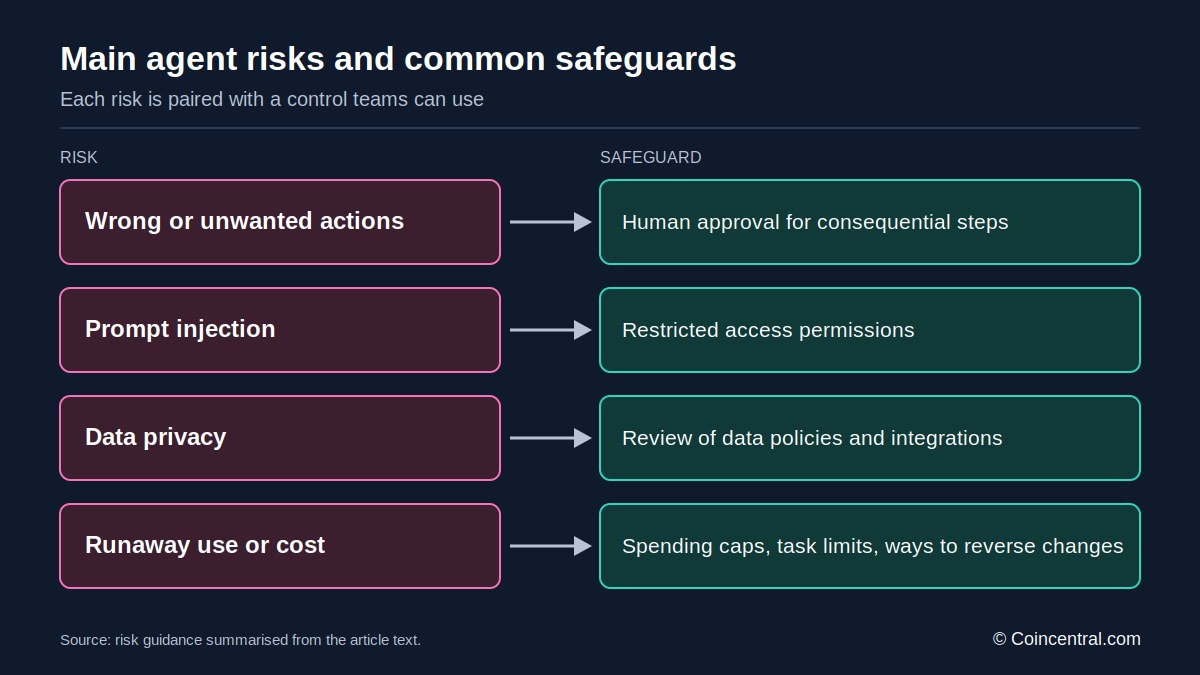
Wrong or unwanted actions | An agent sends a message or edits a record by mistake | Require human approval for consequential steps |
Prompt injection | Hidden text in a page or file steers the agent | Restrict access permissions |
Data privacy | Confidential data reaches the wrong system | Review data-handling policies and integrations |
Runaway use or cost | An agent loops or uses far more credits than planned | Set spending caps and task limits, and allow changes to be reversed |
Clear limits help. Teams can set spending caps, task limits and approval checkpoints, and they should have a way to reverse changes. No autonomous system should be treated as fully reliable.
Some tools build in controls. n8n offers approval steps before selected tool actions, and Copilot Studio includes permission and monitoring tools.
How to Choose the Right Agent
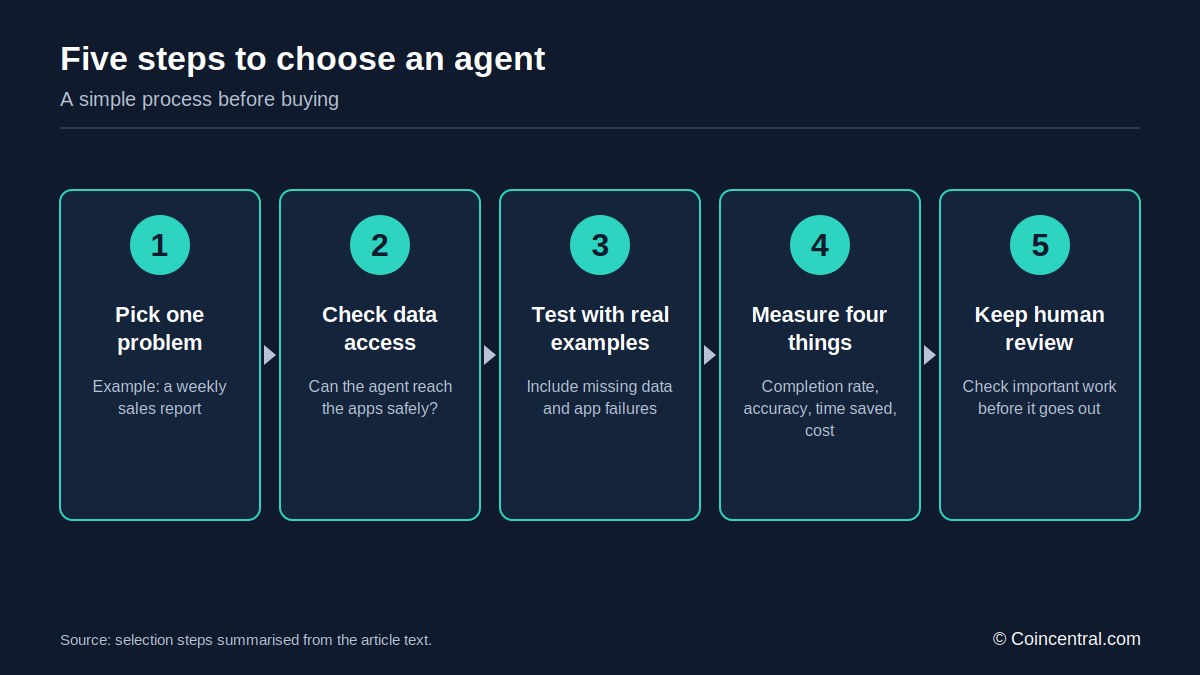
Start with a specific problem, such as a weekly sales report. Picking a tool based on marketing claims is less reliable.
Next, check which apps hold the data and whether the agent can reach them safely. Then test the workflow with real examples.
Track four measures: completion rate, accuracy, time saved and operating cost. Include cases where data is missing or an outside app fails. An agent that works in ideal conditions may struggle with surprises.
For small businesses, the best choice depends on where staff spend their time. ChatGPT Work is a reasonable start for research, reports and admin. Teams with repeat tasks across several apps may do better with Zapier Agents or n8n.
An online retailer, for example, may need to process enquiries, organise orders and update records. A workflow platform will likely fit that job better than a general research agent.
Not every task needs AI. Traditional automation is often cheaper and more reliable when a task follows fixed rules. For important work, human oversight stays essential.
Summary: Which Agent Fits Which Need
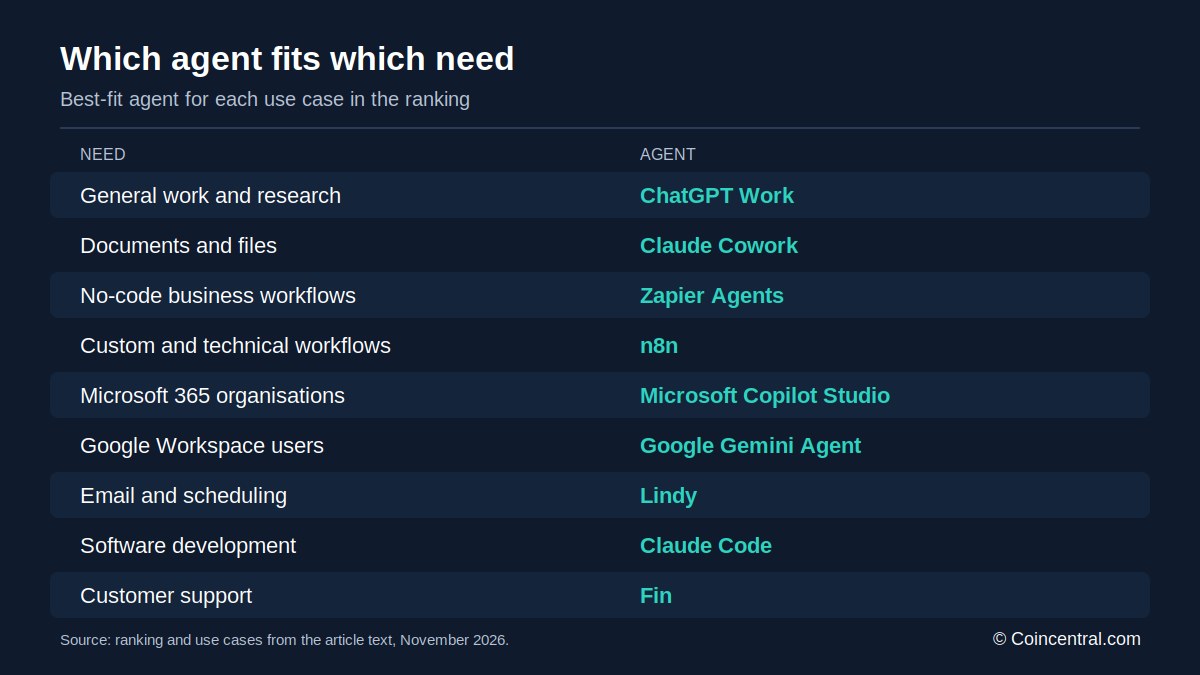
The ranking places ChatGPT Work first for general productivity, followed by Claude Cowork for document-heavy work. Zapier Agents and n8n come next for recurring workflows.
For developers, Claude Code leads the coding picks. Companies already on Microsoft 365 or Google Workspace may find their own platforms easier to fit into existing systems.
Prices run from free plans to about $200 a month, and one tool charges $0.99 per outcome. The most advanced agent is not always the best fit.
Reliability, integrations, security and measurable time savings matter more. Agents that finish useful work accurately, securely and at a lower total cost than the alternatives are the ones most likely to last.
Buyers should also expect change. ChatGPT Work launched in July 2026 and Google announced its universal Gemini agent in October 2026. Plans, credits and limits are updated often, so reviewing prices every few months is sensible.
Quick Answers
What is the best AI agent in 2026?
ChatGPT Work ranks first for general productivity. Zapier Agents and n8n may suit recurring business automation better, and Claude Code is strong for programming.
Are there free AI agents?
Yes. Zapier Agents has a free tier and n8n has a self-hosted Community edition. Others offer limited access or trials, and some still need paid AI model usage.
Do AI agents need coding skills?
Not always. Zapier and Gumloop offer visual tools. Custom integrations may need programming skills.
Can an agent run a whole business?
No. Agents can automate selected processes, but decisions on finance, security, customers and legal duties need human oversight.