

TLDR
- Brent crude oil has climbed past the $100 per barrel mark following Iran’s commitment to maintain closure of the Strait of Hormuz.
- The IEA has declared this the most significant supply disruption in the history of oil markets and approved the release of 400 million barrels from strategic reserves.
- A temporary waiver from the US permits select nations to purchase Russian oil, with the authorization lasting through April 11.
- Reports indicate Iran has started deploying mines throughout the strait, creating additional hazards for vessel traffic.
- Plans for US Navy escort operations through the strait could commence before the end of March, though analysts remain skeptical about resolving the crisis.
Brent crude oil climbed beyond the $100 per barrel threshold this week following Iran’s declaration that it would maintain its blockade of the Strait of Hormuz, triggering widespread disruption across global energy markets and driving equity indexes downward.
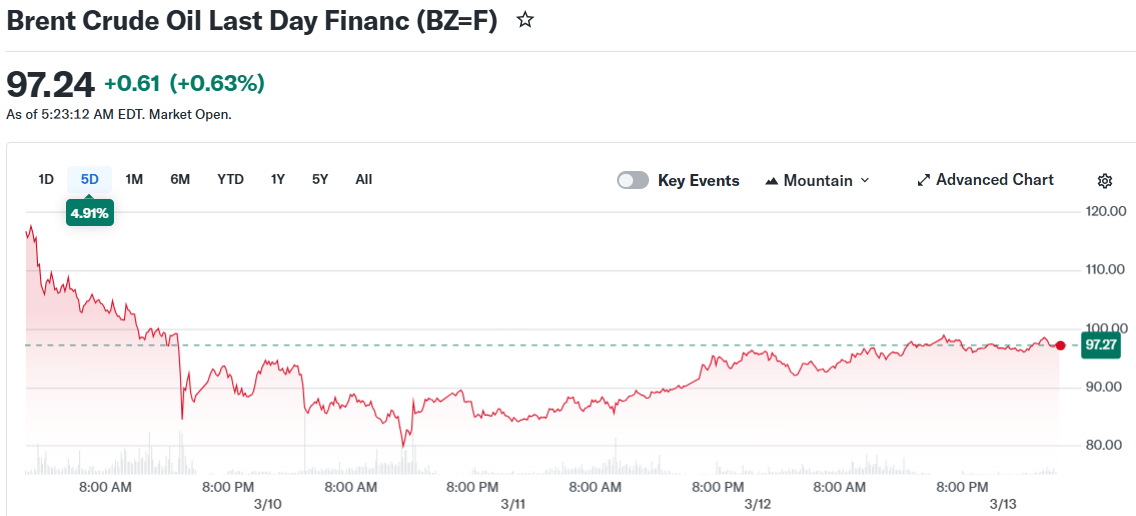
The price increase comes amid some of the most dramatic market volatility witnessed in recent years. West Texas crude approached $97, with both benchmark grades experiencing wide trading ranges comparable to the pandemic era.
Mojtaba Khamenei, Iran’s new supreme leader, delivered his inaugural public remarks since assuming power from his father. He stated Iran’s intention to maintain the shipping blockade through the strait.
The Strait of Hormuz represents a critical chokepoint between Iran and Oman. Approximately 20% of global oil supplies transit through this waterway. Maritime traffic has declined to near-zero levels since the US-Israel conflict with Iran commenced on February 28.
The International Energy Agency has characterized this as the most severe supply disruption ever recorded in petroleum markets. The agency approved an unprecedented drawdown of 400 million barrels from strategic petroleum reserves maintained by member nations.
According to reporting by the New York Times citing US government sources, Iran has commenced mine-laying operations within the strait. This development creates substantial additional risks for commercial vessel operations.
Chris Wright, US Energy Secretary, indicated the Navy might initiate tanker escort missions through the strait before March concludes. A prior social media statement suggesting an escort operation had already occurred was subsequently retracted by White House officials.
US Eases Russia Oil Sanctions
In an effort to reduce market stress, the US Treasury Department authorized a temporary exemption permitting certain nations to accept deliveries of Russian oil that had been loaded aboard vessels prior to March 12. This authorization extends through April 11.
Scott Bessent, Treasury Secretary, characterized the action as designed to provide stability to worldwide energy markets. Russian authorities reported approximately 100 million barrels of petroleum currently traveling at sea.
The United Kingdom announced it would maintain its existing sanctions framework regarding Russian oil. Michael Shanks, British energy minister, expressed concern the waiver might enable Russia to generate revenue for military operations.
Emmanuel Macron, French President, also objected, stating the Hormuz situation did not warrant relaxing sanctions against Russia. Ukrainian President Zelensky characterized the decision as a “serious blow” to Ukraine’s interests.
Markets and Prices
Stock markets declined throughout the week as petroleum prices advanced. The extreme price fluctuations have been amplified by trading activity in derivatives markets and exchange-traded funds.
WTI crude moved through approximately a $43 range during the week, representing the widest band observed since oil prices briefly turned negative during the pandemic. Brent experienced roughly a $38 trading range.
Asian nations, heavily dependent on Middle Eastern crude supplies, have responded rapidly. Japan, South Korea, and Thailand implemented petrol price ceiling mechanisms. The Philippines, which sources roughly 95% of its crude from the Middle East region, directed government employees to adopt four-day work schedules to reduce fuel consumption.
One market analyst projected a price band of $85 to $105 per barrel would likely persist during the ongoing conflict. While the IEA reserve deployment may provide near-term support, energy experts indicate it will prove insufficient to stabilize markets independently.
President Trump stated via social media that denying Iran access to nuclear weapons technology held greater priority for him than managing oil price levels.
Remember: Preserve all tokens like [[EMBED_0]], [[IMG_0]], [[LINK_START_0]], [[LINK_END_0]], [[SCRIPT_0]], [[FIGURE_0]] etc. exactly as they appear. These are placeholders for embeds, images, and links that must not be changed.



