

Key Highlights
- Futures showed minimal movement Friday morning with traders awaiting March CPI inflation figures
- Tech-heavy Nasdaq positioned for eighth consecutive session of gains, matching its best performance since August 2024
- Middle East diplomatic situation remains fluid, with Israeli officials stating “there is no ceasefire in Lebanon”
- Crude oil advanced, with Brent futures gaining 2% to approach $97.81 per barrel
- Analyst forecasts point to a 0.9% monthly increase in March consumer prices
Trading in US equity futures remained subdued Friday morning as market participants positioned themselves cautiously before two significant developments: the release of updated inflation figures and diplomatic discussions scheduled for the weekend concerning the Iran-Israel situation.
Contracts tracking the Dow Jones Industrial Average showed virtually no change. Futures linked to the S&P 500 advanced modestly by less than 0.1%. Nasdaq 100 contracts climbed 0.1%, extending the technology benchmark’s rally to a potential eighth consecutive session — a winning run that would match its best performance since August 2024.
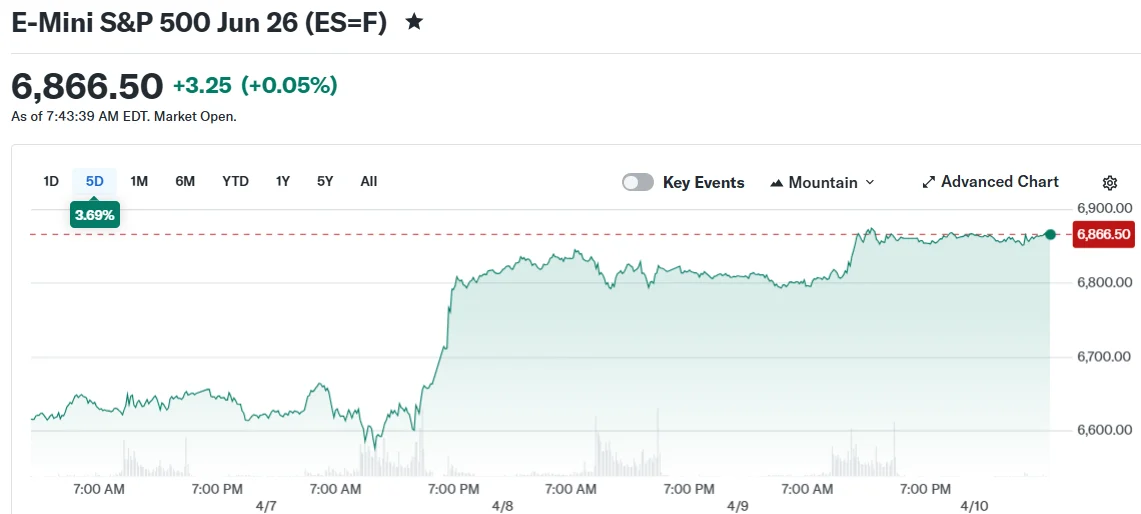
Thursday’s trading session delivered positive closes across all three primary equity benchmarks, with the Dow Jones Industrial Average climbing back into positive territory for the calendar year 2026.
Market participants are focused on the upcoming consumer price index release for March, which represents the initial inflation assessment covering the timeframe following the onset of military operations involving Iran. Economic forecasters anticipate the headline CPI figure will demonstrate a 0.9% monthly advancement, with annual comparisons showing a 3.3% elevation.
Henry Allen, a macro strategist at Deutsche Bank, emphasized the significance of the upcoming data. “It’s the first to cover the period since the Iran war began,” he noted.
Middle East Conflict Creates Market Uncertainty
Geopolitical pressures emanating from the Middle East continue to shape investor sentiment. Prime Minister Benjamin Netanyahu of Israel has agreed to enter into discussions with Lebanese counterparts. Meanwhile, Israel’s formal stance clarified: “There is no ceasefire in Lebanon.”
Officials from Iran have pointed to Israeli actions as violations of the existing ceasefire arrangement and implemented closures affecting tanker passage through the Strait of Hormuz. President Donald Trump addressed the situation via Truth Social, characterizing Iran’s management of oil transit through the strategic waterway as inadequate.
🚨BREAKING:
🇮🇷🇵🇰🇺🇸 Iran says its negotiating team has not arrived in Islamabad, and the talks are on hold.
Tehran's condition: the U.S. must hold Israel to the ceasefire in Lebanon before negotiations can begin.
TL;DR: Iran may not show up.
Source: Tasnim https://t.co/5FNP0milF7 pic.twitter.com/HMjCaTB5wN
— Mario Nawfal (@MarioNawfal) April 10, 2026
Top-level White House representatives contacted Netanyahu midweek, requesting that Israel reduce the intensity of military actions in Lebanon. Diplomatic negotiations are set to commence over the weekend.
Crude oil markets responded to the geopolitical volatility with upward momentum. Brent crude contracts advanced 2% to reach $97.81 per barrel. West Texas Intermediate contracts increased 1.9% to $99.75 per barrel. Saudi Arabian authorities additionally issued warnings that recent Iranian military actions have diminished the kingdom’s petroleum production capabilities.
Precious Metals, Fixed Income, and Currency Markets
Gold contracts declined 0.9% to $4,777 per ounce during Friday trading, although the precious metal maintains a trajectory for weekly appreciation.
The US dollar strengthened marginally by 0.1% relative to a basket of peer currencies. Yields on 10-year Treasury securities increased by 2 basis points to reach 4.30%.
Analysts at Goldman Sachs observed that any supply normalization originating from Persian Gulf sources would likely require multiple weeks before becoming evident in global markets.
The March consumer price data represents traders’ initial comprehensive view of how the energy price surge has propagated through to consumer-level costs following the commencement of the Iran-related conflict.



