
TLDR
- Solana gained more than 2% on Monday following a four-day losing streak that resulted in a 5% weekly decline.
- Spot Solana ETFs in the United States saw $7.84 million exit on Friday, marking the fourth-largest daily withdrawal since launch.
- Derivative markets experienced $22.98 million in liquidations over 24 hours, with long positions representing $19.18 million of the total.
- Funding rates dropped to -0.0141%, indicating traders are compensating others to maintain short exposure.
- Critical support exists near the $70–$75 range, with market observers anticipating potential moves toward $50 if this level fails.
Solana shows signs of attempting recovery following a challenging week, yet underlying metrics paint a picture of continued caution. Withdrawal activity from ETFs, substantial liquidation events, and derivative market positioning indicate the current bounce may face resistance.
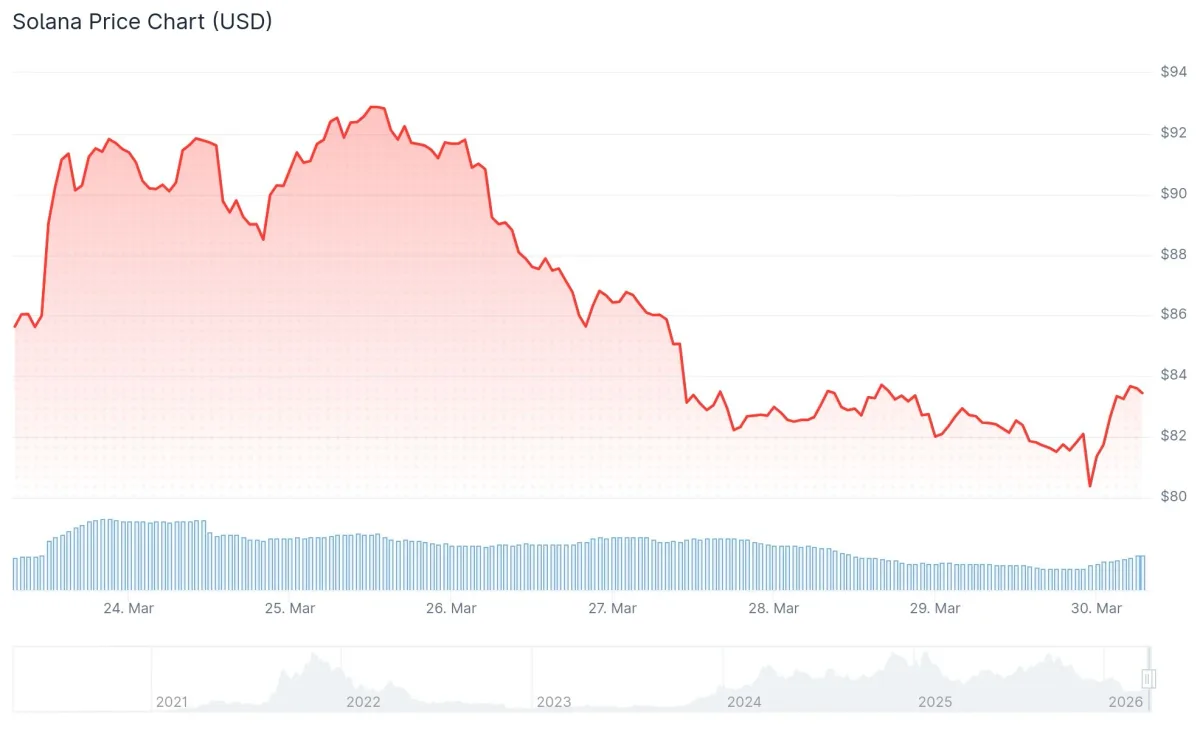
SOL closed the previous week with approximately 5% in losses, reaching lows just above the $81 mark before staging Monday’s 2%+ recovery. The asset breached an ascending support trendline positioned near $88, a development many chart analysts identified as significant.
The 50-day, 100-day, and 200-day Exponential Moving Averages (EMAs) remain positioned above current trading levels, reinforcing the bearish technical setup. A sustained daily close above $91 would be required to begin reversing this configuration.
The MACD indicator has crossed beneath its signal line and entered negative territory. The RSI currently reads 42, remaining below the 50 midpoint, indicating continued selling dominance in the market.
Spot Solana ETF products in the United States registered $7.84 million in net withdrawals on Friday alone. This figure represents the fourth-largest single-day exit since these investment vehicles became available, extending a pattern of negative flows into the third consecutive week.

Should institutional withdrawal trends persist throughout the current week, additional downward pressure could accumulate on an already vulnerable price structure.
Within derivatives markets, $22.98 million worth of SOL positions faced liquidation over the past 24-hour period. Long positions comprised the majority of these forced closures, totaling $19.18 million.
The negative funding rate of -0.0141% demonstrates that market participants are paying premiums to maintain short positions, providing a clear indication of prevailing bearish sentiment.
Analysts Eye $70–$75 as the Key Zone
Analyst Crypto Patel shared a two-week chart illustrating that SOL has declined approximately 77% from its all-time high near $250. His technical analysis identifies a significant support and potential entry zone spanning $45 to $75, with a Fibonacci retracement level at $52.11 representing a deeper target.
Where Are All The Solana Maxis Now? 🤔
They Told Their Followers To Buy $SOL Above $250. Screamed "To The Moon" At ATH.
Now Price Is Below $80… And They're Silent. Not A Single Tweet Saying "Buy Now."
Funny How That Works Right?
Bullish At $250. Silent At $80. That Tells You… pic.twitter.com/SRiCYSIr5N— Crypto Patel (@CryptoPatel) March 28, 2026
Patel observed that market enthusiasm was prevalent when Solana traded above $250, while current levels below $80 have brought quieter sentiment. He interprets the present weakness as a possible accumulation opportunity for patient investors, projecting longer-term targets of $500 and $1,000.
A separate technical examination from More Crypto Online utilized a one-hour timeframe to illustrate that Solana had violated a short-term ascending trendline. This analyst characterized the move as a potential “wave 3” decline, identifying a support zone between $71.91 and $77.91.
What the Charts Say Now
Near-term support resides at the recent low of $81.44. A breach of this level would expose $75.63, the February 24 low that initiated the previous upward trend.
Resistance clusters between $84.85 and $87.71, with the 50-day EMA at $91.24 representing a more substantial barrier.
SOL ETF flow data remains under close observation, with Friday’s $7.84 million withdrawal providing the most concrete evidence of institutional caution to date.