
Key Highlights
- Brent crude declined toward $98 per barrel, WTI approached $93, marking weekly losses exceeding 3%
- Trump revealed a 10-day Israel-Lebanon truce and stated Iran accepted critical negotiation points
- Tehran has yet to publicly verify any agreements, including Strait of Hormuz reopening
- IEA cautioned that restoring oil and gas output could require up to two years
- Leading energy forecasters project diminished global petroleum demand ahead
Oil prices declined Friday following diplomatic overtures from Washington suggesting a potential resolution to the US-Iran standoff, which is nearing day 50.
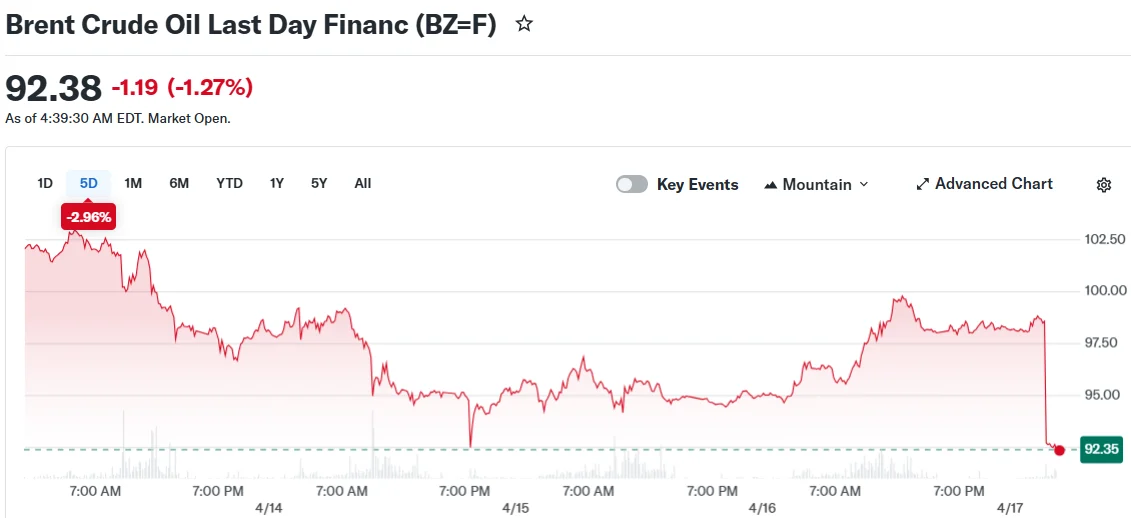
Brent crude decreased 1.1% to approximately $98.32 per barrel, while West Texas Intermediate slipped 1.3% to $89.95. Weekly losses for both benchmarks exceeded 3%.
The standoff commenced in February following coordinated US and Israeli military operations against Iran. Tehran responded by restricting most vessel traffic through the Strait of Hormuz, impacting approximately 20% of worldwide petroleum transport. Washington subsequently imposed its own maritime blockade.
President Donald Trump adopted an encouraging stance Thursday, asserting Iran had accepted previously contested conditions, including permitting Strait of Hormuz transit. Tehran has yet to publicly validate these claims.
Trump simultaneously declared a 10-day cessation of hostilities between Israel and Lebanon. He extended White House invitations to Israeli Prime Minister Benjamin Netanyahu and Lebanese President Joseph Aoun for direct discussions.
BREAKING: President Trump says a 10-day ceasefire between Lebanon and Israel will begin at 5 PM ET today. pic.twitter.com/coWBrqaL8k
— The Kobeissi Letter (@KobeissiLetter) April 16, 2026
Lebanon’s participation in ceasefire arrangements represented a fundamental prerequisite Iran had established for comprehensive talks. The agreement remained intact through early Friday.
“The prevailing narrative has shifted toward stabilization rather than escalation,” said Priyanka Sachdeva, senior market analyst at Phillip Nova. “Fear propelled the rally upward, diplomacy is guiding the pullback.”
Comprehensive Agreement May Require Extended Timeline
Several Gulf Arab and European officials indicated a complete US-Iran accord might require approximately six months. They encouraged both nations to prolong the existing ceasefire throughout that negotiation window.
OCBC analysts observed the US naval blockade reached its fourth day, maintaining Hormuz vessel traffic at severely reduced levels. Petroleum flows through the waterway remain minimal compared to pre-conflict volumes.
Trump expressed confidence he would achieve an agreement without extending the ceasefire, forecasting a conclusion “fairly soon.” He mentioned potentially visiting Pakistan, where initial negotiations occurred, should an accord be finalized.
Following weeks of dramatic volatility, price fluctuations have moderated. Brent operated within roughly a $10 per barrel range this week, contrasting sharply with a record $38 swing recorded during mid-March.
Production Infrastructure Faces Prolonged Restoration Period
IEA Executive Director Fatih Birol cautioned that restoring a substantial portion of interrupted oil and gas output could extend up to two years. Any production recovery would occur incrementally, he emphasized.
Both the IEA and OPEC released revised forecasts showing diminished global petroleum consumption expectations for upcoming months, contributing additional bearish pressure on valuations.
“While geopolitical developments have shown positive movement, tangible impacts on actual flows remain absent,” said Rebecca Babin, senior energy trader at CIBC Private Wealth Group.
Authority over Strait of Hormuz operations remains undetermined. Iran has indicated intentions to implement transit fees for vessels even following conflict resolution.
The present US-Iran ceasefire reaches its expiration date on April 21.



