

Key Highlights
- Thursday’s 2.4% decline pushed the Nasdaq Composite more than 10% below its October 29 peak, confirming correction status
- Middle East conflict between the U.S., Israel, and Iran creates market volatility and economic uncertainty
- U.S. gasoline prices surged to $3.98 per gallon, marking a $1.00 increase over the past 30 days
- Meta Platforms plunged 8% following dual court rulings holding the company responsible for youth user harm
- Major tech players including Nvidia, Alphabet, and Tesla experienced declines ranging from 3.4% to 4.2%
The Nasdaq Composite has entered correction territory following Thursday’s trading session. The technology-heavy index declined 2.4%, bringing its total retreat to approximately 11% from the record closing level reached on October 29, 2025. This represents the first confirmed correction for the Nasdaq in twelve months.
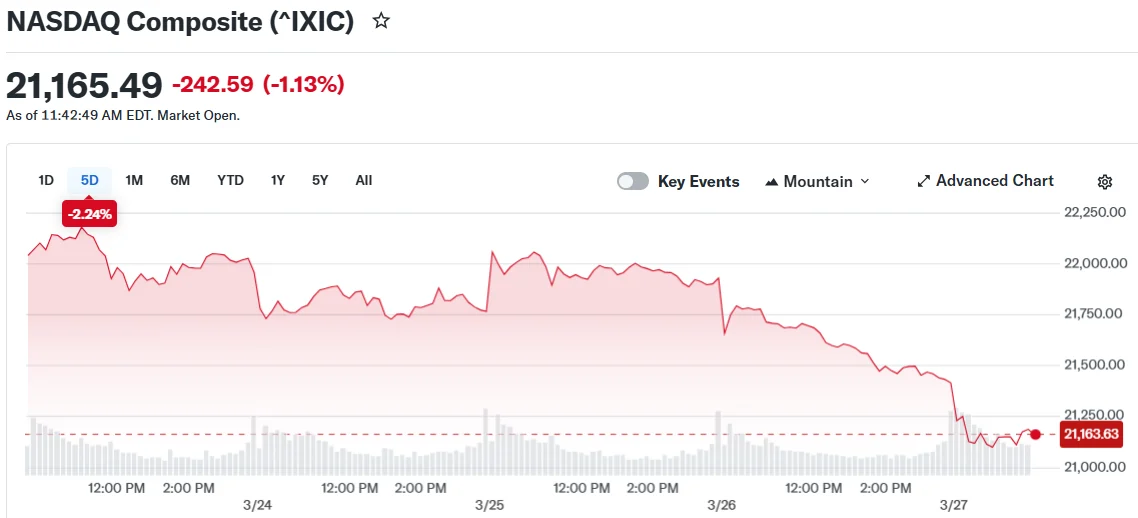
This downturn represents the index’s steepest slide since April 2025, when President Trump’s “Liberation Day” tariff declaration triggered widespread global market declines.
The Nasdaq has fallen nearly 8% year-to-date in 2026 and currently trades at levels last observed in early September 2025.
Ongoing uncertainty surrounding the military engagement between the U.S., Israel, and Iran serves as the primary catalyst for the market retreat. Market participants remain unclear about the conflict’s duration and its potential ramifications for worldwide economic stability.
A survey conducted among Seeking Alpha community members revealed that most participants anticipate the military operation will extend for up to three months. White House officials have projected a four-to-six week duration. This divergence in expectations contributes to heightened market anxiety.
Energy costs are experiencing rapid acceleration. The national average for gasoline has climbed to $3.98 per gallon, representing a full dollar increase within just thirty days. Seasonal demand patterns suggest additional price increases as the spring season approaches.
Market analysts indicate this energy price shock could generate two potential outcomes: either pushing inflation metrics higher, or suppressing consumer spending sufficiently to trigger economic deceleration. Which scenario unfolds depends largely on the conflict’s timeline.
Technology Sector Bears the Brunt
Technology equities have suffered particularly severe losses. Nvidia declined 4.2%, Alphabet fell 3.4%, and Tesla retreated 3.6%. The Roundhill Magnificent Seven ETF dropped 3.3% and has now declined 17% from the Nasdaq’s October high point.
Market participants are increasingly scrutinizing whether the substantial artificial intelligence expenditures by corporations such as Microsoft, Alphabet, and Amazon are generating returns quickly enough. Concerns center on whether extensive infrastructure investments have produced commensurate revenue expansion.
“There definitely has been an erosion in market enthusiasm since hostilities broke out,” said Steve Sosnick, market strategist at Interactive Brokers.
Meta Compounds Market Weakness
Meta Platforms emerged as one of Thursday’s most significant index detractors, tumbling 8%. Two separate court decisions determined Meta bears liability for causing harm to younger platform users, sparking concerns the company may face mandatory restructuring of its advertising business model.
The widespread losses throughout Big Tech companies carry amplified consequences because these firms now represent substantial portions of both the Nasdaq and the S&P 500. Any significant retreat in these stocks creates disproportionate pressure on broader market indices.
Jim Carroll, senior wealth adviser at Ballast Rock Private Wealth, characterized the market’s oscillating movements as sufficient to “make people seasick.”
The Nasdaq experienced a nearly 23% decline from its 2024 peak before mounting a recovery that extended through October 2025. Market observers are now monitoring whether this current correction will trace a comparable recovery trajectory or potentially deepen further.



