
Key Takeaways
- Michael Wilson from Morgan Stanley believes the S&P 500 has reached its floor and further declines are improbable
- A “barbell” approach is recommended: combining cyclical exposure with quality growth names including the Magnificent 7
- Serena Tang identifies oil prices as the dominant force controlling market direction
- Morgan Stanley presents three potential oil trajectories: normalization ($80–$90), sustained pressure ($100–$110), or crisis levels ($150+)
- The 10-year Treasury yield reaching 4.50% represents a critical threshold that could pressure equity valuations
Morgan Stanley has delivered a message to investors: the S&P 500 appears to have established its low point — assuming oil prices remain contained.
Michael Wilson, the firm’s chief strategist, stated on Monday that he anticipates the S&P 500 will hold above recent lows. According to Wilson, the index is forming a solid foundation, creating opportunities for investors to increase positions in select equities.
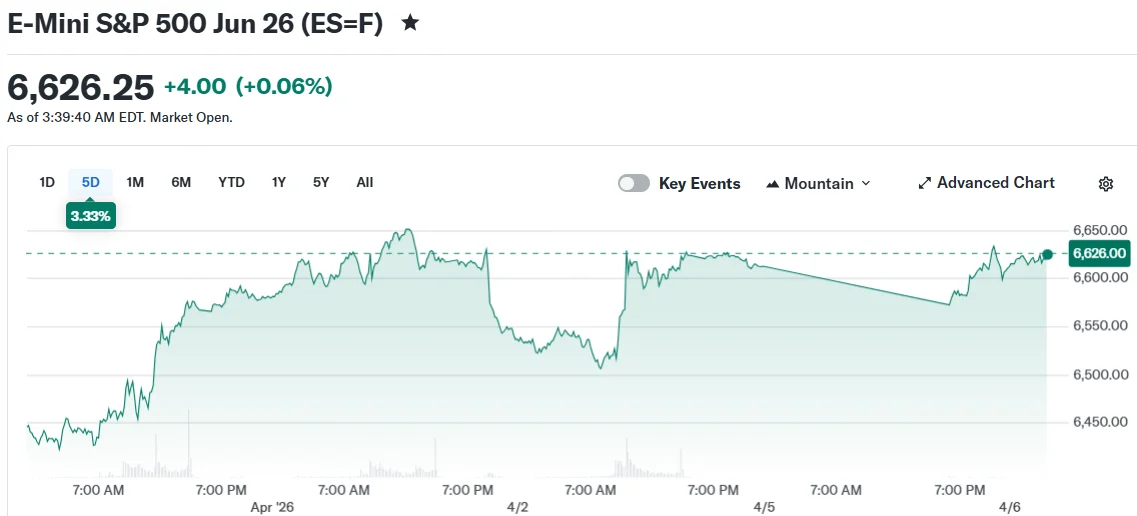
Wilson highlighted the index’s rebound from support zones he identified previously, specifically the 6,300–6,500 territory.
According to Wilson, the U.S. remains within a bull market cycle that commenced last April, preceded by what he characterizes as a “rolling recession” spanning from 2022 through 2025.
The forward price-to-earnings ratio for the S&P 500 has contracted 18% from its high over the last six months. Wilson noted that such valuation compression typically occurs only during economic recessions or aggressive Federal Reserve tightening — scenarios Morgan Stanley considers unlikely.
Morgan Stanley’s Investment Strategy Recommendations
Wilson advocates for a barbell positioning strategy. One end features cyclical exposures across Financials, Consumer Discretionary, and short-cycle Industrial companies. The opposite end emphasizes quality growth stocks, particularly hyperscaler technology firms.
The Magnificent 7 currently commands approximately 24x forward earnings — comparable to Consumer Staples at 22x — while delivering earnings growth exceeding three times that sector. Wilson indicated the group sits at the 2nd percentile of its valuation band since 2023.
He identified 4.50% on the 10-year Treasury as a critical marker. Historical patterns show yield movements beyond this point typically weigh on equity multiples.
Hard economic indicators are beginning to validate the recovery thesis. March’s ISM Manufacturing PMI registered 52.7, surpassing expectations, while U.S. hotel revenue per available room climbed 8% during the previous six months.
Oil Prices Emerge as Primary Market Catalyst
In parallel commentary, Serena Tang, Morgan Stanley’s Chief Cross-Asset Strategist, identified oil as the dominant factor influencing markets — determining how investors interpret growth prospects, inflation trends, monetary policy, and risk appetite.
Tang presented three distinct pathways. The first involves de-escalation, with oil settling between $80–$90 per barrel. This environment favors equities over bonds, drives yields lower, and allows cyclical sectors to lead. Tang characterizes this as a “classic risk-on environment.”
The second scenario places oil in the $100–$110 range. Markets could digest this level, though with increased volatility. The S&P 500 would likely trade within a broader band, companies with robust balance sheets would gain favor, and credit markets would face headwinds.
The most extreme scenario — oil exceeding $150 — would trigger a recession-oriented response from investors, according to Tang. Capital would flow toward government bonds, cash positions, and defensive sectors.
Goldman Sachs has characterized the ongoing Strait of Hormuz disruption as “the largest supply shock in the history of the global crude market” and cautioned that sustained elevated prices could compel central banks to postpone rate reductions.
Tang emphasized that during oil shocks, equities and bonds can decline simultaneously, undermining the protective qualities of traditional 60/40 portfolio allocations. The past month witnessed equity valuations decline roughly 15% measured by forward price-to-earnings ratios.



