
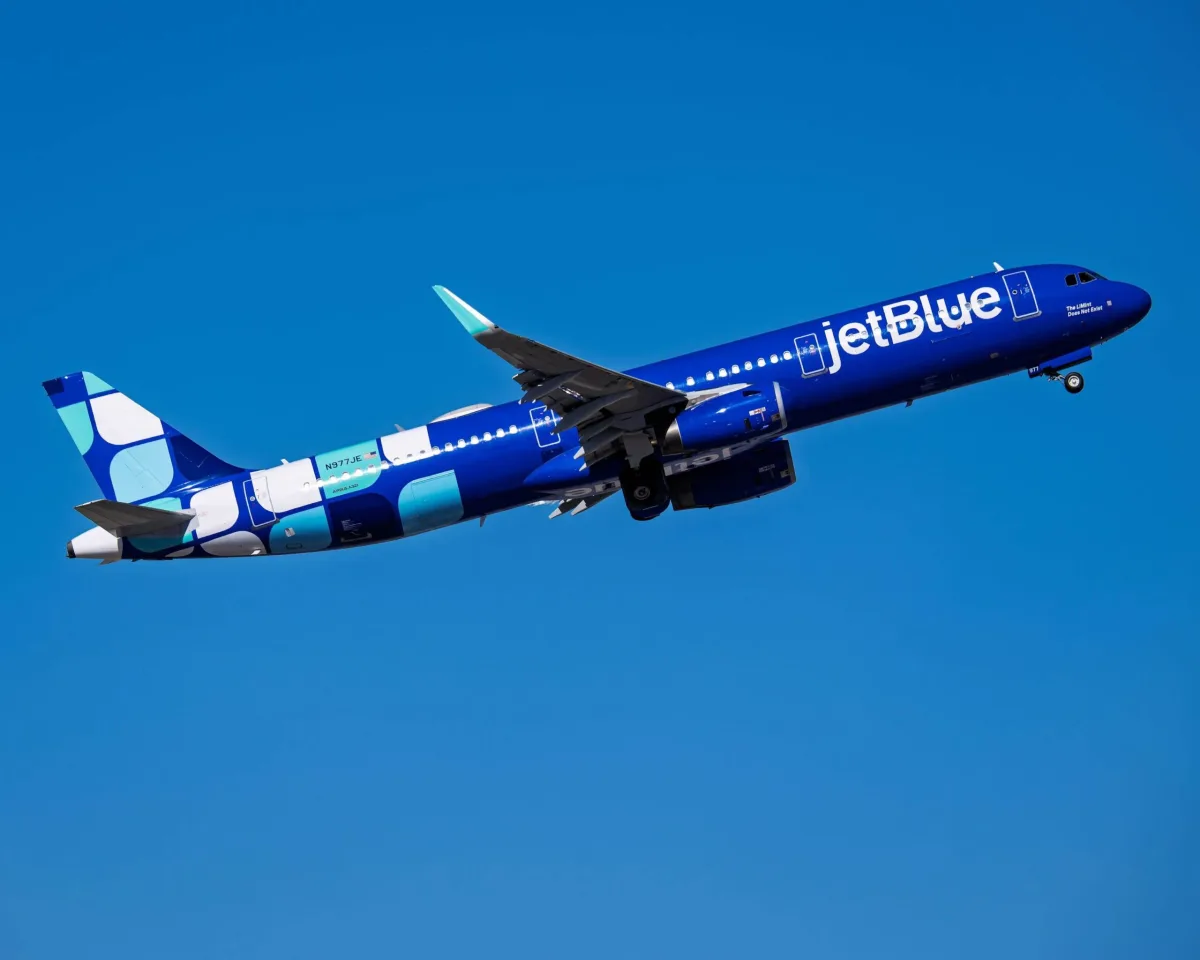
Key Highlights
- Shares of JetBlue Airways climbed more than 15% to $4.88 following a Semafor report about potential acquisition talks
- The carrier has engaged financial advisers to examine the possibility of selling to competitors such as United Airlines, Alaska Air, or Southwest
- JetBlue has conducted preliminary assessments of how antitrust authorities might view different merger configurations
- The airline’s market capitalization stood at approximately $1.55 billion at the close of trading on Tuesday
- Company leadership maintains commitment to the JetForward plan, designed to generate $850–$950 million in additional operating profit by 2027
Shares of JetBlue Airways (JBLU) reached $4.88, climbing more than 15%, in response to the published report.
JetBlue Airways Corporation, JBLU
JetBlue Airways (JBLU) experienced a substantial stock price increase exceeding 15% on Wednesday following publication of a report indicating the airline is examining the possibility of being acquired by a competing carrier.
According to Semafor, which cited sources with knowledge of the situation, JetBlue has engaged financial advisers to evaluate whether a sale would be feasible. The airline has declined to verify the report’s accuracy.
The stock price advanced to $4.88, representing a significant movement for an airline that has faced operational challenges in recent years. Shares of the potential acquiring companies — United Airlines (UAL), Alaska Air (ALK), and Southwest Airlines (LUV) — showed minimal reaction to the news, registering small increases that were already underway before the report’s publication.
JetBlue has conducted detailed analyses of how federal antitrust regulators might evaluate each possible merger scenario. This type of advance regulatory planning indicates the airline is taking a systematic approach, though no transaction appears close to completion.
The Semafor report indicates JetBlue remains in exploratory phases and may ultimately choose to forgo discussions with any of the airlines mentioned. No expressions of interest or official negotiations have been confirmed.
An Airline Facing Headwinds
The financial data paints a challenging picture. JetBlue has failed to record an annual net profit since 2019. The company has experienced revenue declines for two consecutive fiscal years. Share prices have fallen more than 75% from the five-year peak closing price of $21.25, reached on April 6, 2021.
With a market valuation hovering around $1.55 billion as of Tuesday’s market close, JetBlue represents a considerably smaller entity than it was at its height — and substantially smaller than the airlines that might consider acquiring it.
The carrier has previously pursued expansion through collaborative agreements and industry consolidation. Last year, JetBlue established a partnership with United Airlines enabling passengers to make reservations through either carrier’s platform, accumulate and use rewards points across both frequent flyer programs, and granting United access to JetBlue’s terminal slots at JFK beginning in 2027.
Prior to that arrangement, JetBlue pursued a $3.8 billion combination with Spirit Airlines. A federal judge prohibited the transaction in January 2024, determining it would “substantially lessen competition.” Spirit subsequently entered bankruptcy proceedings in August of that year.
Company Response
JetBlue chose against providing direct commentary on the acquisition speculation. In an official statement, the company referenced its current JetForward initiative — a comprehensive plan designed to reduce expenses, broaden route offerings, and enhance service quality for travelers.
Earlier this month, airline executives indicated JetForward remains positioned to produce $850 to $950 million in additional operating profit by 2027.
“We’re confident JetForward is the right strategy to restore profitability and create value for our shareholders,” the company said.
United Airlines and Southwest Airlines similarly declined to provide statements. Alaska Air has yet to respond to media inquiries.
Reuters indicated it was unable to independently verify the details contained in the Semafor report.



