
Key Highlights
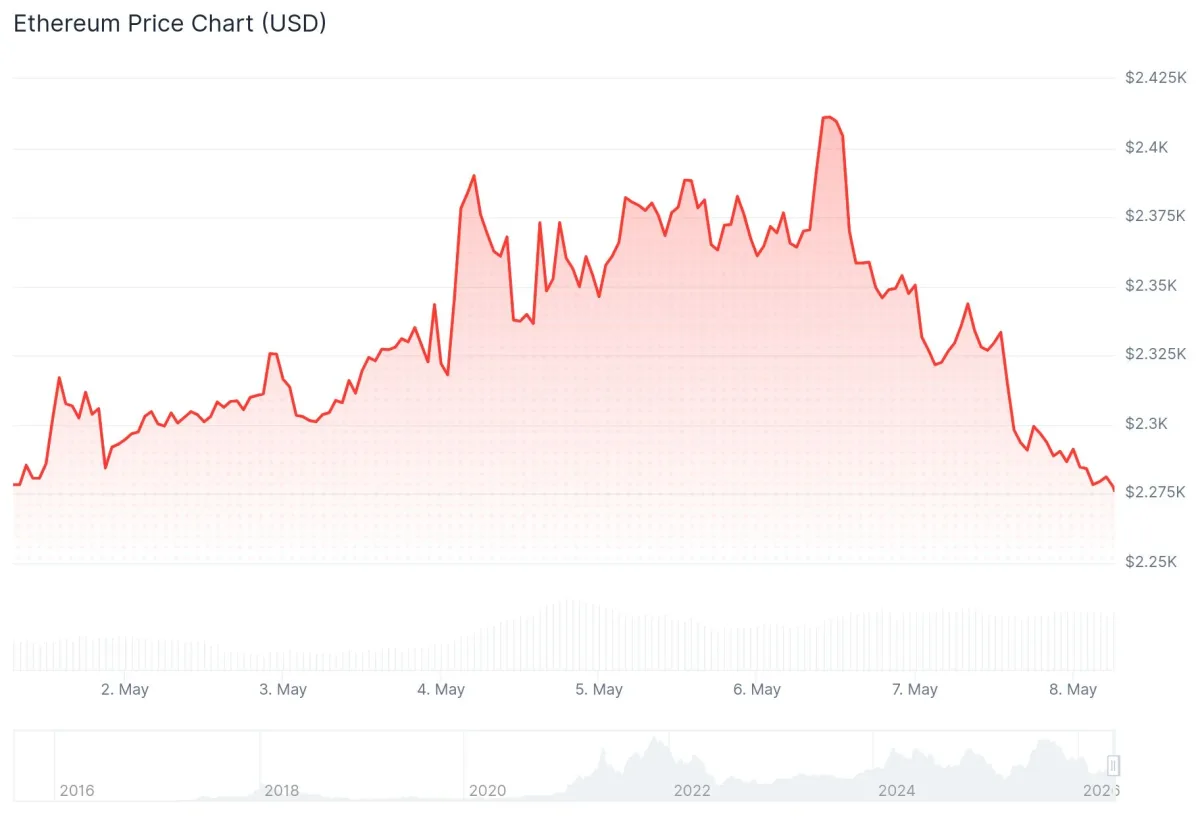
- ETH declined approximately 3%, currently trading between $2,280 and $2,293
- Major holders transferred more than 63,000 ETH to Binance exchange
- Whale accumulation declined 21.5% from October 2025 highs
- Open interest surged to 14.85M ETH amid growing short activity
- Ted Pillows highlights subdued spot buying as key pressure point for ETH
Ethereum has experienced a decline of nearly 3% over the last 24 hours, currently trading near $2,280. This downward movement coincides with substantial transfers from large holders to centralized exchanges, typically signaling potential liquidation activity.
Blockchain monitoring platform Lookonchain identified that a wallet associated with Metalpha, a digital asset management firm, transferred 27,000 ETH valued at approximately $62.78 million to Binance. Another significant wallet moved an additional 14,062 ETH, representing $32.82 million, to the platform during the same period.
Whales/Institutions are dumping $ETH!
Wallets linked to Metalpha deposited 27,000 $ETH($62.78M) into #Binance in the past hour.
Whale 0x8Ad4 deposited 14,062 $ETH($32.82M) into #Binance an hour ago.https://t.co/imWchYKdyMhttps://t.co/pwiAq47Asu pic.twitter.com/gWzMT1vgdA
— Lookonchain (@lookonchain) May 7, 2026
These transactions came after Bitcoin veteran Garrett Jin deposited 166,000 ETH to Binance on Wednesday, totaling around $396 million. This succession of substantial exchange inflows has intensified worries about mounting selling momentum.
Market observer Ali Martinez highlighted a broader trend in whale accumulation patterns. Addresses containing 1,000 to 10,000 ETH grew from 12.95 million coins in April 2025, reaching a high of 15.95 million by October 6, 2025. However, these holdings have since contracted to approximately 12.52 million ETH — representing a 21.5% reduction.
Ethereum whales are doing something they haven't done in a year.
Since October 6, 2025, Ethereum whales holding 1,000 to 10,000 $ETH have undergone a significant regime change in their market behavior.
Before this shift, this cohort was in a steady accumulation regime. Their… https://t.co/5WAJSKsnl9 pic.twitter.com/qezrxfq6Re
— Ali Charts (@alicharts) May 7, 2026
Martinez suggested Ethereum requires a “fresh wave of institutional or retail demand” to push toward the $3,000 threshold.
Bearish Momentum Builds in Derivatives Markets
Futures market indicators reveal growing pessimism. Open interest expanded to 14.85 million ETH — the highest level recorded since July of the previous year — while prices continued declining. This pattern, combined with negative funding rates, indicates accelerating short position accumulation.
The 30-day moving average for Ethereum’s Net Taker Volume approaches negative territory, signaling that short traders are gaining dominance in futures trading. Additionally, ETH saw $96.3 million in liquidations during the past day, with long positions accounting for $89.1 million of those forced closures.
Market analyst Ted Pillows shared on X: “$ETH tried to hold above the $2,400 level again but failed. Spot demand is very weak, which is pushing Ethereum lower. Until that changes, ETH will continue to underperform the market.”
$ETH tried to hold above the $2,400 level again but failed.
Spot demand is very weak, which is pushing Ethereum lower.
Until that changes, ETH will continue to underperform the market. pic.twitter.com/AgG76lPjoP
— Ted (@TedPillows) May 7, 2026
Critical Support and Resistance Zones
Technically, Ethereum maintains a position above the 50-day EMA at $2,262 while facing resistance from the 100-day EMA at $2,349. The RSI indicator hovers slightly beneath 50, with the Stochastic Oscillator declining toward the 30 level.
A breakdown below $2,262 would expose support zones at $2,211, followed by $2,107. For upward movement, clearing $2,388 becomes essential to unlock potential toward $2,746.
The $2,300–$2,500 price range has served as a distribution area throughout the past month, with smaller holders offloading approximately 1.5 million ETH during the most recent two-week period.