
Key Highlights
- Ethereum retreated 6% following a brief spike to $2,200, pressured by US equity weakness and Middle East tensions
- Options market skew climbed to 7%, indicating professional traders are positioning for potential downside
- US spot Ethereum ETFs experienced net outflows totaling $91 million on March 5
- The validator entry queue expanded to 3.4 million ETH while the exit queue declined to 58,944 ETH
- Ethereum commands 65% of blockchain TVL across all layers, with $55.4B locked on the base layer
Ethereum is currently trading near $2,080 following a rejection at the $2,200 level earlier this week. Global market anxiety intensified due to escalating Iran tensions and a US court decision mandating over $130 billion in tariff refunds to businesses.
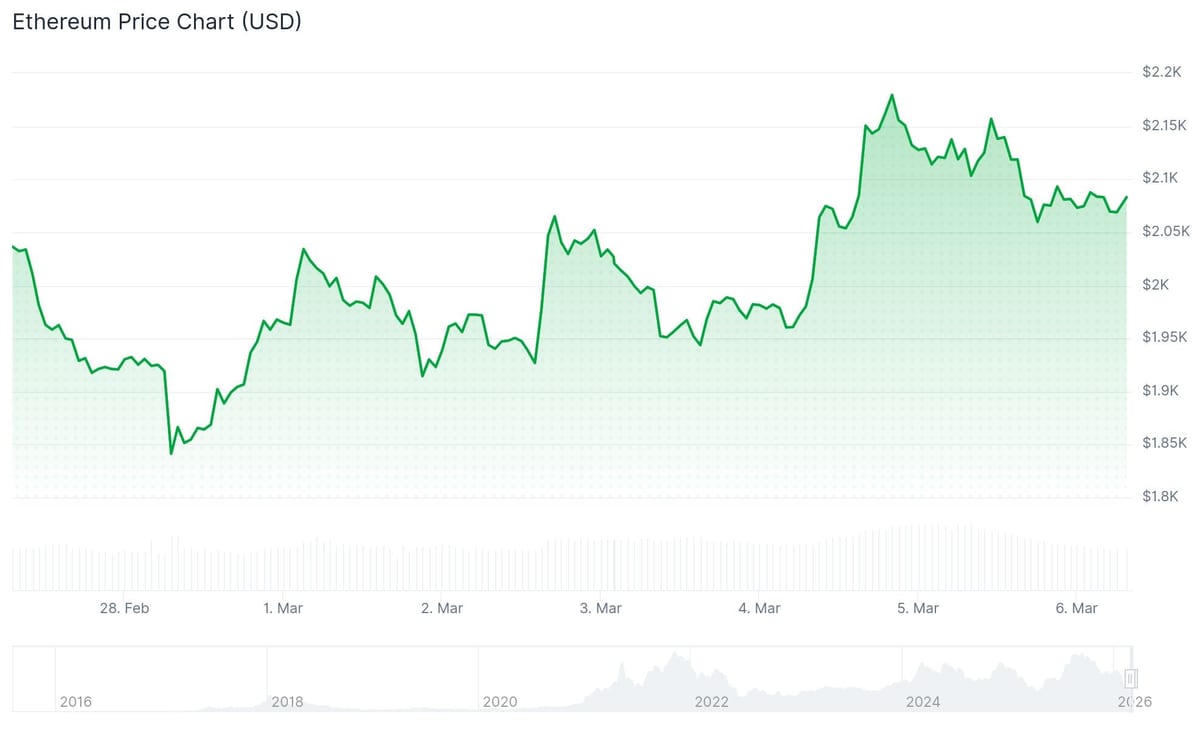
The asset had climbed 22% from February’s $1,800 low before encountering resistance. Wednesday’s attempt to breach $2,200 resulted in a 6% pullback, matching the decline observed across US equity markets.
Ethereum’s 30-day futures annualized premium remains significantly below the 5% neutral benchmark. This reading points to limited appetite for leveraged long positions among market participants.
The options market reveals additional caution. ETH’s put-call skew reached 7% on Thursday. Readings above 6% generally indicate that sophisticated market participants are purchasing downside protection.
Liquidations totaled $58 million over a 24-hour period, with long positions accounting for $35.7 million of that figure, per CoinGlass tracking data.
Institutional Flows and Validator Trends
ETF activity mirrored the price weakness. March 5 saw US spot Ethereum ETFs register combined net outflows of $91 million, marking a retreat in institutional demand for that trading session.
On March 5 Eastern Time, Bitcoin spot ETFs recorded a total net outflow of $228 million. Ethereum spot ETFs recorded a total net outflow of $90.9365 million. https://t.co/Hj2Gs49bWa pic.twitter.com/U9ROciWqe9
— Wu Blockchain (@WuBlockchain) March 6, 2026
This represented a sharp reversal from earlier in the week when inflows were stronger, highlighting how rapidly sentiment adjusts alongside broader market dynamics.
Meanwhile, the validator entry queue presents a contrasting picture. The queue expanded to approximately 3.4 million ETH, while validators waiting to exit dropped to merely 58,944 ETH. Current wait times for new validators have extended to 57 days.
This pattern indicates that significant ETH holders are choosing to stake their assets for yield generation rather than liquidating positions during market turbulence.
On-Chain Metrics and Value Locked
Ethereum’s weekly DEX trading volume decreased to $12.6 billion, down from $20.2 billion recorded one month prior. DApp revenue generation fell to $14.1 million over the seven-day period, representing a 47% month-over-month decline.
Solana experienced comparable trends, with DEX volumes contracting by 50% across the same 30-day timeframe.
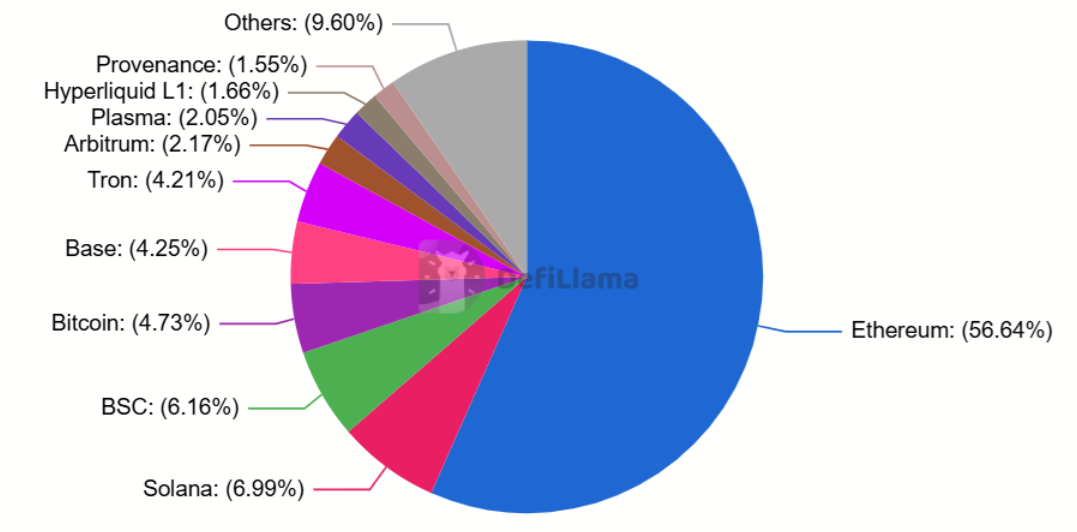
Despite reduced on-chain activity metrics, Ethereum maintains its dominant position in total value locked. When layer-2 solutions are included, the Ethereum ecosystem captures approximately 65% of all blockchain TVL. The base layer independently secures $55.4 billion, while Solana holds $6.8 billion.
Immediate resistance appears at $2,108 on daily timeframes. Breaking above this threshold could establish a pathway toward $2,388. Should the $1,741 support level fail, subsequent targets emerge at $1,524 and $1,404.
Technical analysts identify $1,826 as the lower support boundary within the current trading range, representing the next likely destination if selling momentum intensifies.