Key Highlights
- Bitcoin surged past $72,000, marking its highest level since the February 5 market decline, with a 5.9% increase over 24 hours
- Major altcoins including Ether, Dogecoin, Solana, XRP, and BNB recorded gains ranging from 3% to 7.5% as market confidence improved
- U.S. spot Bitcoin ETFs attracted approximately $700 million in capital inflows during early March
- U.S. equity futures showed weakness Thursday morning following Wednesday’s positive session, with Dow futures declining 0.3%
- Iran initiated discussions with Trump regarding potential ceasefire arrangements, while crude oil prices stabilized near $76 per barrel
Bitcoin crossed the $72,000 threshold on Thursday, achieving this milestone for the first time since the February 5 market correction. During Asian afternoon trading, the leading cryptocurrency reached $72,180, representing a 5.9% gain over the previous 24-hour period.
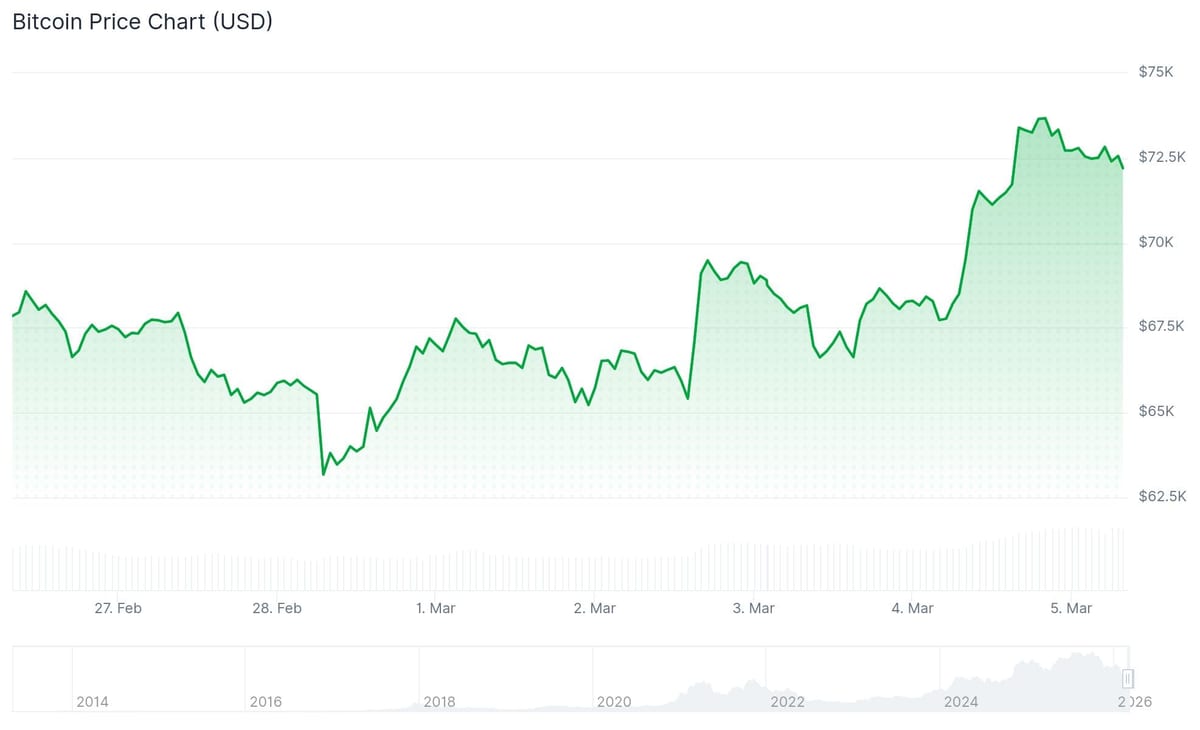
This upward movement coincided with a notable shift in global market sentiment. Asian stock markets experienced robust gains, with South Korea’s primary index surging 11% after experiencing its largest single-day decline in history.
The wider cryptocurrency ecosystem mirrored this positive momentum. Ethereum advanced 7.5% to reach $2,114, successfully recapturing the $2,000 threshold for the first time since February’s closing days.
Dogecoin increased 7.5% to $0.095. Solana posted gains of 5.3% to $89.91. XRP advanced 4.2% to $1.41, while BNB climbed 3% to $650. WhiteBIT Coin jumped 5.6%. Tron showed the most modest performance, rising 1.4%.
Institutional investment flows provided additional momentum. U.S. spot Bitcoin ETFs have absorbed approximately $700 million in capital since March began.
Geopolitical Tensions Show Signs of Cooling
The Iran-Israel confrontation, now entering its sixth day, has served as the primary catalyst for market fluctuations throughout the week. However, market participants have begun adapting to the situation.
The Strait of Hormuz conditions appear to be moving toward stability. Trump announced plans for the U.S. to provide risk insurance and naval protection for vessels traversing the strategic waterway.
BREAKING: Brent oil prices surge above $82.50/barrel with gas prices now up nearly +20% since January.
Keep watching oil prices as a leading indicator for a potential "deal" or market intervention.
The world simply cannot afford oil prices rising toward $100/barrel. pic.twitter.com/MEOXt0z4Iu
— The Kobeissi Letter (@KobeissiLetter) March 5, 2026
Oil prices found equilibrium following substantial gains earlier in the week. West Texas Intermediate futures held steady around $76 per barrel, while Brent crude maintained levels above $82.
According to The New York Times, Iranian officials have initiated contact with Trump to explore ceasefire possibilities. Defense Secretary Pete Hegseth indicated that military activities could extend between three and eight weeks.
U.S. and Israeli forces maintained their strikes against Iranian targets, including the destruction of an Iranian naval vessel in international waters. While the situation remains active, market participants are assigning lower probabilities to broader regional expansion.
Equity Futures Show Weakness
Wall Street experienced gains during Wednesday’s regular trading hours. The Dow ended its three-session decline, while both the S&P 500 and Nasdaq Composite finished positively.
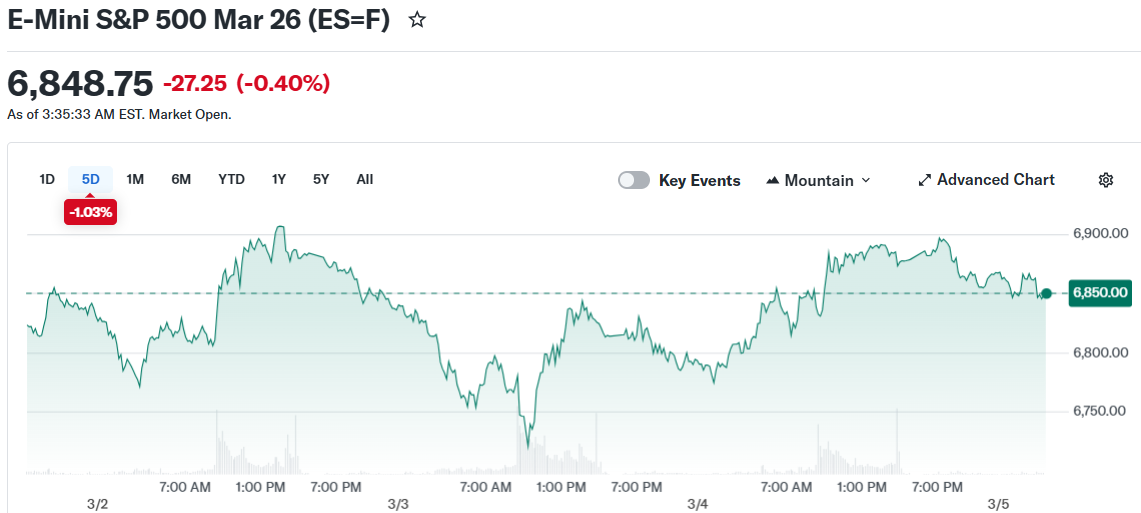
Thursday morning presented a contrasting picture. Dow futures decreased 0.3%, Nasdaq 100 futures fell approximately 0.2%, and S&P 500 futures declined 0.1%.
Economic indicators published earlier in the week helped alleviate inflation worries, contributing to Wednesday’s market recovery. Market participants are now focused on Friday’s monthly employment figures for additional insights into labor market conditions.
Corporate earnings season continues Thursday after market close, with Costco and Marvell Technology scheduled to release their quarterly results.
Iran’s diminished oil output, given its position as OPEC’s fourth-largest producer, continues to draw attention. Rising crude prices could influence Federal Reserve policy considerations regarding interest rates.