

TLDR
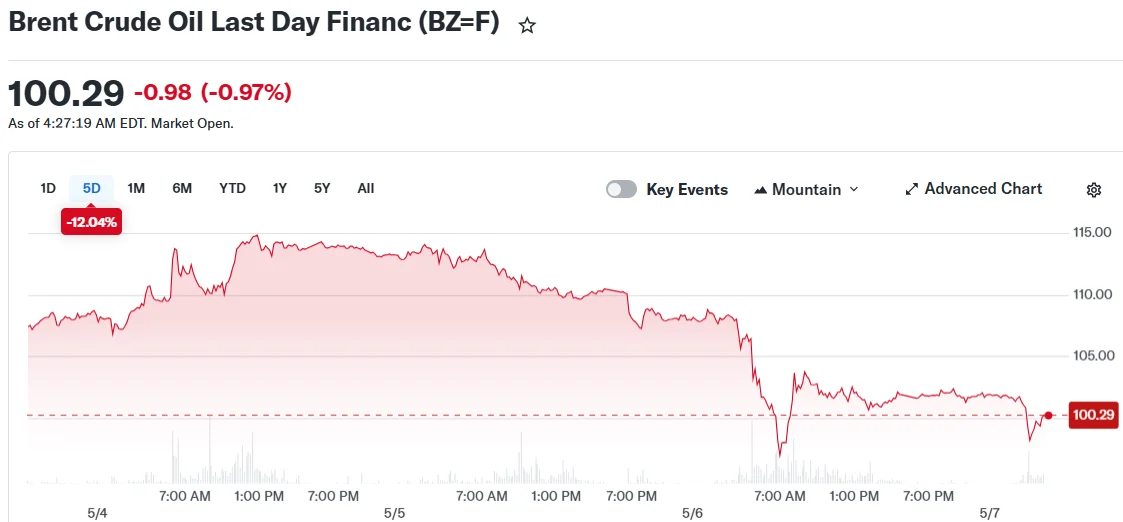
- Brent crude declined over 2% to $99.11 per barrel; WTI retreated to $93.08 during Thursday trading
- Wednesday’s session saw both benchmarks lose more than 7% amid diplomatic optimism
- Sources indicate Washington and Tehran are nearing agreement on a single-page memorandum to conclude hostilities
- The framework includes provisions for phased restoration of access to the Strait of Hormuz, a conduit for approximately 20% of worldwide petroleum commerce
- American crude stockpiles decreased by 2.3 million barrels, falling short of forecasted 3.4 million barrel reduction
Crude oil benchmarks continued their downward trajectory Thursday, building on significant declines from the previous session, as diplomatic momentum between Washington and Tehran raised expectations for restored access to a critical global petroleum transit route.
Brent crude decreased $2.16, representing roughly 2.1%, settling at $99.11 per barrel. US West Texas Intermediate declined $2 to reach $93.08. Wednesday’s trading had already delivered losses exceeding 7% for both benchmarks, marking their lowest levels in two weeks.
Market sentiment shifted primarily due to multiple reports indicating the United States and Iran are approaching consensus on a single-page memorandum of understanding designed to formally conclude the conflict.
Axios published details suggesting the White House anticipated Iran’s formal response within a 48-hour window. CNN reported Tehran would likely deliver its answer to the American proposal by Thursday. An Iranian foreign ministry representative verified that Iran would transmit its response through intermediary channels.
Saudi Arabia’s Al Arabiya additionally reported that both governments had achieved preliminary understandings regarding easing the American blockade of Iranian port facilities in return for phased restoration of Strait of Hormuz access. Reuters was unable to independently confirm this reporting.
BREAKING: President Trump releases a statement amid reports that a deal to end the Iran War is imminent.
"Assuming Iran agrees to give what has been agreed to… Epic Fury will be at an end." pic.twitter.com/5YnAkg1Y8a
— The Kobeissi Letter (@KobeissiLetter) May 6, 2026
The Strait of Hormuz represents one of the planet’s most strategically significant petroleum shipping corridors. Approximately one-fifth of worldwide oil commerce transits through this waterway. Any interruption or restoration of maritime traffic through this channel directly influences global supply dynamics and pricing.
Earlier this week, the United States suspended military operations aimed at restoring commercial shipping through the strait following forceful Iranian responses.
Diplomatic Developments Shape Market Sentiment
Markets have demonstrated volatile reactions to each development emerging from the negotiations. Priyanka Sachdeva, senior market analyst at Phillip Nova, noted that crude markets have experienced a state of “being caught between diplomacy and disruption for over two months.”
Sachdeva indicated that a formal agreement could trigger sharp declines in oil prices as geopolitical risk premiums evaporate from market calculations.
ING analysts suggested that an accord restoring Hormuz maritime traffic would diminish supply-risk premiums, though any postponement could rapidly elevate prices once again.
US Treasury Secretary Scott Bessent appealed to China this week to encourage Iran toward reopening the strait. He confirmed that President Trump and Chinese President Xi Jinping would address the matter during their scheduled meeting next week.
Hiroyuki Kikukawa of Nissan Securities Investment projected that peace negotiations would likely persist at minimum until the US-China summit, though the trajectory beyond that gathering remains uncertain.
Inventory Data Provides Modest Price Support
Weekly American petroleum inventory figures released by the Energy Information Administration provided modest upward pressure on prices. Crude reserves declined by 2.3 million barrels during the week concluding May 1, reaching 457.2 million barrels.
Market analysts had projected a more substantial drawdown of 3.4 million barrels, so the smaller-than-anticipated decrease limited any potential price rebound.
Gasoline reserves dropped by 2.5 million barrels. Distillate inventories, encompassing diesel fuel and heating oil, decreased by 1.3 million barrels.
The EIA report additionally highlighted robust US petroleum exports, signaling sustained demand for American supplies while Middle Eastern energy flows face ongoing disruptions.
Iran indicated Wednesday that it was examining the American proposal, which sources characterized as formally ending the war while leaving several key American demands unaddressed, including Iran’s suspension of its nuclear program.



