

Key Takeaways
- Brent crude temporarily dropped below $100 per barrel with losses exceeding 5% during Wednesday’s session
- President Trump announced a potential US withdrawal from Iran within two to three weeks
- Crude prices remain approximately 40% above pre-conflict levels from late February
- The Strait of Hormuz continues to experience severe shipping disruptions, affecting one-fifth of global oil transport
- American crude stockpiles increased by 10.26 million barrels last week, significantly exceeding analyst forecasts
Global petroleum markets experienced substantial volatility on Wednesday following President Donald Trump’s indication that American forces could complete their withdrawal from Iran within several weeks. The announcement triggered Brent crude’s first drop below the $100-per-barrel threshold since hostilities commenced.
Brent crude prices declined more than 5% during the session’s lowest point before staging a partial rebound. Trading concluded near $102.25 per barrel. Prior to the conflict’s outbreak in late February, Brent had been valued around $70 per barrel.
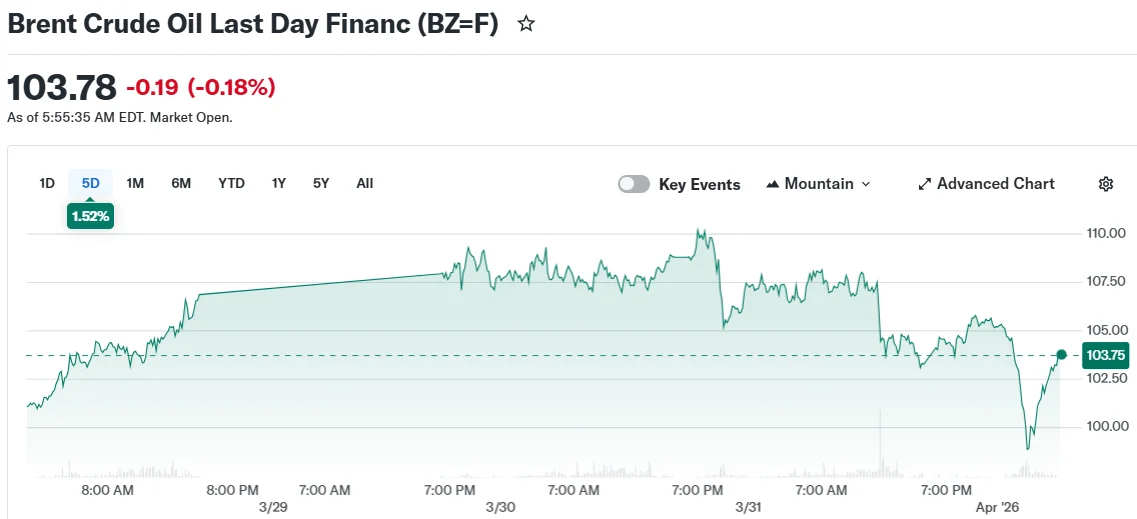
US West Texas Intermediate crude similarly declined, falling 2.4% to reach $98.92 per barrel.
Speaking to reporters at the White House, Trump stated that American forces could depart Iran within “two to three weeks.” He added that Iran does not require a formal agreement for the conflict to conclude.
NOW – Trump says the U.S. will leave the Iran War in 2 or 3 weeks. pic.twitter.com/p0j83neowV
— Disclose.tv (@disclosetv) March 31, 2026
Iran’s president suggested the nation possesses the “necessary will” to conclude hostilities provided it receives assurances against future attacks. Iranian Foreign Minister Abbas Araghchi acknowledged ongoing message exchanges with the US while clarifying that formal negotiations have yet to commence.
The White House scheduled a presidential address for Wednesday evening at 9 p.m. Eastern time, described as an “important update on Iran.”
Despite de-escalation discussions, military actions persisted throughout Wednesday. An oil tanker sustained damage near Qatar, igniting a fire that crews subsequently extinguished. Authorities reported no environmental contamination.
Factors Sustaining Elevated Crude Valuations
Oil prices remain elevated approximately 40% above their pre-March levels. The Strait of Hormuz, a critical passage for roughly one-fifth of global petroleum shipments, has experienced near-total tanker traffic cessation due to Iranian attack concerns.
The International Energy Agency characterized the disruption as the largest supply shock in recorded history. Fuel prices in certain markets have exceeded $200 per barrel. American gasoline prices surpassed $4 per gallon this week, marking the first occurrence since August 2022.
Market analysts caution that even partial restoration of strait operations could require considerable time. Trump has indicated that US allies would need to participate in securing the waterway. The Wall Street Journal documented the United Arab Emirates’ advocacy for Western and Asian nations to establish a coalition for forcible reopening.
China and Pakistan released a joint statement Tuesday calling for immediate cessation of hostilities and restoration of secure maritime commerce.
Inventory Data Suggests Demand Softening
Recent figures from the American Petroleum Institute revealed US crude stockpiles grew by 10.26 million barrels during the previous week. This increase substantially exceeded analyst expectations of a 1.3 million barrel decline.
API chief Mike Sommers identified reopening the Strait of Hormuz as “the critical piece” for stabilizing global markets, cautioning that prices would continue climbing without restored flow.
A third US aircraft carrier strike group is currently en route to the Middle East, maintaining the potential for further military escalation.



