Key Takeaways
- BTC climbed past $72,000 following Israeli Prime Minister Netanyahu’s announcement of Lebanon ceasefire discussions
- Bitcoin has gained 9% in the last 30 days, contrasting with the iShares Tech-Software ETF’s 12% decline
- The February PCE inflation reading matched expectations at 2.8% year-over-year
- Fourth quarter US GDP underwent downward revision to 0.5% annualized growth, intensifying recession worries
- Tomorrow’s March CPI release will provide the initial inflation snapshot following the outbreak of US-Iran tensions
Bitcoin crossed the $72,000 threshold on Thursday following encouraging developments in Middle East diplomacy. Prime Minister Benjamin Netanyahu of Israel directed his cabinet to pursue ceasefire discussions with Lebanon regarding Hezbollah’s disarmament. This development triggered a reversal in cryptocurrency markets, which had been trending downward earlier in the session.
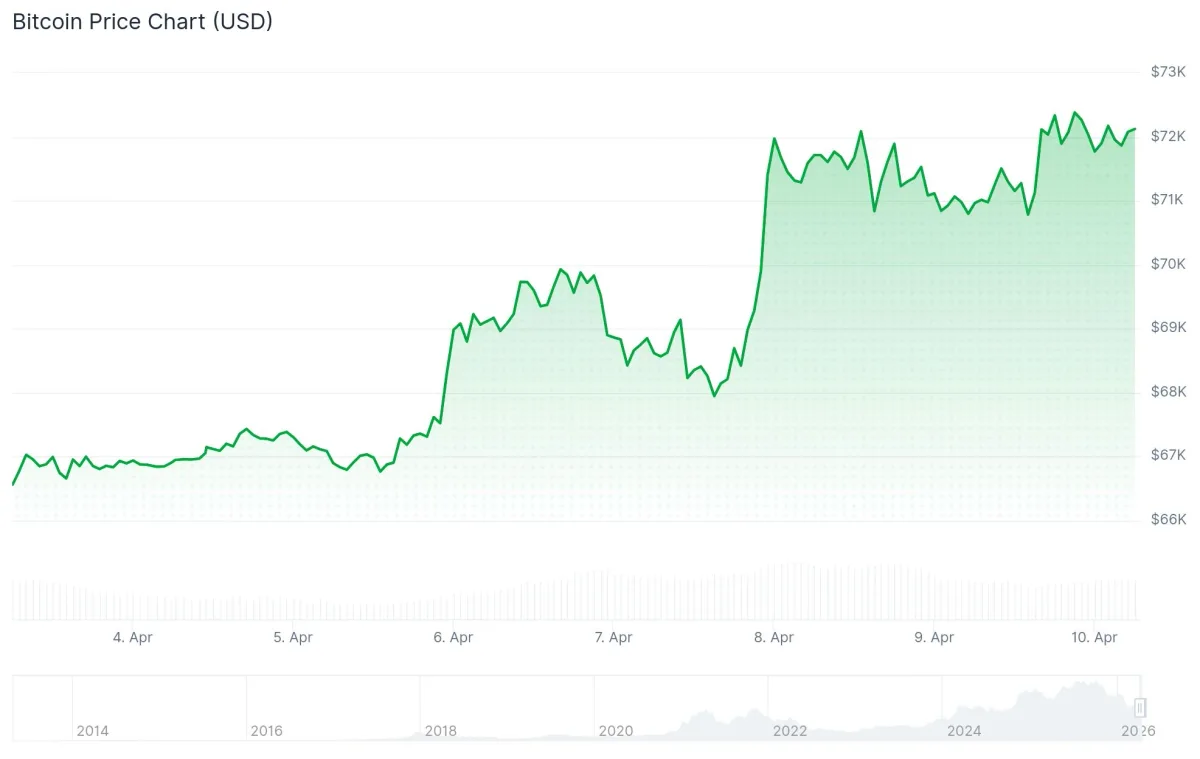
The leading cryptocurrency advanced approximately 3% following the announcement, touching $72,300. American equity markets experienced similar uplift, with the Nasdaq advancing 0.65%. WTI crude oil retreated from nearly $103 per barrel down to approximately $98.60 in response to the diplomatic news.
Bitcoin demonstrated superior performance compared to alternative digital assets throughout the trading session. Ethereum (ETH), Solana (SOL), and XRP each registered gains below 1%, while BTC maintained its advantage.
The Bureau of Economic Analysis released February PCE inflation figures earlier in the day, which aligned with analyst predictions. The report showed PCE increased 2.8% on a year-over-year basis, with core PCE moderating to 3%, compared to January’s 3.1% reading.
BREAKING: February PCE inflation, the Fed's preferred inflation measure, was unchanged at 2.8%, in-line expectations of 2.8%.
Core PCE inflation falls to 3.0%, in-line with expectations of 3.0%.
This marks the final pre-Iran War PCE inflation datapoint.
— The Kobeissi Letter (@KobeissiLetter) April 9, 2026
Bitcoin had already begun recovering prior to the ceasefire announcement, climbing from a session low of $70,500 to approximately $71,200 after the inflation data emerged.
Traders should recognize that February’s PCE data reflects the period preceding the late-February commencement of US-Iran hostilities. Market participants are looking toward more recent economic indicators to gauge the conflict’s impact on consumer prices.
Bitcoin Diverges From Technology Software Equities
Bitcoin and software company stocks have exhibited contrasting trajectories throughout the past 30 days. The iShares Expanded Tech-Software ETF (IGV) has declined 12% during this period, while BTC has appreciated 9%.
The 20-day correlation coefficient between Bitcoin and IGV has declined to 0.34, demonstrating a pronounced divergence in asset performance.
Federal Reserve Maintains Current Policy Amid Growing Recession Concerns
The fourth quarter US GDP figure received a downward adjustment to 0.5% on an annualized basis, signaling decelerating economic expansion. Despite this development, market participants reduced their risk aversion, partially driven by expectations that deteriorating growth could prompt governmental liquidity measures.
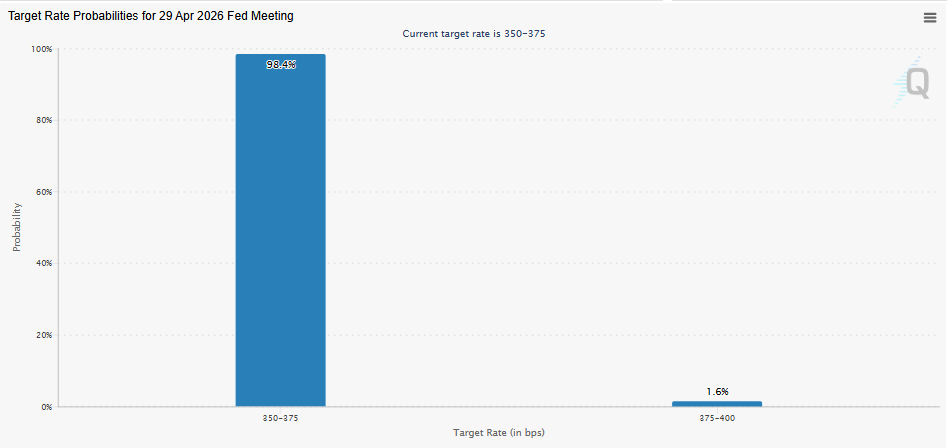
Wednesday’s FOMC minutes revealed that Federal Reserve policymakers continue to view rate reductions as possible this year, although the majority indicated openness to rate increases should inflation remain significantly above the 2% objective. CME FedWatch data indicates a 98.4% likelihood that the Federal Reserve maintains current rates at its April 29 policy meeting.
Dollar weakness has provided support for Bitcoin, as diminished confidence in the Federal Reserve’s inflation management typically benefits assets with limited supply.
Friday will bring March CPI data. Street consensus anticipates 3.3% year-over-year growth, up from February’s 2.4%, representing the initial inflation measurement following the beginning of US-Iran military engagement.