Key Points
- Bitcoin declined to $69,393 following attacks on two oil tankers in Iraqi waters that sent Brent crude above $100 per barrel.
- Iran announced a transition from “reciprocal hits” to “continuous strikes,” warning of potential $200 oil prices.
- The Strait of Hormuz continues blocking ships transporting oil to Israel and the US.
- On-chain metrics indicate apparent demand at -30,800 BTC over 30 days, while the bull-bear indicator remains in bearish territory.
- The upcoming Fed meeting on March 17-18 draws closer, with oil above $100 reducing the likelihood of rate cuts.
Bitcoin slipped below the $70,000 threshold on Thursday following attacks on two oil tankers in Iraqi waters that drove Brent crude back above the $100 per barrel mark.
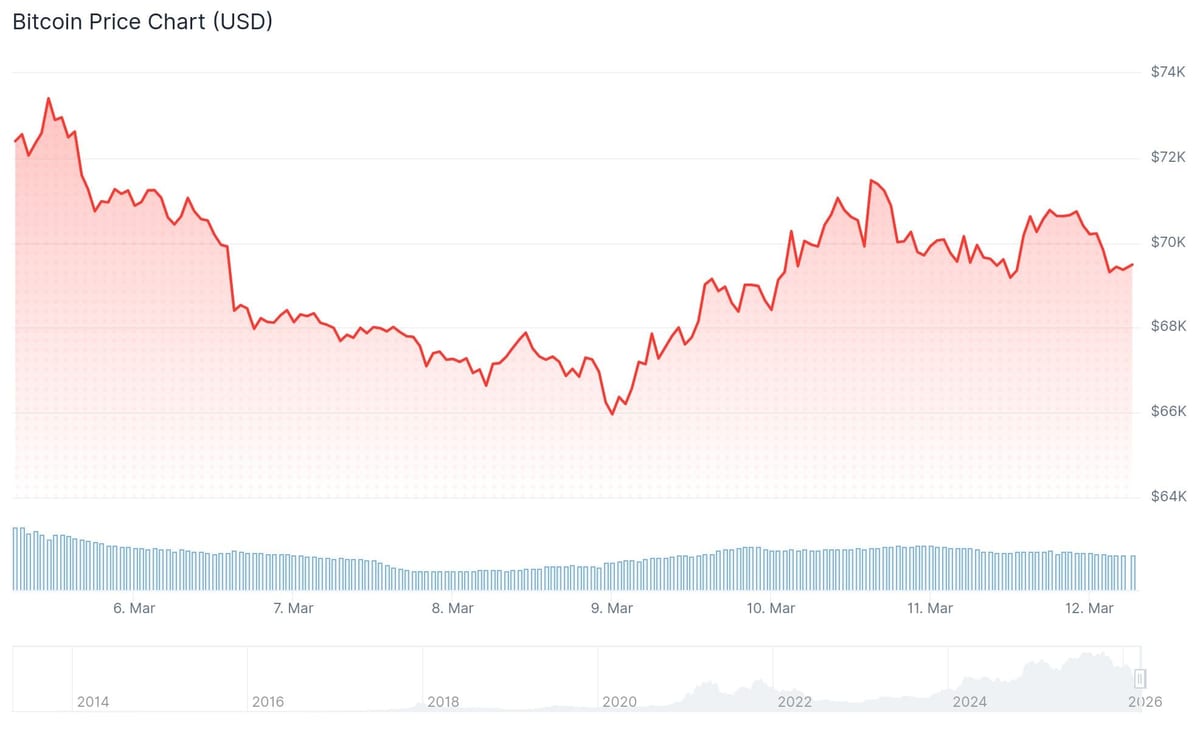
The leading cryptocurrency declined to $69,393, marking a 0.8% decrease over 24 hours and a 4.3% drop for the week. Late Wednesday evening, the price briefly reached $71,230 before tanker attack news emerged, wiping nearly $2,000 from its value within hours.
JUST IN: Massive fire breaks out on oil tanker in Persian Gulf following reported attack. pic.twitter.com/Ozx7LBKmJu
— BRICS News (@BRICSinfo) March 11, 2026
This marks the third occasion in two weeks where Bitcoin has climbed above $71,000 before Middle East conflict developments reversed its gains.
Brent crude surged as much as 10.5% on Thursday. The spike resulted from the tanker attacks, ongoing Persian Gulf hostilities, clearance of Oman’s Mina Al Fahal port, and skepticism surrounding the IEA reserve release’s ability to compensate for supply disruptions.
The IEA proposed releasing 400 million barrels from strategic reserves, though markets remain unconvinced about its adequacy.
Iran Announces Strategic Escalation
Iran’s Islamic Revolutionary Guard Corps declared a transition from “reciprocal hits” to “continuous strikes.” The nation also confirmed its ongoing blockade of ships transporting oil to Israel and the United States through the Strait of Hormuz.
Our most frequent question right now:
President Trump said the war is ending "very soon," and the IEA and the US are releasing 572 million barrels of oil reserves.
So, why are oil prices nearing $100/barrel again?
In the lead-up to Sunday night's historic $30+ rally in oil…
— The Kobeissi Letter (@KobeissiLetter) March 12, 2026
Iran has expressed intentions to drive crude oil prices to $200 per barrel.
President Trump stated this week the war would conclude “very soon” and military objectives were “pretty well complete.” Iran’s announcement directly contradicts that assessment.
Reports also suggest the US faces depleting interceptor supplies, potentially prolonging the conflict.
Cryptocurrency Market Response
The wider crypto market declined in tandem with Bitcoin. Ether fell to $2,025, down 0.5% daily and 4.5% weekly. Solana dropped 1.5% to $85, declining 5.7% over seven days.
$BTC has dropped below the $70,000 level.
This is due to Oil prices going up again, which shows the de-escalation is not happening yet.
If Bitcoin loses the $69,000-$70,000 support zone here, there's a decent chance of dump below the $66,000 zone. pic.twitter.com/z1sG2T8JGb
— Ted (@TedPillows) March 11, 2026
XRP decreased 0.8% to $1.37. Dogecoin shed 0.8% to $0.092, surrendering most of Tuesday’s Elon Musk-related gains. BNB held steady at $642.
MSCI’s Asia Pacific index dropped 1.8%, with energy standing as the sole sector recording gains.
On-chain analytics reveal apparent BTC demand at -30,800 BTC on a 30-day timeframe. CryptoQuant’s bull-bear indicator stays in bearish territory. Supply in loss continues climbing, while price bounces face selling pressure.
US inflation registered 2.4% headline and 2.5% core for February, both exceeding the Fed’s 2% target.
The Federal Reserve convenes March 17-18. With oil above $100 and inflation remaining elevated, rate cuts appear increasingly improbable in the immediate future.
Bitcoin’s technical analysis reveals a bearish flag pattern developing on the daily chart, with the asset positioned below its 50-day and 100-day EMAs while the Supertrend indicator displays red.