

TLDR
- Friday’s quadruple witching event will trigger simultaneous expiry of trillions in stock and index derivatives
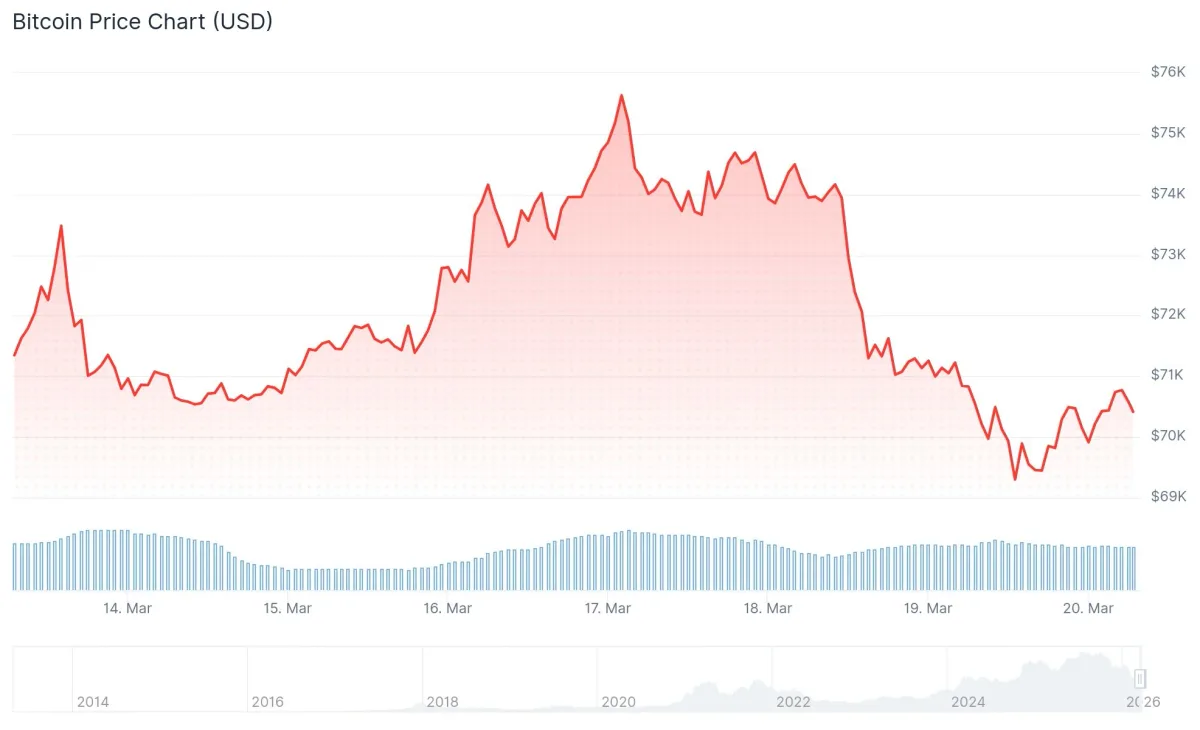
- Bitcoin slipped under $70,000 on Thursday, facing pressure at critical support zones
- Historical data shows quadruple witching days typically result in muted price action, with subsequent weakness emerging over following weeks
- Perpetual futures traders are leading the current market downturn rather than spot market participants
- Deribit will see $13.5 billion in crypto derivatives expire on March 27
Bitcoin traded below $70,000 on Thursday while global financial markets positioned themselves for a major quarterly derivatives settlement in traditional finance.
Quadruple witching occurs four times annually — each third Friday of March, June, September, and December. This phenomenon involves the concurrent expiration of stock index futures, stock index options, individual stock options, and individual stock futures.
🚨 QUADRUPLE WITCHING ARRIVES TOMORROW.
$4.7 TRILLION in derivatives expires.
What it means → 4 types of derivatives expire simultaneously. Trillions in positions get closed or rolled.
Why it matters → Volume surges. Prices can swing hard, especially in the final hour of…— Manpreet Kailon (@preetkailon) March 19, 2026
The magnitude of this quarterly event is substantial. March 2025 witnessed approximately $4.7 trillion in equity and index derivatives reaching expiration during a single trading session. That particular day generated the highest S&P 500 trading volume recorded throughout the entire year, data from TradeStation confirms.
March 2026 expiry statistics remain unreleased at this time.
These events compel institutional players to simultaneously close, extend, or settle their positions. Market activity typically intensifies, with price volatility frequently accelerating during the trading session’s final sixty minutes.
Cole Kennelly, CEO of Volmex Finance, indicated the event might create ripple effects across crypto markets. He stated “quadruple witching could trigger a spike in cross-asset volatility as large derivatives positions expire,” noting that the Bitcoin Volmex Implied Volatility index had already begun climbing ahead of the event.
Bitcoin’s Historical Performance During Witching Days
Examining 2025 data reveals that Bitcoin’s price movements on actual quadruple witching days remained relatively subdued. Significant declines materialized during subsequent days and weeks.
March 21, 2025 saw Bitcoin experience minor intraday losses before eventually bottoming near $76,000 following market reactions to President Trump’s “Liberation Day” tariff announcements. June 20 brought a 1.5% decline, followed by a local bottom near $98,000 just two trading days later.
September 19 witnessed Bitcoin falling over 1% before experiencing a sharp correction from $177,000 down to $108,000 throughout the following week. December 19 concluded with approximately 3% gains at $85,000, though the broader downtrend persisted.
This recurring pattern emerges clearly: limited movement during the event itself, followed by deteriorating price action over subsequent days or weeks.
Forces Behind Today’s Market Decline
Market data reveals that perpetual futures traders are primarily responsible for Bitcoin’s current decline rather than spot market buyers. The Coinbase premium gap shifted negative, indicating reduced demand from U.S. investors.
Crypto analyst IT Tech observed that spot selling decreased by approximately $40 million, while perpetual futures market selling reached a significantly higher $506.75 million. This data indicates leveraged traders are the primary drivers of the downward pressure.
Certain traders anticipate potential near-term rebounds. Should Bitcoin successfully recapture $70,000 rapidly, the subsequent target sits at $76,000. However, a breakdown below $68,300 would expose support levels at $65,000 and $62,000.
Bryan Tan of Wintermute proposed that “being flat is a strong position” under current conditions and advised maintaining cash reserves until the market establishes clearer directional momentum.
The broader financial landscape continues applying additional pressure. Oil prices have climbed toward $120 per barrel, the VIX volatility index surged above 35 last week — reaching its highest level in a year — and gold retreated below $4,600.
March 27 will bring a separate $13.5 billion crypto derivatives expiry on Deribit. Market positioning ahead of that event suggests traders favor volatility strategies over strong directional positions.



