



Key Takeaways
- Crude markets advanced approximately 0.3% Thursday with U.S.-Iran nuclear negotiations underway in Geneva
- Energy analysts at ING estimate an agreement could eliminate up to $10/barrel in geopolitical risk premium
- EIA data revealed a 16 million barrel surge in U.S. crude stocks, marking the steepest climb in almost three years
- OPEC+ members are likely to approve renewed production increases beginning in April during this weekend’s meeting
- Kazakh crude shipments and declining floating storage indicate improving physical market supply conditions
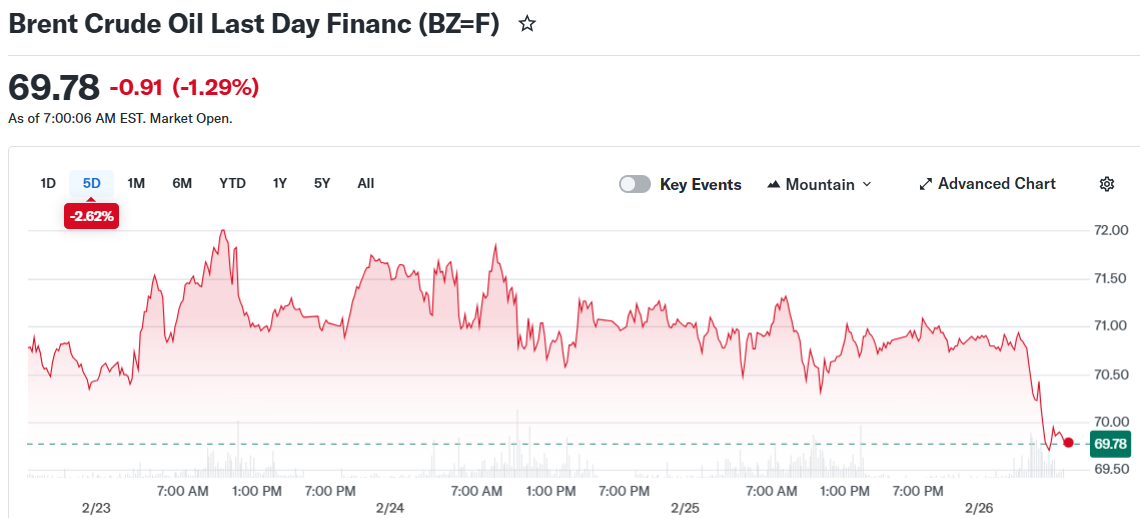
Crude markets experienced modest gains Thursday as market participants prepared for the third session of nuclear discussions between Washington and Tehran. Brent crude advanced 0.3% to approximately $71 per barrel, with WTI following suit to reach roughly $65.55.
Geneva serves as the venue for these diplomatic proceedings. U.S. special envoy Steve Witkoff and Jared Kushner have scheduled meetings with Iranian representatives to address concerns surrounding Tehran’s nuclear ambitions and ballistic missile capabilities.
Iranian Foreign Minister Abbas Araqchi expressed optimism that diplomatic channels could yield results if both nations approach discussions with genuine engagement. President Trump has indicated severe consequences may follow without substantial advancement in negotiations.
Trump established a 10-to-15-day deadline for reaching an agreement and maintained pressure on Tehran throughout his State of the Union remarks. Market analysts at Tradu observed that increased U.S. military presence in the Middle East maintains the possibility of armed confrontation.
Tehran represents a significant OPEC producer. Supply interruptions from Iranian fields, or blockages affecting traffic through the Strait of Hormuz, would likely trigger substantial upward price movements.
Analysts at ING projected that successful negotiations could lead to a gradual reduction of up to $10 per barrel in geopolitical risk premium currently embedded in market pricing. Should discussions collapse, upside risk remains present, though markets may adopt a wait-and-see approach regarding the extent of U.S. military action.
Abundant Supply Conditions Create Downward Pressure
Supply-side developments from the U.S. Energy Information Administration introduced bearish factors to the market. Commercial crude inventories expanded by 16 million barrels during the week concluding February 20. This figure substantially exceeded analyst projections and represented the most significant weekly accumulation since February 2023.
Gasoline stocks decreased by approximately 1 million barrels over the identical timeframe. Distillate inventories posted a minor increase of around 250,000 barrels, while refinery utilization rates decreased.
Meanwhile, pricing differentials between prompt and deferred Brent crude futures have narrowed. Market observers typically interpret this pattern as evidence of improving physical oil market supply availability.
Kazakh crude shipments via the Caspian Pipeline Consortium terminal are recovering to standard volumes following earlier interruptions. Floating storage capacity is also contracting, which industry experts interpret as evidence that previously sanctioned volumes are securing market access.
OPEC+ Production Policy Decision Approaches
OPEC+ members are scheduled to convene this weekend. ING analysts anticipate the coalition will authorize resumed production increases commencing in April.
Should this scenario materialize concurrent with reduced U.S.-Iran tensions, analysts project that weakening market fundamentals would likely translate into lower benchmark crude prices. The convergence of expanding inventories, returning production capacity, and a potential Iran agreement provides multiple bearish catalysts for market pricing.
The Geneva diplomatic sessions were scheduled for later on Thursday, February 26.
