



Key Highlights
- Spot gold advanced 0.9% to $5,232.21 on Friday, extending its winning streak to seven consecutive months
- Bernstein elevated its gold projections to $4,800 in 2026 and $6,100 by 2030
- Central bank purchasing activity and ETF capital flows underpin the optimistic forecast
- Trade policy ambiguity and U.S.-Iran geopolitical dynamics bolster safe-haven appetite
- Bernstein elevated Newmont (NEM) rating to Outperform with $157 target price
Spot gold advanced 0.9% to reach $5,232.21 on Friday, marking the seventh straight month of upward momentum for the precious metal. U.S. gold futures for April delivery increased 1.2% to settle at $5,253.20.
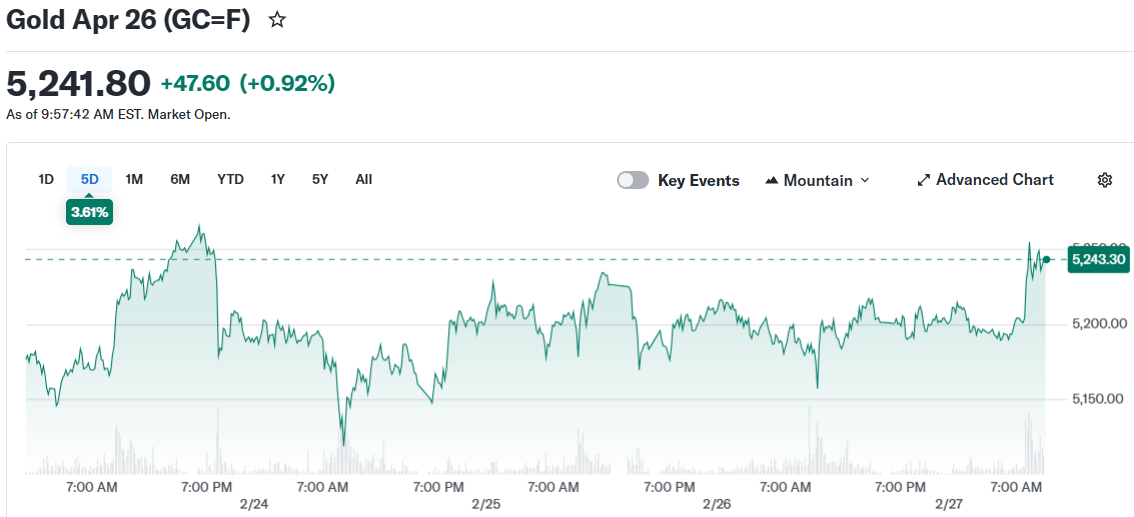
February alone saw gold appreciate 6.5%. Across the past seven-month period, the metal has surged 58%.
The upward price action reflects market participants evaluating persistent questions around U.S. tariff implementation and diplomatic negotiations between Washington and Tehran regarding Iran’s nuclear activities.
“There are two things supporting gold. First is the tariff uncertainty in the market right now, and on the other hand, the Iran and the U.S. situation,” said ANZ analyst Soni Kumari.
The United States began imposing a 10% global import tariff on Tuesday. U.S. Trade Representative Jamieson Greer indicated that rate will increase to 15% for certain countries.
U.S. and Iranian representatives engaged in indirect discussions in Geneva on Thursday. The Omani intermediary reported progress, with technical-level meetings scheduled for next week in Vienna.
“The latest rounds of talks have not produced a clear outcome, leaving geopolitical risks present but not escalating,” said Linh Tran, senior market analyst at XS.com.
U.S. 10-year Treasury yields declined to a three-month low on Friday, decreasing the opportunity cost associated with holding non-yielding gold — a factor that has historically supported the metal’s performance.
Bernstein’s Extended Price Projections
Brokerage firm Bernstein elevated its long-term gold price forecasts, establishing new targets of $4,800 per ounce in 2026 and $6,100 by 2030.
Analyst Bob Brackett constructed the forecast using a framework centered on net central bank demand and ETF flows, combined with anticipated effects from U.S. rate reductions.
Central bank acquisition activity moderated in 2025 while maintaining levels significantly above pre-2022 benchmarks. Survey findings indicate 95% of central banks anticipate global gold reserves will increase throughout the coming year.
ETF holdings have expanded substantially since mid-2024. Brackett characterized ETFs as a “swing” component — one capable of magnifying price movements when capital inflows accelerate.
Market pricing currently reflects expectations of two to three Fed rate reductions in 2026. Brackett observed that gold has historically gained an average of 6.53% during the twelve months after rate cuts, suggesting a possible total return of approximately 13% from rate reductions alone.
Newmont Rating Elevation
Bernstein simultaneously elevated Newmont (NEM) to Outperform status, establishing a price target of $157. The firm increased its EBITDA projection for the mining company by 26% to $21.9 billion, supported by its updated gold price outlook.
NEM shares advanced 2.33% during the session.
Across other precious metals, spot silver increased 4.4% to $92.20 an ounce, positioning for a 6.2% monthly advance. Spot platinum jumped 5.3% to reach a four-week peak of $2,393.80, while palladium added 1.5% to $1,810.60.
