


TLDR
- Mark Karpelès, who previously led Mt. Gox, has introduced a Bitcoin hard fork concept to retrieve approximately 80,000 BTC taken during a 2011 security breach, currently valued above $5.2 billion.
- The concept would enable fund transfer without accessing the original private key, implementing a fresh consensus mechanism linked to one specific wallet address.
- Karpelès posted the initial draft on GitHub to spark conversation rather than submitting a formal Bitcoin Improvement Proposal.
- Opponents believe this approach establishes a risky precedent, potentially undermining Bitcoin’s foundational commitment to immutability.
- These compromised coins remain distinct from the approximately 200,000 BTC currently flowing to Mt. Gox creditors through a distribution process continuing through October 2026.
Mark Karpelès, who formerly managed the defunct Bitcoin exchange Mt. Gox, has released a preliminary proposal advocating for a Bitcoin hard fork. His objective centers on retrieving approximately 79,956 BTC taken during a security breach that occurred over 15 years ago.
The cryptocurrency, presently held within a single wallet address, carries a valuation exceeding $5.2 billion based on current market prices. These funds have remained untouched since their removal in June 2011.
Bitcoin’s existing protocol permits fund transfers exclusively through use of the original private key. That particular key remains unrecovered to this day.
Karpelès uploaded his proposal to GitHub last Friday. His plan introduces a fresh consensus mechanism enabling fund relocation to a recovery address without requiring that key.
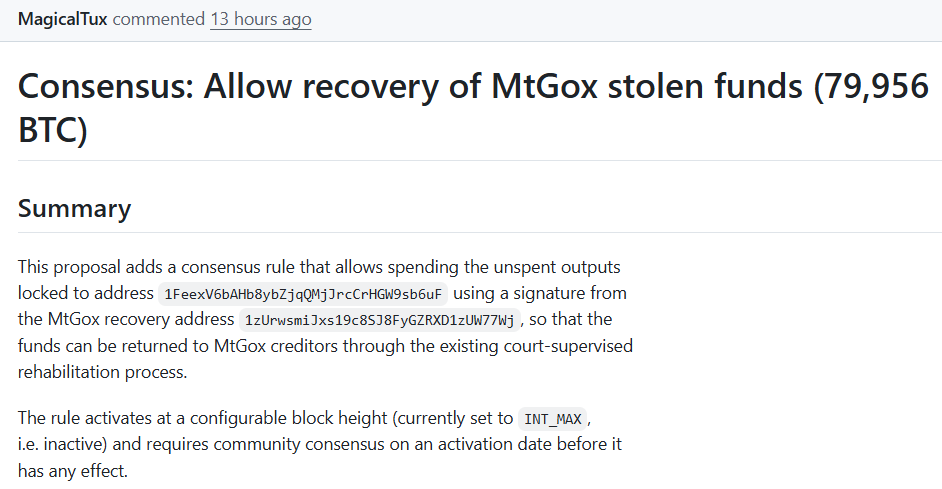
The mechanism would function exclusively for that particular wallet address. Activation would occur at a designated future block height, contingent upon network-wide adoption.
Karpelès maintained transparency regarding his proposal’s implications. “I want to be upfront: this is a hard fork,” he stated in his submission.
He positioned the submission as a solution to an ongoing impasse. Mt. Gox trustee Nobuaki Kobayashi has refused to pursue on-chain recovery methods without guaranteed community backing for a protocol modification.
Why Critics Are Pushing Back
The proposal has generated considerable opposition, primarily focusing on Bitcoin’s immutability principles. Bitcoin operates on a foundation where transactions remain final and permanent.
Numerous Bitcoin community members contend that modifying ownership protocols for a single address, even following an obvious theft, creates problematic precedent. Bitcointalk forum participants have cautioned that such action might encourage comparable requests following future security breaches.
The proposal document recognizes this concern. It notes: “If it can be done once, the argument goes, it can be done again.”
A governance challenge also exists. Bitcoin currently lacks established procedures for determining which historical thefts warrant protocol rule modifications.
Successful hard fork implementation demands extensive backing from miners, node operators, and exchanges. Throughout Bitcoin history, achieving consensus on disputed modifications has proven extremely difficult.
How This Fits Into Broader Mt. Gox Repayments
The 80,000 BTC held in the compromised wallet exist separately from funds currently flowing to creditors. Those distributions originate from a distinct reserve of roughly 200,000 BTC retrieved following the exchange’s 2014 failure.
Creditor distributions commenced during mid-2024, with the completion deadline now pushed to October 2026. The stolen coins remain completely beyond trustee jurisdiction.
Mt. Gox entered bankruptcy proceedings in Tokyo on February 28, 2014, following the disappearance of approximately 750,000 customer bitcoins. The platform had processed 70% of worldwide Bitcoin transactions during its operational peak.
Certain creditors have expressed approval for the proposal. One individual identifying as a creditor mentioned receiving roughly 15% of their Bitcoin through bankruptcy proceedings and would welcome a court directive to claim the remaining stolen assets.
The proposal currently exists as a discussion draft without official endorsement or implementation schedule.
