


TLDR
- Correlation between Bitcoin and the S&P 500 and Nasdaq has climbed to approximately 0.5, yet equity market dynamics account for merely 25% of price fluctuations
- Crypto-native elements such as ETF capital flows, derivatives markets, and blockchain network growth drive the remaining 75% of Bitcoin’s valuation
- NYDIG’s research director maintains this supports Bitcoin’s function as a diversification tool
- Market discourse has evolved from questioning Bitcoin’s viability to examining its potential as a central bank reserve holding
- NYDIG maintains Bitcoin’s expansion trajectory continues independently of sovereign adoption
Bitcoin continues to offer meaningful portfolio diversification benefits despite moving in tandem with technology equities, according to analysis from investment research firm NYDIG.
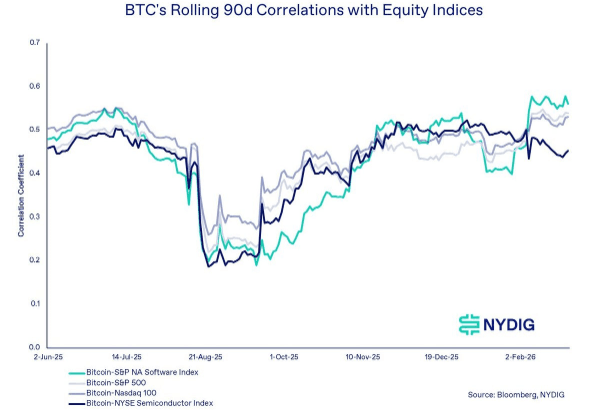
In his weekly market commentary, Greg Cipolaro, serving as NYDIG’s global head of research, detailed how correlation metrics between Bitcoin and prominent U.S. stock indices have increased during recent months. The S&P 500, Nasdaq 100, and the IGV ETF tracking software companies have demonstrated closer alignment with Bitcoin’s trading patterns.
Certain market observers have interpreted this pattern as evidence that Bitcoin now functions primarily as a proxy for technology sector exposure. Cipolaro challenges this interpretation directly.
Despite the 90-day rolling correlation hovering around 0.5, Cipolaro explains this metric indicates equity market dynamics account for approximately 25% of Bitcoin’s price movements. Crypto-specific market forces determine the remaining 75%.
These crypto-native drivers encompass institutional capital entering Bitcoin exchange-traded products, changes in futures and options market positioning, blockchain network growth metrics, and evolving regulatory frameworks.
Why Bitcoin Still Behaves Differently From Stocks
Cipolaro attributes the current price synchronization between Bitcoin and growth-oriented equities to shared macro conditions rather than fundamental structural convergence. Both asset categories respond simultaneously to changes in market liquidity and shifts in investor appetite for risk exposure.
“Cross-asset correlations with equities are currently elevated, but they remain far from determinative of Bitcoin’s returns,” Cipolaro wrote.
The NYDIG analysis also examined recent public statements from well-known investors. Chamath Palihapitiya, who described Bitcoin as “Gold 2.0” back in 2013, has lately expressed skepticism about the asset’s suitability for sovereign treasury holdings. Ray Dalio has consistently voiced concerns regarding Bitcoin’s price volatility, regulatory uncertainties, and potential vulnerabilities to quantum computing breakthroughs.
Cipolaro interprets these critical perspectives as evidence of Bitcoin’s evolution into mainstream financial discourse. The conversation has progressed from existential questions about Bitcoin’s survival to substantive debates about its role in central bank reserves.
Bitcoin’s Growth Path Does Not Rely on Central Banks
NYDIG’s position holds that sovereign adoption represents an optional catalyst rather than a necessary condition for Bitcoin’s continued expansion. The network has already achieved substantial adoption across family offices, institutional asset management firms, and exchange-traded investment products.
This adoption trajectory diverges from typical financial innovation patterns, where institutional capital usually leads before retail participation follows. Bitcoin has traveled the reverse path.
“Central bank ownership may ultimately validate the asset class further, but it is not a prerequisite for continued growth,” Cipolaro wrote.
NYDIG’s analysis emphasized Bitcoin’s foundational characteristics: a globally distributed network infrastructure, absence of political affiliation, and technical architecture enabling censorship-resistant value transfer alongside programmable scarcity independent from governmental or monetary authorities.
Bitcoin was trading at around $67,769 at the time of the report’s publication.
