



TLDR
- BTC fell under $63,000 on February 24, 2026, registering close to a 7% weekly decline
- Whale addresses have transferred Bitcoin to trading platforms, suggesting additional selling pressure ahead
- Escalating tariff rates from 10% to 15% under Trump administration policy have reduced appetite for risk assets
- Market sentiment measured by the fear and greed index plunged to 8, marking extreme fear territory
- Critical support exists around $60,000; failure to maintain this level may lead prices toward the $50,000 zone
Bitcoin fell beneath the $63,000 threshold on February 24, 2026, continuing a downward trajectory that has erased nearly 7% of value over seven days.
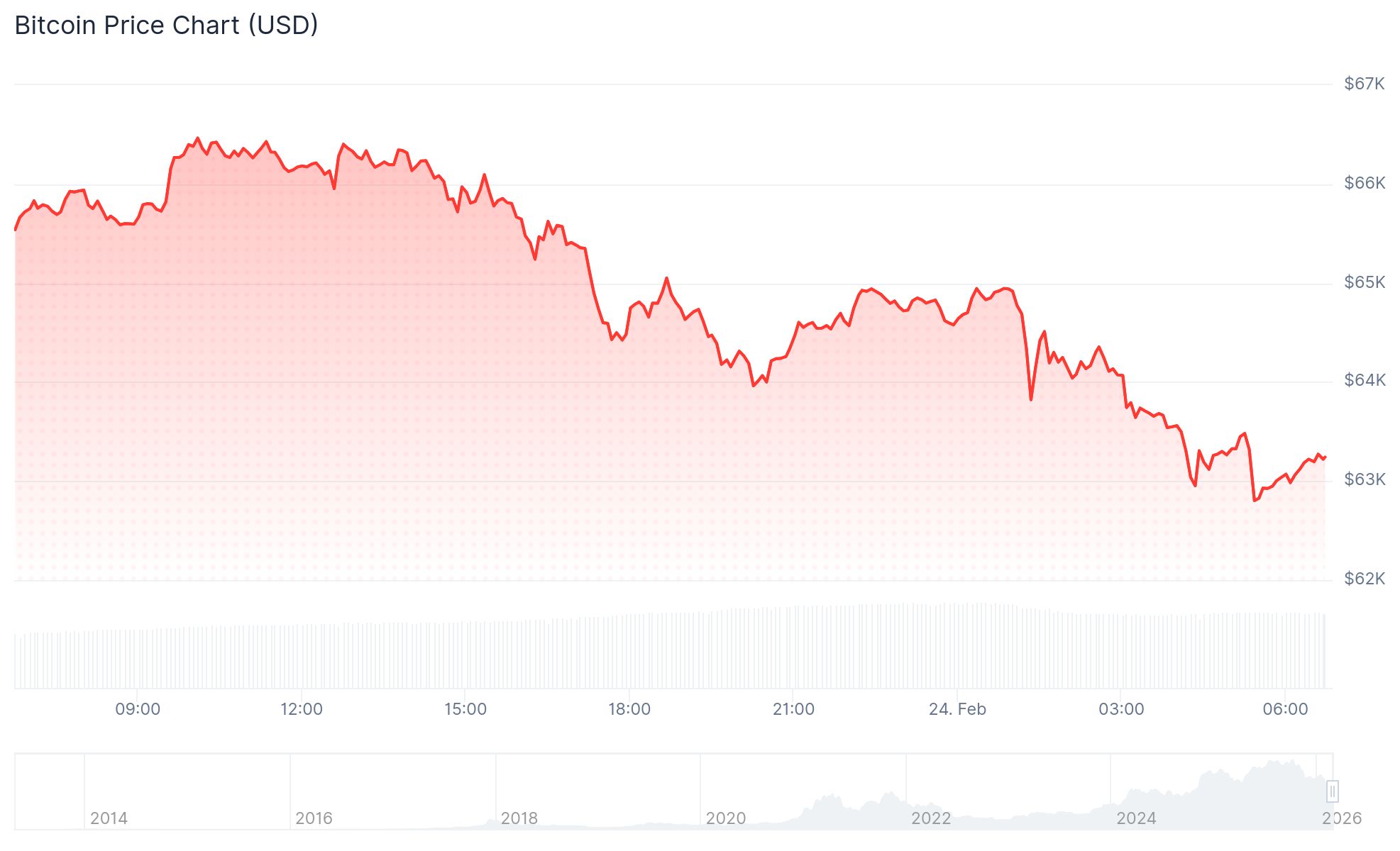
This decline returned BTC to price levels first observed during the opening days of February, a period when valuations temporarily slipped beneath $60,000.
Current trading activity shows Bitcoin hovering near $63,285, representing approximately a 4.5% loss across the past 24 hours.
Selling momentum has emerged from several sources simultaneously, creating challenges for market participants attempting to establish upward price movement.
CryptoQuant’s blockchain analytics revealed substantial Bitcoin holders, commonly referred to as whales, have relocated their holdings from self-custody solutions to centralized trading venues.
Such transfer patterns typically indicate preparation for liquidation events, expanding the volume of Bitcoin available for trading on public markets.
Meanwhile, purchasing activity on leading exchanges has remained subdued, with broader cryptocurrency market confidence facing ongoing challenges.
Tariff Uncertainty Weighs on Markets
Trade policy decisions from President Trump have emerged as a primary catalyst behind the current market downturn.
The U.S. Supreme Court invalidated substantial elements of his initial tariff framework, determining he had exceeded constitutional authority limits.
Following this ruling, Trump unveiled a 10% universal import tariff, subsequently elevating it to 15%, representing the statutory ceiling under applicable legislation.
This policy shift triggered volatility across financial sectors, with stock markets declining as capital flowed toward traditional safe-haven assets like gold, which surpassed the $5,200 mark.
Matt Howells-Barby from Kraken drew parallels to tariff-induced market volatility observed during April 2025.
He emphasized that market participants are monitoring the $60,000 threshold intensely. “If that level fails to hold, we could potentially see a move into the mid-to-low $50K range,” he stated.
The fear and greed index for Bitcoin has descended to 8, representing its most bearish reading in considerable time, demonstrating pervasive market anxiety.
Liquidations across cryptocurrency derivatives markets exceeded $461 million within a 24-hour window, with long positions accounting for 93% of forced closures.
What Historical Patterns Show
Bitcoin’s extended timeframe technical analysis introduces additional caution to price projections.
Throughout market history, BTC has failed to establish sustained price floors until the 50-week exponential moving average descends beneath the 100-week moving average.
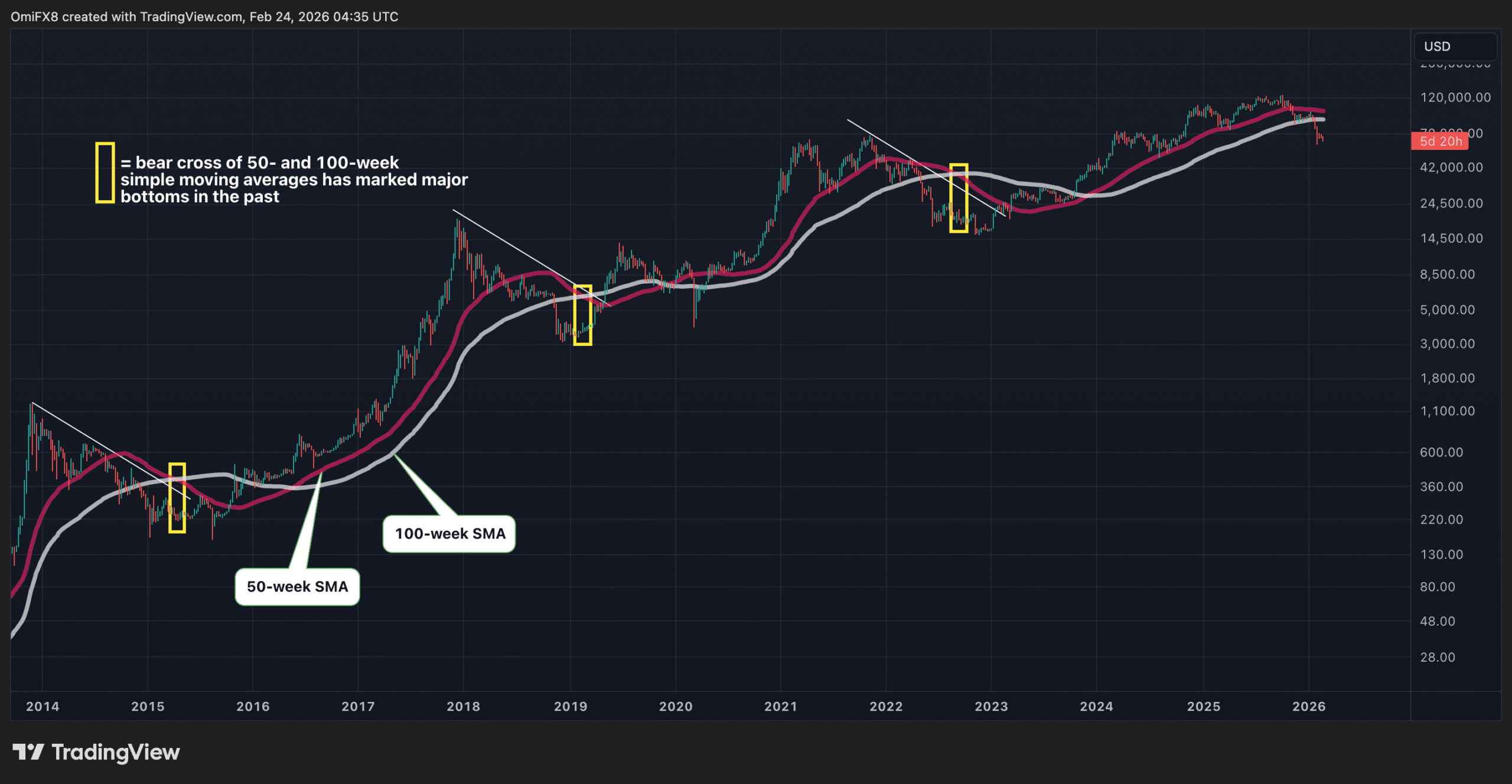
This technical indicator has consistently marked conclusions to significant bear cycles, including those experienced in 2018 and 2022.
Presently, the 50-week average maintains elevation above the 100-week benchmark, indicating this crossover event remains pending.
Market analyst Rashad Hajiyev has projected consolidation activity near $50,000, with a possible bottom formation approaching $30,000 during Q4 2026.
CoinCodex modeling suggests Bitcoin could climb to $79,579 before 2026 concludes and potentially reach $166,372 by 2030.
Treasury Secretary Scott Bessent has indicated BTC may achieve fresh all-time highs following passage of comprehensive regulatory clarity legislation.
Remember: Preserve all tokens like [[EMBED_0]], [[IMG_0]], [[LINK_START_0]], [[LINK_END_0]], [[SCRIPT_0]], [[FIGURE_0]] etc. exactly as they appear. These are placeholders for embeds, images, and links that must not be changed.
