



Key Points
- Artificial intelligence equities generate over 80% of S&P 500 returns in 2026; without them, the benchmark index shows only 2% appreciation
- Jefferies analysts attribute the surge to fundamental earnings expansion rather than valuation inflation, labeling AI “the cheapest sector to own” by PEG ratio
- Forward earnings projections for the AI segment have climbed more than 30% since mid-2025, with expected EPS compound growth of 38.5% through 2026–27
- Samsung Electronics achieved $1 trillion market capitalization, entering the elite group with Nvidia, TSMC, and Broadcom in AI infrastructure
- Q1 2026 saw 86% of S&P 500 firms exceed earnings forecasts — the highest rate since the pandemic — with AI and commodity sectors at the forefront
Artificial intelligence equities are the primary engine behind U.S. stock market advancement in 2026. Research from Jefferies indicates these technology names represent over 80% of the S&P 500’s year-to-date performance. Remove the AI component from calculations, and the broader index shows merely 2% gains.
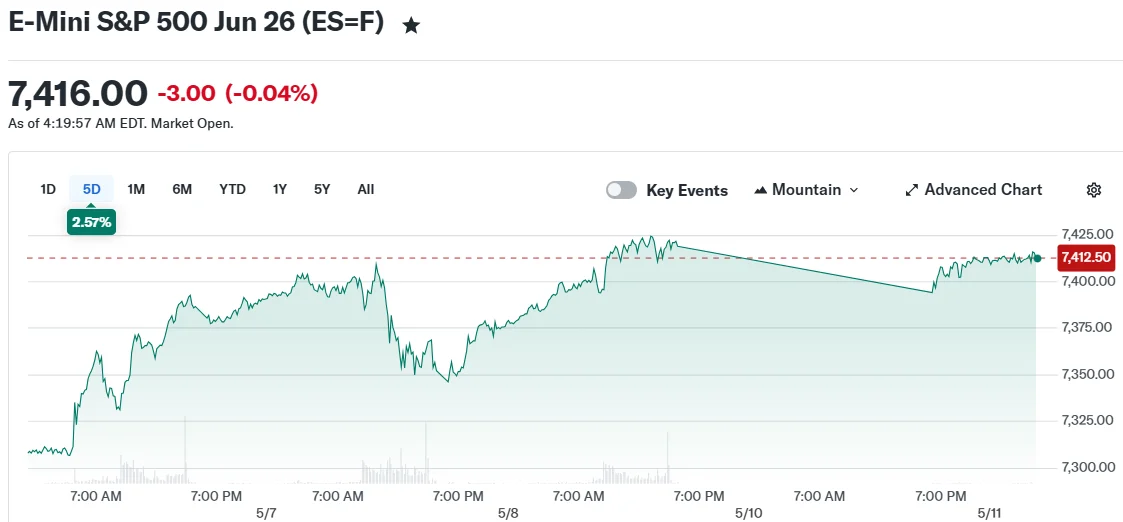
Such heavy concentration has prompted caution among certain market participants. Jefferies, however, identifies compelling fundamentals supporting this trend.
The firm’s quantitative strategy division examined the underlying catalysts for these advances. Their analysis reveals earnings expansion as the primary driver, with valuations remaining stable. This differentiation carries significant implications for assessing market sustainability.
The AI basket’s forward earnings projections for 2026 have expanded by over 30% since the middle of 2025. Wall Street analysts forecast 38.5% compound annual earnings growth for artificial intelligence companies spanning 2026 and 2027. Sectors outside AI show projected growth of only 11.9% during the same period.
Despite robust growth trajectories, the AI segment trades around 25 times forward earnings. This multiple remains beneath its one standard deviation threshold. The price-to-earnings-growth metric stands at a modest 0.6 times.
“AI is the cheapest sector to own in the U.S.,” according to Jefferies strategists in their research note.
Performance Varies Across AI Categories
Results within artificial intelligence investments have shown considerable dispersion. AI server manufacturers, optical component producers, and memory suppliers have delivered superior returns this year. Cloud hyperscalers and chip architecture firms have underperformed by comparison.
From a valuation perspective, memory and compute equities appear most compelling on a PEG basis. Semiconductor manufacturing equipment and chip design companies trade at premium multiples relative to growth rates.
First quarter 2026 earnings provided additional insight. Approximately 86% of S&P 500 constituents exceeded earnings projections — the strongest performance since the COVID period, rising from 75% in the prior quarter. Revenue beats reached 82% of reporting companies.
The nuance: most positive surprises failed to generate outperformance. Stocks typically maintained existing trajectories after beating estimates, with exceptions in AI and select other sectors. Earnings disappointments triggered sharp declines, suggesting elevated investor expectations throughout the market.
Jefferies analyzed roughly 330 earnings conference calls through the AlphaSense platform. Management commentary reflected 95% optimism. Analyst sentiment likewise improved, with 58% of calls demonstrating positive tone, advancing from 48% in Q4 2025.
One recurring concern emerged from these discussions: the U.S.-Iran geopolitical situation. Approximately 44% of companies identified it as a headwind, citing supply chain complications and weakened consumer confidence.
Samsung Achieves Trillion-Dollar Valuation
The artificial intelligence market surge extends beyond software applications and chip architects. Hardware manufacturers are experiencing parallel momentum. Samsung Electronics recently surpassed $1 trillion in market capitalization, becoming the newest AI-adjacent company reaching this milestone.
Samsung joins Nvidia, TSMC, and Broadcom — enterprises producing the processors, memory modules, and infrastructure enabling AI deployment. Samsung’s ascent stems from its high-bandwidth memory production, a critical component in AI computing systems.
The trillion-dollar valuation tier previously consisted primarily of consumer-facing platforms. Apple, Amazon, Microsoft, Alphabet, Meta, and Tesla achieved this status through smartphones, cloud services, e-commerce, and software ecosystems.
The current expansion wave emphasizes physical infrastructure. Nvidia reached $1 trillion in May 2023. TSMC followed throughout 2024. Broadcom joined subsequently that year. Samsung now adds memory manufacturing to this cohort.
Berkshire Hathaway and Walmart have also entered the trillion-dollar group, alongside Eli Lilly driven by pharmaceutical demand and energy majors Saudi Aramco and PetroChina. The most dynamic segment currently centers on AI infrastructure providers.
Earnings estimate revisions across the S&P 500 have increased 6% over the recent three-month period. Remove AI and commodity sectors from the calculation, and revision growth diminishes to merely 0.3%.
